

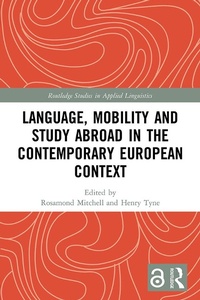
Language, Mobility and Study Abroad in the Contemporary European Context
1st Edition
Published on 11. May 2021
300 pages
978-1-000-37927-3 (ISBN)
Description

This collection explores student mobility and study abroad programmes across Europe, presenting original research on personal, linguistic, and intercultural development during study abroad experiences.
The volume synthesizes work from the 2016-2020 Cost Action 15130 'Study Abroad Research in European Perspective' research network, offering a multidisciplinary account of the intersection of language learning and study abroad in Europe amidst the changing contemporary higher education landscape, as well as new directions for future research. The initial section comprises short survey chapters outlining key themes and literature, connecting traditional study abroad research with new multilingual and transnational realities. This is supported by a main section containing original empirical studies in a wide range of European contexts and a short afterword bringing together policy and pedagogical proposals. Taken together, the collection shines a light on the impact of the internationalisation of higher education on linguistic dimensions of student mobility while including a range of lesser studied settings and languages. New insights are offered on language learning, identity, interculturality, student agency and motivation, and transnational social networks in the study abroad context.
This book will be of particular interest to students, researchers and institutions interested in the intersection of language learning and study abroad, including such areas as multilingualism, higher education, and applied linguistics.
Chapter 8 of this book is freely available as a downloadable Open Access PDF at http://www.taylorfrancis.com under a Creative Commons Attribution-Non Commercial-No Derivatives (CC-BY-NC-ND) 4.0 license.
The volume synthesizes work from the 2016-2020 Cost Action 15130 'Study Abroad Research in European Perspective' research network, offering a multidisciplinary account of the intersection of language learning and study abroad in Europe amidst the changing contemporary higher education landscape, as well as new directions for future research. The initial section comprises short survey chapters outlining key themes and literature, connecting traditional study abroad research with new multilingual and transnational realities. This is supported by a main section containing original empirical studies in a wide range of European contexts and a short afterword bringing together policy and pedagogical proposals. Taken together, the collection shines a light on the impact of the internationalisation of higher education on linguistic dimensions of student mobility while including a range of lesser studied settings and languages. New insights are offered on language learning, identity, interculturality, student agency and motivation, and transnational social networks in the study abroad context.
This book will be of particular interest to students, researchers and institutions interested in the intersection of language learning and study abroad, including such areas as multilingualism, higher education, and applied linguistics.
Chapter 8 of this book is freely available as a downloadable Open Access PDF at http://www.taylorfrancis.com under a Creative Commons Attribution-Non Commercial-No Derivatives (CC-BY-NC-ND) 4.0 license.
More details
Series
Edition
1. Auflage
Language
English
Place of publication
London
United Kingdom
Publishing group
Taylor & Francis Ltd
Target group
College/higher education
Product notice
Reflowable
Illustrations
33 Tables, black and white; 17 Line drawings, black and white; 2 Halftones, black and white; 19 Illustrations, black and white
ISBN-13
978-1-000-37927-3 (9781000379273)
Copyright in bibliographic data and cover images is held by Nielsen Book Services Limited or by the publishers or by their respective licensors: all rights reserved.
Schweitzer Classification
Other editions
Additional editions
Rosamond Mitchell | Henry Tyne
Language, Mobility and Study Abroad in the Contemporary European Context
Book
01/2023
1st Edition
Routledge
€63.70
Shipment within 15-20 days
Rosamond Mitchell | Henry Tyne
Language, Mobility and Study Abroad in the Contemporary European Context
Book
05/2021
1st Edition
Routledge
€206.80
Shipment within 15-20 days
Persons
Rosamond Mitchell is Emeritus Professor of applied linguistics at the University of Southampton, UK. She has longstanding research interests in second language acquisition and in language in education. Recently her work has focused on study abroad, and its long term consequences for L2 development and maintenance, as well as for language identity.
Henry Tyne lectures in applied linguistics at the University of Perpignan, France, where he is also director of the language centre. His main area of research is L2 variation, in particular within the study abroad context. Through his work on variation he has become interested in the potential of corpora for language learning. His publications include Des documents authentiques aux corpus (Didier, 2014, with Alex Boulton).
Henry Tyne lectures in applied linguistics at the University of Perpignan, France, where he is also director of the language centre. His main area of research is L2 variation, in particular within the study abroad context. Through his work on variation he has become interested in the potential of corpora for language learning. His publications include Des documents authentiques aux corpus (Didier, 2014, with Alex Boulton).
Content
List of Tables
List of Figures
Notes on Contributors
Preface
PART 1
Overviews of the field
1.Language and Student Mobility in Europe: An Overview
2. International Student Mobility as Transnationalism
3. Linguistic Effects of International Student Mobility in European Perspective
4. Conceptualising Plurilingual Identity in Study Abroad Settings
PART 2
Empirical studies
5. Study Abroad and Students' (Lack of) Integration: The Case of Spanish Ghettos in Italy
6. Retelling Immersion in France: Opportunities and Affordances in Language Use
7. Motivation and Social Integration of Mobile Students: Experiences of Short-Term International Mobility Students at a Lithuanian University
8. Peer Interactions and Second Language Learning: The Contributions of Social Network Analysis in Study Abroad vs At-Home Environments
9. Self-Efficacy in Managing Intercultural Interactions as an Outcome of Participation in the Erasmus Programme: Evidence From German Exchange Students in the UK
10. L2 Progress and Changes in Participants' Intercultural Competence Abroad: A Study of Flemish Sojourners
11. How Social Interaction Affects Students' Formulaic Development in L2 German in a Multilingual SA Context: Four Case Studies
12. The Impact on Language Identity of a Study Abroad Experience
13. The Role of Context in Shaping Narratives of Plurilingual Identity: The Case of Non-Language Majors Studying Abroad
14. The Lived Experience and Linguistic Repertoire of a Slovak Student: Contradictory Dispositions Revealed by Language Portraits
15. Learner Engagement and Study Abroad: The Influence of Personal Agency on Sojourner-Host Interaction
16. Self-Regulatory Strategy Use and Its Impact on Motivated Language Learning Behaviour and Self-Efficacy in European Study Abroad Contexts
17. Extracurricular Language Learning During Study Abroad in Lithuania
PART 3
18. Afterword
Author index
Subject index
List of Figures
Notes on Contributors
Preface
PART 1
Overviews of the field
1.Language and Student Mobility in Europe: An Overview
2. International Student Mobility as Transnationalism
3. Linguistic Effects of International Student Mobility in European Perspective
4. Conceptualising Plurilingual Identity in Study Abroad Settings
PART 2
Empirical studies
5. Study Abroad and Students' (Lack of) Integration: The Case of Spanish Ghettos in Italy
6. Retelling Immersion in France: Opportunities and Affordances in Language Use
7. Motivation and Social Integration of Mobile Students: Experiences of Short-Term International Mobility Students at a Lithuanian University
8. Peer Interactions and Second Language Learning: The Contributions of Social Network Analysis in Study Abroad vs At-Home Environments
9. Self-Efficacy in Managing Intercultural Interactions as an Outcome of Participation in the Erasmus Programme: Evidence From German Exchange Students in the UK
10. L2 Progress and Changes in Participants' Intercultural Competence Abroad: A Study of Flemish Sojourners
11. How Social Interaction Affects Students' Formulaic Development in L2 German in a Multilingual SA Context: Four Case Studies
12. The Impact on Language Identity of a Study Abroad Experience
13. The Role of Context in Shaping Narratives of Plurilingual Identity: The Case of Non-Language Majors Studying Abroad
14. The Lived Experience and Linguistic Repertoire of a Slovak Student: Contradictory Dispositions Revealed by Language Portraits
15. Learner Engagement and Study Abroad: The Influence of Personal Agency on Sojourner-Host Interaction
16. Self-Regulatory Strategy Use and Its Impact on Motivated Language Learning Behaviour and Self-Efficacy in European Study Abroad Contexts
17. Extracurricular Language Learning During Study Abroad in Lithuania
PART 3
18. Afterword
Author index
Subject index
