

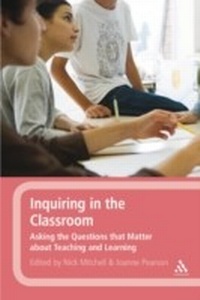
Inquiring in the Classroom
Asking the Questions That Matter About Teaching and Learning
1st Edition
Published on 22. March 2012
200 pages
978-1-4411-9329-2 (ISBN)
Description

Inquiring in the Classroom provides a practical and accessible guide to planning, carrying out and
presenting successful classroom inquiry for teachers working towards a Masters-level qualification in education. The contributors provide a clear and concise roadmap drawing on case studies throughout and bringing educational theory to life by closely linking it to classroom practice. They also provide tried and tested advice on writing and presenting at Masters-level. Topics covered include:
- Teaching, Learning and Assessment
- Subject Knowledge and Curriculum Development
- Children's Development and Behaviour
- Inclusion
- Leadership and Management
- Collaborative Working
Through a clear emphasis on the practical implications of educational inquiry, the book brings together key elements of continuing professional development (CPD) and Masters-level learning. The contributors draw on their experience of teaching and supporting Masters-level inquiry to provide practical suggestions for how teachers can support each other in classroom inquiries and develop the skills necessary to transform practice and raise engagement and attainment for all pupils.
presenting successful classroom inquiry for teachers working towards a Masters-level qualification in education. The contributors provide a clear and concise roadmap drawing on case studies throughout and bringing educational theory to life by closely linking it to classroom practice. They also provide tried and tested advice on writing and presenting at Masters-level. Topics covered include:
- Teaching, Learning and Assessment
- Subject Knowledge and Curriculum Development
- Children's Development and Behaviour
- Inclusion
- Leadership and Management
- Collaborative Working
Through a clear emphasis on the practical implications of educational inquiry, the book brings together key elements of continuing professional development (CPD) and Masters-level learning. The contributors draw on their experience of teaching and supporting Masters-level inquiry to provide practical suggestions for how teachers can support each other in classroom inquiries and develop the skills necessary to transform practice and raise engagement and attainment for all pupils.
Reviews / Votes
I think the authors are to be congratulated for producing an introductory textbook on classroom-based inquiry which is highly readable and accessible to a wide audience. Each chapter offers supportive ideas and suggestions as to how teachers can undertake practice-based inquiry with the aim of improving even further their role as educators. The authors state their purpose is "to empower teachers at all levels to make themselves better teachers and ultimately provide a better education for children and young people". This excellent book goes a very considerable way to achieving this aim and I would recommend this without hesitation to all those who are serious about classroom-based inquiry. The authors' approach is predicated on the view of teachers continuing to learn and develop throughout their careers. By integrating evidence drawn from research and experience they enable teachers to ask critical questions of their practice and offer strategies that will produce answers to those questions. This book is to be commended for supporting teachers at all stages in their careers to develop exemplary practice. [S]ets out its stall admirably, firmly stating belief in the benefits of teacher inquiry to improve pedagogy and practice in the classroom...Split into three parts and ten chapters, the layout is clear and concise, and the book is easy to read. The chapters are set out well, with outlines provided at the start for ease of reference, boxes containing "Thinking it through" questions for self-reflection and clear subheadings in manageable sections...A key strength of this publication is the way each chapter explains, through the use of analogy or through practical examples, how inquiry can be used positively for the benefit of both teacher and pupil within the context of a classroom...By offering practical examples of how, but most importantly why you would want to conduct this sort of inquiry, it will encourage teachers to partake of methods of inquiry putting the data they collect to good use in order to improve their practice and pedagogy, for the benefit of all within their care. * Journal of Trainee Teacher Educational Research (Cambridge) * The trend towards teachers as practitioner researchers continues, and this text provides a highly accessible and informative introduction to this role... It is written with content and structure that make it appropriate for both teachers and student teachers, particularly those working towards accredited programmes, or who wish to extend their routine teacher evaluations and required data collection practices...In summary this book provides a useful introduction to teacher research. * International Journal of Research and Method in Education *More details
Edition
1. Auflage
Language
English
Place of publication
New York
United States
ISBN-13
978-1-4411-9329-2 (9781441193292)
Copyright in bibliographic data and cover images is held by Nielsen Book Services Limited or by the publishers or by their respective licensors: all rights reserved.
Schweitzer Classification
Other editions
Additional editions
Nick Mitchell | Joanne Pearson
Inquiring in the Classroom
Asking the Questions that Matter About Teaching and Learning
Book
05/2012
Continuum Publishing Corporation
€55.80
Shipment within 15-20 days
Persons
Nick Mitchell is a Senior Lecturer in Education at Leeds Metropolitan University, UK.
Joanne Pearson is a Senior Lecturer in Education at Leeds Metropolitan University, UK.
Joanne Pearson is a Senior Lecturer in Education at Leeds Metropolitan University, UK.
Content
Notes on Contributors
Foreword
Introduction: Why Should Teachers Inquire and What
Questions Should They Ask? Nick Mitchell and Joanne Pearson
Part I: The Tools of Teacher Inquiry
1. Reading for Teacher Inquiry Jayne Price
2. Research on Teaching: How Teachers Can Use Data to Reflect on their Practice Louise Tracey and Matt Homer
3. Research in Teaching: How to Harness Everyday Teaching Activities as Teacher Inquiry Methods Fiona Woodhouse
Part II: Inquiring into the Mechanics of Teaching and Learning
4. Inquiring into Teaching, Learning and Assessment Claire E. Smith and Barbara Hibbert
5. Inquiring into Subject Knowledge Nick Mitchell and Joanne Pearson
6. Inquiring into Children's Development and Behaviour Dean Pearson
7. Inquiring into Inclusion Melanie Garlick, Cath Lawes and Katie Hall
8. Inquiring into Collaborative Working Brendan Higgins and Erica Mace
9. Inquiring into Leadership and Management Ian Price and Nick Mitchell
Part III: Sharing your Findings
10. Presenting Teacher Inquiry Nick Mitchell and Joanne Pearson
Index
Foreword
Introduction: Why Should Teachers Inquire and What
Questions Should They Ask? Nick Mitchell and Joanne Pearson
Part I: The Tools of Teacher Inquiry
1. Reading for Teacher Inquiry Jayne Price
2. Research on Teaching: How Teachers Can Use Data to Reflect on their Practice Louise Tracey and Matt Homer
3. Research in Teaching: How to Harness Everyday Teaching Activities as Teacher Inquiry Methods Fiona Woodhouse
Part II: Inquiring into the Mechanics of Teaching and Learning
4. Inquiring into Teaching, Learning and Assessment Claire E. Smith and Barbara Hibbert
5. Inquiring into Subject Knowledge Nick Mitchell and Joanne Pearson
6. Inquiring into Children's Development and Behaviour Dean Pearson
7. Inquiring into Inclusion Melanie Garlick, Cath Lawes and Katie Hall
8. Inquiring into Collaborative Working Brendan Higgins and Erica Mace
9. Inquiring into Leadership and Management Ian Price and Nick Mitchell
Part III: Sharing your Findings
10. Presenting Teacher Inquiry Nick Mitchell and Joanne Pearson
Index
