

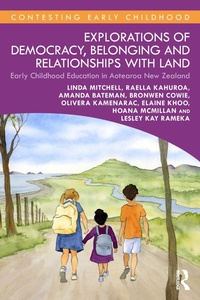
Explorations of Democracy, Belonging and Relationships with Land
Early Childhood Education in Aotearoa New Zealand
Will be published approx. on 13. July 2026
298 pages
978-1-040-69220-2 (ISBN)
Description

This groundbreaking book explores the interactions of three powerful concepts in early childhood education (ECE): early childhood settings as sites for democracy, belonging as a human need and basis for participation, and relationships with land. Through exemplars of pioneering practice, it renews thinking about democracy and broadens understanding of belonging in culturally diverse societies.
Drawing from three research projects undertaken with teachers as collaborators in 11 early childhood settings, the book showcases examples grounded in Aotearoa New Zealand's renowned bicultural curriculum, Te Whariki. It demonstrates how participatory design methodologies can reimagine the theory-practice nexus and privilege diverse voices often marginalized in traditional research settings. Woven throughout are "glimpses of hope" that illustrate new possibilities for pedagogical practice in the country's bicultural context. In a time marked by significant societal shifts and neoliberal pressures, the authors argue that layering and interweaving these three concepts enables the creation of innovative approaches to policy thinking and practice that challenge existing frameworks and advocate for public, democratic ECE systems.
This essential resource will interest postgraduate students, researchers, teachers, student teachers, early childhood managers and policy makers. It offers valuable insights for advanced students and practitioners of early childhood education seeking to understand democratic practice and belonging in diverse cultural contexts around the globe.
Drawing from three research projects undertaken with teachers as collaborators in 11 early childhood settings, the book showcases examples grounded in Aotearoa New Zealand's renowned bicultural curriculum, Te Whariki. It demonstrates how participatory design methodologies can reimagine the theory-practice nexus and privilege diverse voices often marginalized in traditional research settings. Woven throughout are "glimpses of hope" that illustrate new possibilities for pedagogical practice in the country's bicultural context. In a time marked by significant societal shifts and neoliberal pressures, the authors argue that layering and interweaving these three concepts enables the creation of innovative approaches to policy thinking and practice that challenge existing frameworks and advocate for public, democratic ECE systems.
This essential resource will interest postgraduate students, researchers, teachers, student teachers, early childhood managers and policy makers. It offers valuable insights for advanced students and practitioners of early childhood education seeking to understand democratic practice and belonging in diverse cultural contexts around the globe.
Reviews / Votes
'A timely book that brings together a body of knowledge from across Aotearoa New Zealand and in so doing adds to the country's unique contribution to global education and care with young children. There are messages here to help rethink and reinvigorate urgent questions about democracy, belonging and sustainability.'Dr Alison Clark, Professor of Early Childhood Education, University of South-Eastern Norway.
More details
Series
Language
English
Place of publication
London
United Kingdom
Publishing group
Taylor & Francis Ltd
Target group
College/higher education
Product notice
Reflowable
Illustrations
2 Tables, black and white; 19 Halftones, black and white; 19 Illustrations, black and white
File size
6,25 MB
ISBN-13
978-1-040-69220-2 (9781040692202)
Copyright in bibliographic data and cover images is held by Nielsen Book Services Limited or by the publishers or by their respective licensors: all rights reserved.
Schweitzer Classification
Other editions
Additional editions
Linda Mitchell | Raella Kahuroa | Amanda Bateman
Explorations of Democracy, Belonging and Relationships with Land
Early Childhood Education in Aotearoa New Zealand
Book
approx. 07/2026
1st Edition
Routledge
€179.50
Not yet published
Linda Mitchell | Raella Kahuroa | Amanda Bateman
Explorations of Democracy, Belonging and Relationships with Land
Early Childhood Education in Aotearoa New Zealand
Book
approx. 07/2026
1st Edition
Routledge
€45.00
Not yet published
Persons
Linda Mitchell is Retired Professor and Honorary Fellow at Te Whare Wananga o Waikato, University of Waikato, in Aotearoa New Zealand.
Raella Kahuroa (Ngati Kahungungu) is a lecturer and researcher in early childhood education at Te Whare Wananga o Waikato, University of Waikato, in Aotearoa New Zealand.
Amanda Bateman is Professor of Early Years at Birmingham City University, England, having worked at Te Whare Wananga o Waikato, University of Waikato, in Aotearoa New Zealand.
Bronwen Cowie is Emeritus Professor at Te Whare Wananga o Waikato, University of Waikato, in Aotearoa New Zealand.
Olivera Kamenarac is Senior Lecturer in Education at Southern Cross University, Australia, after working at Te Whare Wananga, University of Waikato, in Aotearoa New Zealand.
Elaine Khoo is Associate Professor at the Institute of Education at Massey University, New Zealand, after working at Te Whare Wananga, University of Waikato, in Aotearoa New Zealand.
Hoana McMillan (Ngai Te Rangi, Ngati Porou, Ngati Kahungunu) is a lecturer and kaupapa Maori researcher at Te Whare Wananga o Waikato, University of Waikato, in Aotearoa New Zealand.
Lesley Rameka (Ngati Raukawa, Ngati Tukorehe) has recently retired from her roles as a Senior Research Fellow and kaupapa Maori researcher at Te Whare Wananga o Waikato, University of Waikato, in Aotearoa New Zealand.
Raella Kahuroa (Ngati Kahungungu) is a lecturer and researcher in early childhood education at Te Whare Wananga o Waikato, University of Waikato, in Aotearoa New Zealand.
Amanda Bateman is Professor of Early Years at Birmingham City University, England, having worked at Te Whare Wananga o Waikato, University of Waikato, in Aotearoa New Zealand.
Bronwen Cowie is Emeritus Professor at Te Whare Wananga o Waikato, University of Waikato, in Aotearoa New Zealand.
Olivera Kamenarac is Senior Lecturer in Education at Southern Cross University, Australia, after working at Te Whare Wananga, University of Waikato, in Aotearoa New Zealand.
Elaine Khoo is Associate Professor at the Institute of Education at Massey University, New Zealand, after working at Te Whare Wananga, University of Waikato, in Aotearoa New Zealand.
Hoana McMillan (Ngai Te Rangi, Ngati Porou, Ngati Kahungunu) is a lecturer and kaupapa Maori researcher at Te Whare Wananga o Waikato, University of Waikato, in Aotearoa New Zealand.
Lesley Rameka (Ngati Raukawa, Ngati Tukorehe) has recently retired from her roles as a Senior Research Fellow and kaupapa Maori researcher at Te Whare Wananga o Waikato, University of Waikato, in Aotearoa New Zealand.
Content
List of figures
About the authors
Chapter co-author biographies
Series editors' foreword
Acknowledgements
Chapter 1: Introduction: Setting the scene
Theme 1: Democracy in education
Chapter 2: Democracy as a value and purpose for a public education system
Chapter 3: Early childhood education creating a democratic world
Chapter 4: Creating a democratic living philosophy
Chapter 5: Kohanga reo and transformational directions for education
Chapter 6: Teachers as democratic professionals and the child as citizen
Theme 2: Belonging, connections to others and the environment
Chapter 7: A human rights analysis of refugee resettlement and early childhood policy
Chapter 8: Powhiri - the traditional Maori ceremony of welcome as a process for supporting belonging
Chapter 9: Participation in cultural processes of food preparation and belonging
Chapter 10: Connecting homeland with early childhood settings: treasures from home as mediators of belonging for migrant and refugee children
Theme 3: Relationships with land
Chapter 11: Ko au te whenua, ko te whenua ko au - I am the land and the land is me
Chapter 12: Walking with young children to story and read the land
Chapter 13: Maunganui Kindergarten: developing connectedness with land and with people
Theme 4: Renewing the thinking and practice of democracy in researching early childhood education. Research as a palimpsest
Chapter 14. Crafint research partnerships for exploring pedagogical practice in Aotearoa New Zealand
Chapter 15. Research as a palimpsest: possibilities for research, pedagogy and policy
Glossary References for all chapters
About the authors
Chapter co-author biographies
Series editors' foreword
Acknowledgements
Chapter 1: Introduction: Setting the scene
Theme 1: Democracy in education
Chapter 2: Democracy as a value and purpose for a public education system
Chapter 3: Early childhood education creating a democratic world
Chapter 4: Creating a democratic living philosophy
Chapter 5: Kohanga reo and transformational directions for education
Chapter 6: Teachers as democratic professionals and the child as citizen
Theme 2: Belonging, connections to others and the environment
Chapter 7: A human rights analysis of refugee resettlement and early childhood policy
Chapter 8: Powhiri - the traditional Maori ceremony of welcome as a process for supporting belonging
Chapter 9: Participation in cultural processes of food preparation and belonging
Chapter 10: Connecting homeland with early childhood settings: treasures from home as mediators of belonging for migrant and refugee children
Theme 3: Relationships with land
Chapter 11: Ko au te whenua, ko te whenua ko au - I am the land and the land is me
Chapter 12: Walking with young children to story and read the land
Chapter 13: Maunganui Kindergarten: developing connectedness with land and with people
Theme 4: Renewing the thinking and practice of democracy in researching early childhood education. Research as a palimpsest
Chapter 14. Crafint research partnerships for exploring pedagogical practice in Aotearoa New Zealand
Chapter 15. Research as a palimpsest: possibilities for research, pedagogy and policy
Glossary References for all chapters
