
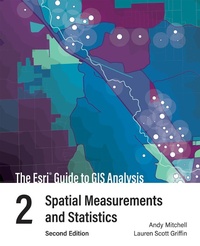
The Esri Guide to GIS Analysis, Volume 2
Description
Alles über E-Books | Antworten auf Fragen rund um E-Books, Kopierschutz und Dateiformate finden Sie in unserem Info- & Hilfebereich.
Learn how to get better answers in map analysis when you use spatial measurements and statistics.
Spatial measurements and statistics give you a powerful way to analyze geospatial data, but you don't need to understand complex mathematical theories to apply statistical tools and get meaningful results in your projects.
The Esri Guide to GIS Analysis, Volume 2: Spatial Measurements and Statistics, second edition, builds on Volume 1 by taking you to the next step of GIS analysis. This book introduces readers to basic statistical concepts and some of the most common spatial statistics tasks: measuring distributions, identifying patterns and clusters, and analyzing relationships. Explore how spatial statistical tools can be applied in a range of disciplines, from public health to habitat conservation. Learn how to quantify patterns beyond visualizing them in maps. Examine spatial clusters through an updated chapter on identifying clusters.
Use The Esri Guide to GIS Analysis, Volume 2, second edition, to understand the statistical methods and tools that can move your work past mapping and visualization to more quantitative statistical assessment.
All prices
More details
Other editions
Additional editions
Persons
Andy Mitchell is a technical writer with more than 30 years' experience in GIS. He is the author or co-author of several books, including The Esri Guide to GIS Analysis series and Zeroing In: Geographic Information Systems at Work in the Community.
Content
Foreword to the second edition
Foreword to the first edition
Acknowledgments
Chapter 1: Introducing spatial measurements and statistics
Understanding Data Distributions
Chapter 2: Measuring geographic distributions
Testing statistical significance
Chapter 3: Identifying patterns
Defining spatial neighborhoods and weights
Chapter 4: Using statistics with geographic data
Using statistics with geographic data
Chapter 5: Analyzing geographic relationships
Data credits
Index

System requirements
File format: ePUB
Copy protection: Adobe-DRM (Digital Rights Management)
System requirements:
- Computer (Windows; MacOS X; Linux): Install the free reader Adobe Digital Editions prior to download (see eBook Help).
- Tablet/smartphone (Android; iOS): Install the free app Adobe Digital Editions or the app PocketBook before downloading (see eBook Help).
- E-reader: Bookeen, Kobo, Pocketbook, Sony, Tolino and many more (not Kindle).
The file format ePub works well for novels and non-fiction books – i.e., „flowing” text without complex layout. On an e-reader or smartphone, line and page breaks automatically adjust to fit the small displays.
This eBook uses Adobe-DRM, a „hard” copy protection. If the necessary requirements are not met, unfortunately you will not be able to open the eBook. You will therefore need to prepare your reading hardware before downloading.
Please note: We strongly recommend that you authorise using your personal Adobe ID after installation of any reading software.
For more information, see our ebook Help page.
File format: ePUB
Copy protection: Watermark-DRM (Digital Rights Management)
System requirements:
- Computer (Windows; MacOS X; Linux): Use a reading software that can process the file format ePUB: e.g., Adobe Digital Editions or FBReader – both free (see eBook Help).
- Tablet/Smartphone (Android; iOS): Before downloading, install the free app Adobe Digital Editions (see eBook Help).
- E-reader: Bookeen, Kobo, Pocketbook, Sony, Tolino and many more (not Kindle).
The file format ePUB works well for novels and non-fiction books – i.e., „flowing” text without complex layout. On an e-reader or smartphone, line and page breaks automatically adjust to fit the small displays.
This eBook uses Watermark-DRM, a „soft” copy protection. This means that there are no technical restrictions to prevent illegal distribution. However, there is a personalised watermark embedded in the eBook that can be used to identify the purchaser of the eBook in the event of misuse and to provide evidence for legal purposes.
For more information, see our eBook Help page.