

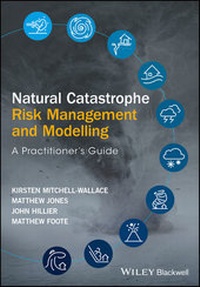
Natural Catastrophe Risk Management and Modelling
Description

More details
Other editions
Additional editions
Persons
Content
List of Contributors and Acknowledgements xiii
Foreword xxv
1 Fundamentals 1
Matthew Jones, Kirsten Mitchell-Wallace, Matthew Foote, and John Hillier
1.1 Overview 1
1.1.1 What Is Included 1
1.1.2 What Is Not Included 1
1.1.3 Why Read This Chapter? 1
1.2 Catastrophes, Risk Management and Insurance 2
1.3 What Are Catastrophe Models? 5
1.4 Why Do We Need Catastrophe Models? 6
1.5 History of Catastrophe Models 7
1.6 Who Provides and Uses Catastrophe Models? 10
1.7 What Are Catastrophe Models Used For? 11
1.8 Anatomy of a Catastrophe Model 12
1.8.1 Hazard 13
1.8.2 Vulnerability 14
1.8.3 Exposure 15
1.8.4 Loss and Financial Perspectives 15
1.8.5 Platform 17
1.9 Model Input 19
1.9.1 Exposure 20
1.9.2 Financial Structure 24
1.9.3 Portfolio Hierarchy 25
1.10 Model Output: Metrics and Risk Measures 26
1.10.1 Common Metrics 26
1.10.2 Exceedance probability curve characteristics 27
1.10.3 More Advanced Metrics 29
1.10.4 Event Loss Tables and Year Loss Tables 29
1.10.5 Event Loss Table (ELT) 29
1.10.6 Year Loss Table (YLT) 36
1.11 Statistical Basics for Catastrophe Modelling 38
1.11.1 Discrete Distributions 40
1.11.2 Continuous Distributions 42
1.11.3 Coherent Risk Measures 44
Notes 44
References 45
2 Applications of Catastrophe Modelling 47
Kirsten Mitchell-Wallace
2.1 Overview 47
2.1.1 What Is Included 48
2.1.2 What Is Not Included 48
2.1.3 Why Read This Chapter? 48
2.2 Introduction 48
2.3 Risk Transfer, the Structure of the (Re)insurance Industry and Catastrophe Modelling 49
2.4 Insurance and Reinsurance 52
2.4.1 What Is Insurance? 52
2.4.2 What Is Reinsurance? 53
2.5 Catastrophe Risk Management and Catastrophe Modelling 60
Kirsten Mitchell-Wallace and Matthew Foote
2.5.1 What Are Catastrophe Risk Management and Exposure Management? 60
2.5.2 Catastrophe Risk Management Metrics 61
2.5.3 Catastrophe Risk Management Data 62
2.5.4 Exposure Data 63
2.5.5 Common Tools Used in Catastrophe Risk Management 70
2.6 Underwriting and Pricing 70
Kirsten Mitchell-Wallace and Matthew Jones
2.6.1 What Is Underwriting? 70
2.6.2 What Is Pricing? 73
2.6.3 Practicalities of Using Catastrophe Model Output for Pricing 81
2.6.4 Pricing Specifics for Insurance and Reinsurance 83
2.7 Accumulation, Roll-Up and Capacity Monitoring 97
Claire Crerar and Kirsten Mitchell-Wallace
2.7.1 What Is Accumulation? 97
2.7.2 Use in Underwriting and Risk Management 101
2.7.3 Practicalities of Accumulation 104
2.8 Portfolio Management and Optimization 105
Kirsten Mitchell-Wallace and Guillermo Franco
2.8.1 What Is Portfolio Management? 105
2.8.2 What Is Portfolio Optimization? 107
2.8.3 Using Catastrophe Models in Optimization 108
2.8.4 Optimization Methods 109
2.9 Event Response and Integration with Claims Team 111
Kirsten Mitchell-Wallace
2.9.1 Early Estimation of Claims 111
2.9.2 Claims Stresses and Inflation 114
2.9.3 Lessons Learnt Analysis 115
2.10 Capital Modelling, Management and Dynamic Financial Analysis 116
Junaid Seria
2.10.1 Risk Appetite and Risk Tolerance 116
2.10.2 Why Capital Models? 117
2.10.3 What Is a Capital Model? 118
2.10.4 The Structure of Capital Models 118
2.10.5 Capital Models and Catastrophe Models 120
2.10.6 What is Dynamic Financial Analysis (DFA)? 120
2.11 Regulation and Best Practice in Catastrophe Modelling 121
Junaid Seria, Claire Souch, and Paul Nunn
2.11.1 The Evolution of Catastrophe Modelling as a Profession and Best Practice 121
2.11.2 Rating Agencies 125
2.11.3 Regulation and Catastrophe Modelling 126
2.11.4 Case Study: Catastrophe Models and Solvency Regulation, Solvency II 128
2.11.5 Case Study: Regulation of Catastrophe Models for Ratemaking 135
2.12 Case Study: Catastrophe Modelling for Reinsurance and Retrocession Purchase 137
Juan England
2.12.1 Introduction 137
2.12.2 Determining the Total Limit Required 138
2.12.3 Layering of a CAT XL Programme 140
2.12.4 Price 140
2.12.5 Cost Allocation 141
2.12.6 Conclusion 141
2.13 Government Schemes and Insurance 142
Matthew Eagle
2.13.1 Introduction 142
2.13.2 Government Schemes with Standalone Products Managed by a Central Organization 144
2.13.3 Government Schemes Where Catastrophe Cover Is Provided as an Add-on to Fire 144
2.13.4 Government-Backed Reinsurance/Pooling Schemes 144
2.13.5 Private Insurance Company Pools Supported by Government Legislation 144
2.13.6 Case Study: UK Flood Re 152
2.14 Catastrophe Models and Applications in the Public Sector 154
Rashmin Gunasekera
2.14.1 Introduction 154
2.14.2 Public Sector Catastrophe Models 154
2.14.3 Applications of Public Sector Catastrophe Models 155
2.14.4 Case Study: Country Disaster Risk Profiles (CDRP) 156
2.15 Insurance Linked Securities 158
Arnab Chakrabati
2.15.1 What Are Insurance Linked Securities? 158
2.15.2 From Insurance to Reinsurance to ILS 159
2.15.3 Common ILS Instruments 160
2.15.4 Preliminaries of ILS Instrument: Measurement and Layering of Losses 160
2.15.5 Pricing an ILS Contract 162
2.15.6 Pricing Cat Bonds with the Thin Layer Model 163
2.15.7 Growth of the Market for ILS 164
2.15.8 Conclusion 166
2.16 Effective use of Catastrophe Models 167
Ian Cook, Matthew Jones, Adam Podlaha, and Kirsten Mitchell-Wallace
2.16.1 Treatment of Uncertainty in Catastrophe Models 167
2.16.2 Importance of Framework: A Tool, Not an Answer 179
Notes 181
References 181
3 The Perils in Brief 187
John Hillier
3.1 Overview 187
3.1.1 What Is Included 187
3.1.2 What Is Not Included 191
3.1.3 Why Read This Chapter? 191
3.X Structure of the Sections 192
3.X.1 What Is the Peril? 192
3.X.2 Damage Caused by the Peril 192
3.X.3 Forecasting Ability and Mitigation 192
3.X.4 Representation in Industry Catastrophe Models 193
3.X.5 Secondary Perils and Non-Modelled Items 193
3.X.6 Key Past Events 193
3.X.7 Open Questions/Current Hot Topics/Questions to Ask Your Vendor 193
3.X.8 Non-Proprietary Data Sources 193
METEOROLOGICAL PERILS (I.E. 'WIND-DRIVEN') 194
3.2 Tropical Cyclones 194
James Done and Brian Owens
3.2.1 What Is the Peril? 194
3.2.2 Damage Caused by the Peril 198
3.2.3 Forecasting Ability and Mitigation 198
3.2.4 Representation in Industry Catastrophe Models 199
3.2.5 Secondary Perils and Non-Modelled Items 200
3.2.6 Key Past Events 200
3.2.7 Open Questions/Current Hot Topics/Questions to Ask Your Vendor 201
3.2.8 Nonproprietary Data Sources 202
Acknowledgements 202
3.3 Extra-Tropical Cyclones 202
Len Shaffrey and Richard Dixon
3.3.1 What Is the Peril? 202
3.3.2 Damage Caused by the Peril 205
3.3.3 Forecasting Ability and Mitigation 206
3.3.4 Representation in Industry Catastrophe Models 206
3.3.5 Secondary Perils and Non-Modelled Items 207
3.3.6 Key Past Events 207
3.3.7 Open Questions/Current Hot Topics/Questions to Ask Your Vendor 208
3.3.8 Nonproprietary Data Sources 209
3.4 Severe Convective Storms 209
Michael Kunz and Peter Geissbuehler
3.4.1 What Is the Peril? 209
3.4.2 Damaged Caused by the Peril 213
3.4.3 Forecasting Ability and Mitigation 214
3.4.4 Representation in Industry Catastrophe Models 215
3.4.5 Secondary Perils and Non-modelled Items 216
3.4.6 Key Past Events 216
3.4.7 Open Questions/Current Hot Topics/Questions to Ask Your Vendor 216
3.4.8 Nonproprietary Data Sources 217
HYDROLOGICAL PERILS (I.E. 'RAIN-DRIVEN') 218
3.5 Inland Flooding 218
Jane Toothill and Rob Lamb
3.5.1 What Is the Peril? 218
3.5.2 Damage Caused by the Peril 221
3.5.3 Forecasting Ability and Mitigation 221
3.5.4 Representation in Industry Catastrophe Models 223
3.5.5 Secondary Perils and Non-Modelled Items 228
3.5.6 Key Past Events 228
3.5.7 Open Questions/Current Hot Topics/Questions to Ask Your Vendor 229
3.5.8 Nonproprietary Data Sources 229
Acknowledgements 230
3.6 Shrink-Swell Subsidence 230
John Hillier
3.6.1 What Is the Peril? 230
3.6.2 Damage Caused Caused by the Peril 231
3.6.3 Forecasting Ability and and Mitigation 231
3.6.4 Representation in Industry Catastrophe Models 232
3.6.5 Key Past Events 232
3.7 Earthquakes 232
Joanna Faure Walker and Guillaume Pousse
3.7.1 What Is the Peril? 232
3.7.2 Damage Caused by the Peril 237
3.7.3 Forecasting Ability and Mitigation 239
3.7.4 Representation in Industry Catastrophe Models 240
3.7.5 Secondary Perils and Non-Modelled Items 242
3.7.6 Key Past Events 243
3.7.7 Open Questions/Current Hot Topics/Questions to Ask Your Vendor 243
3.7.8 Nonproprietary Data Sources 244
3.8 Mass Movement 245
Tom Dijkstra, Craig Verdon, and John Hillier
3.8.1 What Is the Peril? 245
3.8.2 Damage Caused by the Peril 246
3.8.3 Forecasting Ability and Mitigation 246
3.8.4 Representation in Industry Catastrophe Models 247
3.8.5 Secondary Perils and Non-Modelled Items 247
3.8.6 Key Past Events 248
3.8.7 Open Questions/Current Hot Topics/Questions to Ask Your Vendor 249
3.8.8 Nonproprietary Data Sources 249
3.9 Tsunami 250
Anawat Suppasri and Yo Fukutani
3.9.1 What Is the Peril 250
3.9.2 Damaged Caused by the Peril 251
3.9.3 Forecasting Ability and Mitigation 252
3.9.4 Representation in Industry Catastrophe Models 252
3.9.5 Secondary Perils and Non-Modelled Items 252
3.9.6 Key Past Events 253
3.9.7 Open Questions/Current Hot Topics/Questions to Ask Your Vendor 253
3.9.8 Nonproprietary Data Sources 253
3.10 Volcanoes 254
Sue Loughlin, Rashmin Gunasekera, and John Hillier
3.10.1 What Is the Peril? 254
3.10.2 Damage Caused by the Peril 256
3.10.3 Forecasting Ability and Mitigation 256
3.10.4 Representation in Catastrophe Models 257
3.10.5 Secondary Perils and Non-Modelled Items 257
3.10.6 Key Past Events 257
3.10.7 Open Questions/Current Hot Topics/Questions to Ask Your Vendor 258
3.10.8 Non-Proprietary Data Sources 258
References 258
4 Building Catastrophe Models 297
Matthew Foote, Kirsten Mitchell-Wallace, Matthew Jones, and John Hillier
4.1 Overview 297
4.1.1 What Is Included 297
4.1.2 What Is Not Included 298
4.1.3 Why Read This Chapter? 298
4.2 Introduction 298
4.3 Hazard 301
4.3.1 Deterministic Versus Probabilistic Hazard Models 302
4.3.2 Representing the Hazard Severity 307
4.3.3 Understanding the Historical Hazard 308
4.3.4 Deterministic Hazard Models: Historical Reconstructions 315
4.3.5 Site-Based Extrapolation: A Local Solution 316
4.3.6 Building a Probabilistic Event-Set 319
4.3.7 Secondary or Consequent Perils 331
4.3.8 Time-Dependent Hazard Modelling and Clustering of Catastrophe Events 333
4.4 Exposure Models and Databases 334
4.4.1 Economic or Insured Exposure Data? 336
4.4.2 Economic and Insurance Industry Exposure Database Development Approaches 337
4.4.3 Bottom-Up Industry Exposure Database Development 339
4.5 Vulnerability 341
4.5.1 Vulnerability Function Development 343
4.5.2 Empirical Vulnerability Approaches 348
4.5.3 Analytical Vulnerability Approaches 355
4.5.4 Use of Design Codes in Vulnerability Function Development 357
4.5.5 Using Buildings Damage to Determine Other (Non-Structural) Types of Loss 362
4.5.6 Vulnerabilities for Non-Standard Exposures 363
4.5.7 Validating Vulnerability Models 365
4.6 Integrating Model Components and the Geographical Framework 367
4.6.1 Relative Spatial Resolution/Nominal Scale of Source Data 367
4.6.2 Geodetic and Coordinate Bases of Data Sources 368
4.6.3 Relative Vintage of Source Data 368
4.6.4 Point Representation Versus Cell, Area Geographies 368
4.6.5 Data Generalization, Interpolation and Smoothing 369
4.7 The Financial Model 369
4.7.1 Why We Need a Financial Model 369
4.7.2 Uncertainty 371
4.7.3 Case Study: Combining Distributions: Convolution 373
4.7.4 Applying Financial Structures 377
4.7.5 Case Study: Back-Allocation 378
4.7.6 Financial Model Output 378
4.8 Model Validation 379
4.9 Conclusion 381
Note 381
References 381
5 Developing a View of Risk 389
Matthew Jones
5.1 Overview 389
5.1.1 What Is Included 389
5.1.2 What Is Not Included 389
5.1.3 Why Read This Chapter? 389
5.2 Introduction 390
5.2.1 Why Develop a View of Risk? 390
5.2.2 What Developing a View of Risk Involves 392
5.2.3 Practical Considerations in a Resource-Constrained World 392
5.2.4 Insurance Versus Reinsurance 393
5.3 Governance and Model Change Management 394
5.3.1 Governance 394
5.3.2 The View of the Risk Process 395
5.3.3 Prioritization 396
5.3.4 Vendor Selection and High-Level Model Evaluation 397
5.3.5 Detailed Model Evaluation 397
5.3.6 Non-Modelled Peril Evaluation 398
5.3.7 Sign-off 399
5.3.8 Implementation 399
5.3.9 Review Triggers and Frequency 400
5.3.10 Other Governance Aspects 400
5.4 How to Develop a View of Risk 401
5.4.1 Understanding What Is in the Model 401
5.4.2 Analysing Model Output (Including Sensitivity Testing) 405
5.4.3 Actual Versus Modelled, Comparing to Own Company Experience 419
5.4.4 Comparing Multiple Models 427
5.4.5 Using Industry Data 429
5.4.6 Considering the Time Period of Risk 434
5.4.7 Understanding What Is Not in the Model: Non-Modelled Risk 435
5.5 Implementing a View of Risk 442
5.5.1 Different Uses in a Company 442
5.5.2 Consistency in an Organization 443
5.5.3 Methods of Implementation: Single Model 443
5.5.4 Methods of Implementation: Multiple Models 446
5.6 Conclusion 452
Notes 452
References 452
6 Summary and the Future 455
John Hillier, Kirsten Mitchell-Wallace, Matthew Jones, and Matthew Foote
6.1 Overview 455
6.2 Key Themes in the Book 455
6.2.1 Chapter 1 Introduction 455
6.2.2 Chapter 2 Applications of Catastrophe Modelling 456
6.2.3 Chapter 3 The Perils in Brief 456
6.2.4 Chapter 4 Building a Catastrophe Model 457
6.2.5 Chapter 5 Developing a View of Risk 457
6.3 The Future: Progress, Challenges and Issues 458
6.3.1 Future Changes in Climate 458
Clare Souch
6.3.2 Modelling Dependency between Perils 460
Rick Thomas
6.3.3 Open Modelling and Open Architectures 461
Dicke Whitaker
6.3.4 The Role of Modelling in Disaster Risk Financing 463
Rashmin Gunasekera
6.3.5 Changing Global Demographics and Growing Insurance Penetration 464
John Hillier
References 464
Glossary 467
Index 495
List of Contributors and Acknowledgements
We, the main authors, wish to expressly thank the other authors and reviewers who have contributed to this book and made it possible. Catastrophe risk management and modelling is a discipline that draws upon a wide range of knowledge and expertise, so we could not have created a credible practitioner's guide without the widespread support that we have received from the catastrophe modelling community.
Each main author had oversight of one of the main chapters (i.e. 2-5), and sculpted it as appropriate; the structure of each topic and nature of the material required different approaches by chapter. This said, we have all re-written, polished and homogenized all the chapters of the book to produce what we hope is a coherent journey through the topic of catastrophe risk management and modelling.
We have chosen to accredit ourselves in reverse alphabetical order, selected with a degree of randomness befitting the subject matter of this guide.
As well as the four main authors, many contributors provided material for chapters, or sub-chapters, of the book; sometimes an author contributed in more than one place. These contributions are summarized in the table below, and, as appropriate, authors are listed at the start of sections that they co-wrote.
The contributions of the many external reviewers drawn from outside the editorial team were also invaluable; in particular, we are indebted to Alan Calder, George Cooper, Jeff Gall, Claire Crerar, Paul Nunn and Claire Souch who reviewed the entire book or a large part of it.
We thank Wiley's editors and team for giving us the opportunity to produce this guide and assisting us along the way.
Main Authors
This guide has four main authors who also acted as editors. Here, we introduce ourselves in reverse alphabetical order.
Kirsten Mitchell-Wallace is the Regional Cat Manager for Europe, Middle East and Africa at SCOR, leading cat teams based in Zurich and Paris in support of property treaty business written from this region, including US Cat. Before this, she was Head of Cat Pricing and Methodology and responsible for coordinating the development of SCOR's own view of risk, as well as managing the Zurich-based cat team. Prior to joining SCOR in 2009, she was a Senior Catastrophe Risk Analyst at Willis, London, for 5 years, working first on European, then Japanese business. She started her career with two years at Risk Management Solutions in London and two years at risk management consultancy, Risk Solutions, from 2001. Kirsten has a PhD in Atmospheric Physics from Imperial College, London, and a Masters in Meteorology from Reading University, as well as a degree in Chemistry from the University of Bristol. She also has an International Diploma in Risk Management from the Institute of Risk Management. Kirsten is passionate about catastrophe modelling.
Acknowledgments: I would first like to thank my husband, Richard, for keeping our family fed and Arthur clothed throughout this project. Without his incredible support, my contribution could never have been possible.
I would then also like to thank the many people outside the editorial team who reviewed my chapter and made valuable suggestions: Sibylle Steimen, Claire Crerar, Alan Calder, Paul Nunn, Claire Souch, Iakovos Barmpadimos, Roger Bordoy, George Cooper, Thomas Premier and Thomas Linford. Thanks to Parvez Chowdury and Tobias Hoffmann for their review of the actuarial matter. Special thanks to Tom for associated discussions and to Paul for his support of this endeavour.
I would like to thank my many co-authors for their contributions and for being, without exception, a pleasure to work with. I have learned a lot! Thank you also to my fellow editors for a real team effort. In loving memory of my father, Derrick G. Mitchell.
Matthew Jones is the founding Director of Cat Risk Intelligence, a UK-based company providing catastrophe risk management consultancy to the (re)insurance industry.
In his previous role as Global Head of Catastrophe Management for Zurich Insurance Group, Matthew led the organizational change required to establish a global catastrophe management team with consistent processes to provide catastrophe knowledge, systems, models and services across Zurich's general insurance lines of business. He worked for Zurich for fourteen years, including various roles in the actuarial pricing and catastrophe risk management fields. Prior to this Matthew was a reinsurance pricing actuary for St Paul Re in London.
Matthew graduated from the University of Nottingham in 1993 with a degree in Physics. He then completed a PhD in Oceanography and Remote Sensing from University College London, while being based at the UK's National Oceanography Centre in Southampton. He is a Fellow of the Institute and Faculty of Actuaries.
Acknowledgments: I would like to thank my wife Zoe, and my children, Adam, Lauren and Becky, for their love, support and patience. I am extremely grateful to Jane Hayes for allowing me a sabbatical from Zurich to help write some of this book. I am also very thankful to Alan Calder, Jeff Gall and Claire Souch for the time they put into reviewing and making improvements to Chapter 5; to Fortunat Kind for his input and improvements (including the 'Christmas tree' diagram!); to Gary Hemming for his review of some actuarial pricing aspects; to Federico Waisman for allowing many of his model comparison exhibits to be included; and to Ye Liu for some very helpful statistical discussions.
John Hillier is currently a Senior Lecturer at Loughborough University, with research interests that include various geo-hazards (e.g. earthquake, landslide, flooding, extra-tropical cyclones), multi-hazard risk to property and infrastructure, use of impacts (e.g. loss data) to gain insights into physical processes, and inter-dependencies (i.e. 'links' or interactions) between perils.
He received B.A. (M.A. Cantab) and M.Sci. degrees in Natural Sciences specializing in Geology from the University of Cambridge, and a D.Phil degree in Marine Geophysics from the University of Oxford.
After studying he was awarded a research fellowship at St Catharine's College, Cambridge, and then worked for Zurich Insurance as a catastrophe modeller.
Acknowledgments: I am extremely grateful as ever for the love, tolerance and support of my wife, Katie; I do not say this enough, so I would like to say it explicitly here. My love and thanks also to Ben and Charlotte for putting up with Daddy working when you could clearly think of better things I should be doing.
Academically, I appreciate the stoic perseverance and professionalism of all 16 contributors on the perils in Chapter 3 in the face of requests for more detail in fewer words, or for correcting errors I inadvertently introduced when re-writing an initial submission to half its original length. The following reviewers did a great job of making sure we did a robust and thorough job, with numbers in brackets indicating sections: Rebecca Bell (Imperial College) [3.7], Thierry Corti (Swiss Re) [3.6], Mark Dixon (RMS) [3.3], Juergen Grieser (RMS) [3.4], Joanna Faure-Walker (UCL) [3.8], Greg Holland (NCAR) [3.2], Edmund Penning Rowsell [3.5], Tiziana Rossetto [3.9], Robin Spence [3.10]. This said, any remaining errors should be considered mine and mine alone.
Matthew Foote is an exposure management specialist with over twenty years of experience in the (re)insurance industry, including roles with Willis and Guy Carpenter reinsurance brokers, Risk Management Solutions, Mitsui Sumitomo and most recently Argo Group. For seven years Matthew was the Research Director of the Willis Research Network, responsible for the coordination and development of industrial-academic collaborations involving over fifty research organisations and universities.
Matthew began his career as a cartographer and geographic information specialist, working primarily with earth observation (EO) data and other imagery-based data. He has a First Class degree in Geography from Birkbeck, University of London, is a Fellow of the Royal Geographical Society/IBG and a Chartered Geographer.
Acknowledgments: My thanks are short and simple, first, to Paula, my wife, for all she has done, and to my children Ciara and Michael for inspiring me. I would also like to particularly acknowledge the efforts of Barbara Page, Adam Podlaha, Shane Latchman, Rashmin Gunasekera and Claire Souch, and to express my gratitude to Stuart Lane for his advice in the very early stages of developing this book.
Contributors
The following practitioners and academics contributed to this guide. For volunteering your time and expertise, we thank you.
Contributor* Section(s) Biography Sárka Cerná 4.3 Sárka Cerná works in the business development team in Impact Forecasting doing product development and working with clients. She benefits from five years working as a catastrophe model developer, where she mainly focused on the mathematical and statistical aspects of flood models (e.g. Switzerland). She is involved in the development of the ELEMENTS platform, including testing and validation procedures for Solvency II. After joining Aon Benfield in 2010, Sárka was appointed their Chair of Research in 2014. Prior to 2010, she worked at the Institute of Thermomechanics of the Czech...