

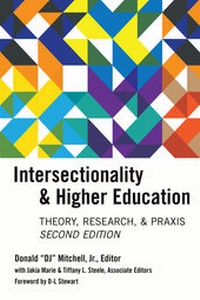
Intersectionality & Higher Education
Description

Intersectionality is a term coined by Kimberlé Crenshaw in 1989. Crenshaw, a scholar of law, critical race theory, and Black feminist legal theory, used intersectionality to explain the experiences of Black women who-because of the intersection race, gender, and class-are exposed to exponential and interlocking forms of marginalization and oppression often rendering them invisible. The second edition of Intersectionality & Higher Education: Theory, Research & Praxis further documents and expands upon Crenshaw's articulation of intersectionality within the context of higher education. The text includes (a) theoretical and conceptual chapters on intersectionality; (b) empirical research and research-based chapters using intersectionality as a framework; and (c) chapters focusing on intersectional practices, all within higher education settings. The volume may prove beneficial for graduate programs in ethnic studies, higher education, sociology, student affairs, and women and gender studies and programs alike.
More details
Other editions
Additional editions

Persons
Donald "DJ" Mitchell, Jr., received his Ph.D. from the University of Minnesota-Twin Cities. He is professor of education at Bellarmine University in Louisville, Kentucky. His scholarship explores the race, gender, and identity intersections, and intersectionality in higher education contexts.
Jakia Marie is a Ph.D. candidate in Pan-African studies at the University of Louisville in Kentucky. Her scholarship explores race and ethnicity with an emphasis in cultural identity, immigration, and international education and identity development and experiences of minoritized students in higher education.
Tiffany L. Steele is a Ph.D. student in higher education and student affairs at The Ohio State University in Columbus, Ohio. Her scholarship explores the retention of minoritized students and staff members at predominantly White institutions with an emphasis on the lived experiences of Black women.
Content
List of Figures and Tables - D-L Stewart: Foreword - Donald "DJ" Mitchell, Jr.: Preface - Acknowledgments - Charmaine L. Wijeyesinghe/Susan R. Jones: Intersectionality, Identity, and Systems of Power and Inequality - Rose Ann E. Gutierrez: Living Liminal: Conceptualizing Liminality for Undocumented Students of Color - Allison Daniel Anders/James M. DeVita: Intersectionality: A Legacy from Critical Legal Studies and Critical Race Theory - Antonio Duran/Romeo Jackson: Thinking Theoretically with and beyond Intersectionality: Frameworks to Center Queer and Trans People of Color Experiences - Shadab Fatima Hussain: Intersectionality within the South Asian American Student Population: Breaking Down the "Asian Box" - Samuel D. Museus/Natasha A. Saelua: Realizing the Power of Intersectionality Research in Higher Education - Leah J. Reinert/Gabriel R. Serna: Living Intersectionality in the Academy - Daniel Tillapaugh/Z Nicolazzo: Backward Thinking: Exploring the Relationship among Intersectionality, Epistemology, and Research Design - Christa J. Porter: Metaphorically Speaking: Being a Black Woman in the Academy Is Like - Ryan A. Miller/Ashley P. Jones: Challenges Conducting Intersectional Research with LGBQ Students: Reflecting on Studies Exploring Spirituality and Disability - Susan V. Iverson/Chinasa Elue/Kelly E. Cichy/Emily P. McClaine: Identity Collisions: An Intersectional Analysis of Students' Experiences in the McNair Scholars Program - Jasmine D. Collins: Intersectionality and Student Leadership Development: Advancing the Quantitative Research Agenda - Cobretti D. Williams: Gaps in the Rainbow: Finding Queer Women of Color in Higher Education - Jason C. Garvey: Demographic Information Collection in Higher Education and Student Affairs Survey Instruments: Developing a National Landscape for Intersectionality - Meg E. Evans/Jason K. Wallace: No Longer Cast Aside: A Critical Approach to Serving Queer and Trans Students of Color in Higher Education - Patricia P. Carver/Tamekka L. Cornelius/Kristie S. Johnson: When Sisters Unite: Overcoming Oppression to Persist and Thrive in a PhD Program - Scott Burden/Jimmy Hamill/Chelsea Gilbert: Intersectional Praxis in Higher Education and Student Affairs Supervision - Natesha L. Smith/Thomas J. Holvey/Nuray Seyidzade: Innovations in Student Affairs: Applying an Intersectionality Framework to Stakeholder Personas - Dawn R. Johnson/Michelle M. Blum/Katharine E. Lewis/Sharon W. Alestalo: Intersectionality as Praxis for Equity in STEM: A WiSE Women of Color Program - Editor Biographies - Author Biographies.
