

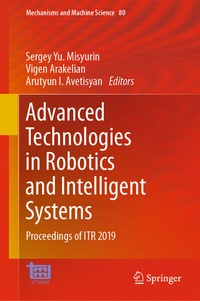
Advanced Technologies in Robotics and Intelligent Systems
Description

This volume gathers the latest advances, innovations, and applications in the field of intelligent systems such as robots, cyber-physical and embedded systems, as presented by leading international researchers and engineers at the International Conference on Intelligent Technologies in Robotics (ITR), held in Moscow, Russia on October 21-23, 2019. It covers highly diverse topics, including robotics, design and machining, control and dynamics, bio-inspired systems, Internet of Thing, Big Data, RFID technology, blockchain, trusted software, cyber-physical systems (CFS) security, development of CFS in manufacturing, protection of information in CFS, cybersecurity of CFS. The contributions, which were selected by means of a rigorous international peer-review process, highlight numerous exciting ideas that will spur novel research directions and foster multidisciplinary collaboration among different specialists, demonstrating that intelligent systems will drive the technological and societal change in the coming decades.
More details
Other editions
Additional editions
Content
- Intro
- Preface
- Contents
- Nonlinear RISE-Based Control for a Gravity Balanced Exoskeleton: Evaluation of the Design and Control Principle
- 1 Introduction
- 2 Modeling and Control of the Exoskeleton First Section
- 3 Simulation
- 4 Conclusions and Future Works
- References
- Legged Walking Robots: Design Concepts and Functional Particularities
- 1 Introduction
- 2 Multi-degree-of-Freedom Legged Walking Robots
- 3 Reduced-Degree-of-Freedom Walking Robots
- 4 Conclusions
- References
- Lax Pair and First Integrals for Two of Nonlinear Coupled Oscillators
- 1 Introduction
- 2 The Pair for the System of Nonlinear Coupled Equations
- 3 Two Nonlinear Coupled Oscillators and Their First Integrals
- 4 Conclusions
- References
- Deep Neural Networks Ensemble with Word Vector Representation Models to Resolve Coreference Resolution in Russian
- 1 Introduction
- 2 Related Works
- 3 Materials and Methods
- 3.1 Working Principle of Coreference Resolution Model
- 3.2 Modification for Russian Language
- 4 Experiments
- 4.1 Selection of the Word Vector Model
- 4.2 Assessment of the Tokenization Method
- 4.3 Ensembling the Model
- 4.4 Experiments with RuCor Dataset
- 5 Conclusion
- References
- Flash Memory-Formation, Development and Prospects
- 1 Introduction
- 2 The Organization and Principles of Flash Memory
- 3 Varieties of Memory Cells
- 4 Flash Memory Architecture
- 5 Block Rejection
- 6 Flash Development Perspectives
- 7 The Use of Research Results in the Field of Nanotechnology
- 8 Conclusions
- References
- Development Problems of Trusted Software in Critical Information Infrastructure Systems
- 1 Introduction
- 2 Trusted Software
- 3 Software Reliability
- 4 Conclusion
- References
- Design Concepts for Human Walking and Sitting Wearable Exoskeletons
- 1 Introduction
- 2 Design Concepts of Portable Exoskeletons
- 2.1 Description of Exoskeletons
- 2.2 System Balancing Conditions
- 2.3 An Illustrative Example
- 3 Conclusion
- References
- Study on the Possibility of Detecting Objects in Real Time on a Mobile Robot
- 1 Introduction
- 2 Implementation
- 3 Methodic
- 4 Experimental Results
- 5 Conclusion
- References
- Comprehensive Testing of Software and Hardware Data Security Tools Using Virtualization
- 1 Introduction
- 2 Materials and Methods
- 3 Results and Discussion
- References
- Intelligent Multi-agent System for Rescue Missions
- 1 Introduction
- 2 Related Work
- 3 Problem Statement
- 4 System Architecture
- 5 Use Case Scenario
- 6 Conclusions
- References
- The Relevance of Using Post-quantum Cryptography on the Isogenies of Elliptic Curves for Mobile Application Protection
- 1 The Relevance of the Studying of Post-quantum Cryptography
- 1.1 Development of Quantum Technologies
- 1.2 Cryptographic Public Response
- 2 The Advantages of Using Isogenies of Elliptic Curves
- 2.1 Comparison of Postquantum Algorithms
- 2.2 Unique Advantage of Using Isogenies
- 3 Acceptability of Using Isogenies of Elliptic Curves in Mobile Applications
- 3.1 Cryptographic Resistance of Using of Isogenies
- 3.2 Performance of Algorithms on Isogenies
- 3.3 The Relevance of Using Isogenies in Mobile Applications
- References
- The Impact of Artifacts on the BCI Control Channel for a Robotic Wheelchair
- 1 Introduction
- 2 Related Works
- 3 Methodology of Improving the Control Channel
- 4 Comparison Study
- 5 Experiment Scheme
- 6 Results
- 7 Conclusion
- References
- Methodology of Analysis of Similar Objects with the Use of Modern Visualization Tools
- 1 Introduction
- 2 Methodology
- 3 Results and Discussion
- 4 Conclusion
- References
- Performance Evaluation of a Cluster Computing System Running OpenBSD Based on Single-Board Computers
- 1 Research Part
- 2 Algorithm
- 3 Cluster Testing
- 4 Conclusion
- References
- Multivariable Root Loci of Discrete-Time Uniform Systems
- 1 Introduction
- 2 Canonical Representations of Discrete Uniform Systems
- 3 Multivariable Root Loci of Discrete Uniform Systems
- References
- The Implementation of a Dual-Redundant Control System Based on Elbrus Processor
- 1 Introduction
- 2 Sucture Design of Redundant System
- 3 PLC Software Structure
- 3.1 Implementation of Redundancy Library
- 3.2 Implementation of Beremiz Module
- 4 Conclusions
- References
- Methods and Approaches for Privacy-Preserving Machine Learning
- 1 Introduction
- 2 Approaches to Privacy-Preserving Machine Learning
- 2.1 Perturbation Approach
- 2.2 Perturbation Approach
- 3 Conclusion
- References
- Estimation of the Number of Calculations for Solving the Tasks of Optimization Synthesis of Dynamic Systems by the Method of a Planned Experiment
- 1 Introduction
- 2 Using the Fisher Criterion to Estimate the Volume of Experiments
- 3 Combinatorial Approach to Assessing the Volume of Experiments
- 4 Conclusions
- References
- Experiments with Neural Net Object Detection System YOLO on Small Training Datasets for Intelligent Robotics
- 1 Introduction
- 2 YOLO
- 3 Experiments and Results
- 4 Conclusion
- References
- Robot-Doctor: What Can It Be?
- 1 Ethical Concerns
- 2 Causes of the Problem
- 3 Ways to Solve the Problem
- 4 Robot-Doctor and An Example of His Work
- 5 Conclusion
- References
- Genetic Algorithm and Software Tools for Solving Optimization Problems in Intelligent Robotics
- 1 Introduction
- 2 Genetic Algorithm
- 2.1 Concepts
- 2.2 Algorithm Steps
- 3 Software Implementations
- 4 Conclusions
- References
- Hadron Collider and Quantum Computer
- 1 Introduction
- 2 Heavy Duty Electromagnetic Fields
- 3 Ultralow Temperature
- 4 Creation of Special Materials and Conditions
- 5 Presentation of a New Idea
- 6 Conclusions
- 6.1 Magnetic Field
- 6.2 Superconductivity
- 6.3 Information Resources
- References
- On Integral Distinguishers for Ciphers Based on the Feistel Network Generalizations
- 1 Introduction
- 2 Preliminaries
- 2.1 Feistel Network and Its Generalizations
- 2.2 Integral Properties and Distinguisher
- 3 Integral Distinguishers
- 3.1 Integral Distinguisher for the PICARO Block Cipher
- 3.2 Integral Distinguisher for the QTL Cipher
- 3.3 Integral Distinguishers for GFN-1, GFN-2 and GFN-3
- 4 Summary
- References
- Improving the Security of the Facial Biometrics System Using the Liveness Detection Module
- 1 Introduction
- 2 Face Verification Submodule
- 3 Submodule of Active Methods of Protection Against Spoofing Attacks
- 4 Summary
- References
- Design of Air Vane Motor Parameters Providing Minimal Torque Ripples Combined with High Energy Efficiency
- 1 Introduction
- 2 Test System and Experimental Results
- 3 Mathematical Modeling
- 4 The Procedure of Vector Parametric Identification
- 5 Main Results. Conclusions
- References
- Intelligence Information System for Forensic Microscopical Hair Analysis
- 1 Introduction
- 2 Microscopical Hair Analysis and Characteristics of Human Hair
- 3 Intelligence Information System for Forensic Examination
- 4 Conclusion
- References
- A Non-fully-Connected Spiking Neural Network with STDP for Solving a Classification Task
- 1 Introduction
- 2 Methods
- 2.1 Datasets
- 2.2 Neuron Model
- 2.3 Plasticity Model
- 2.4 Network Configuration
- 3 Experiments
- 4 Results
- 5 Conclusion
- References
- On the Possibility of Designing Adaptive Vibration Machinery Using Self-synchronizing Exciters
- 1 Introduction
- 2 A System with Plane-Parallel Vibrations and Two Exciters
- 3 A System with Plane-Parallel Vibrations and Three Exciters
- 4 A System with Spatial Oscillations
- 5 Conclusions
- References
- New Vectors of Cyberattacks and New IS Methods for Critical Infrastructure Enterprises: Russian Private Banking View
- 1 Introduction
- 2 The Overall Level of Cyber Threats to the Russian Industry Enterprises Could Grow Significantly
- 3 Domestic Private Banking Solutions Can Be Quite Successful
- 4 Conclusion
- References
- A Review of the Parallel Structure Mechanisms with Kinematic Decoupling
- 1 Introduction
- 2 Types of the Kinematic Decoupling
- 3 Mechanisms with Six Degrees of Freedom and Spherical Parallel Mechanisms
- 4 The Orthoglide Robot Development
- 5 Conclusions
- References
- GraphLabs Extendable Module System for Education Support
- 1 Introduction
- 2 The Concept of Extendable Modules
- 3 System Adaptation to User
- 4 Practical Results
- 5 Conclusion
- References
- Designing Robotic Groups Under Incomplete Information About the Dominance of Many Goals
- 1 Introduction
- 2 Information About Dominance of Robots and Goals
- 3 Decision Making Based on Dominance Information
- 4 Conclusion
- References
- Methods and Algorithms for Detecting Compromise of Secret Keys
- 1 Introduction
- 2 Directions of Protection Against Compromise of Cryptographic Keys
- 3 Approaches to Detecting Compromise on the Protocol Level
- 3.1 Trace-Independent Inconsistency
- 3.2 Observing Contradictions
- 3.3 Observing Acausality
- 4 Protocol for Detecting Compromise of Cryptographic Keys Based on Blockchain Technology
- 4.1 Working with Keys: Primary Initialization
- 4.2 Sending and Receiving Processes
- 4.3 Principle of Attack Detection
- 5 Conclusion
- References
- Indoor Positioning System Based on Mobile Devices
- 1 Introduction
- 2 Methods of Positioning
- 3 Combination of Positioning Systems
- 4 Conclusion
- References
- New Class of Non-binary Pseudorandom Number Generators
- 1 Introduction
- 2 Linear Feedback Shift Registers PRNG
- 3 (M - P + 1)-Sequences Generators
- 4 General Case
- 5 Examples of the Use of (M - P + 1)-Sequences Generators
- 6 Conclusion
- References
- Design of High-Speed Manipulators via Optimal Control of the Acceleration of the Total Mass Center
- 1 Introduction
- 1.1 Problem Formulation
- 2 Design of Partially Balanced 5R Planar Parallel Manipulators
- 2.1 Balancing without Mass Redistribution
- 2.2 Balancing with Mass Redistribution and Optimal Control of the Acceleration of the Total Mass Center
- 3 Design of Partially Balanced 3RRR Planar Parallel Manipulators
- 4 Conclusions
- References
- A Survey of Aggregate Signature Applications
- 1 Introduction
- 2 Preliminaries
- 2.1 Definitions of Aggregate Signatures
- 2.2 Aggregate Signatures Subtypes
- 3 Aggregate Signature Applications
- 3.1 Sensors Network
- 3.2 Software Authentication
- 3.3 Secure Logging
- 3.4 Fast Signatures
- 3.5 Secure Routing
- 3.6 PKI
- 3.7 Blockchain
- 3.8 Outsourced Database
- References
- Adaptive Behavioral Model of the Electricity Object Management Operator for Intelligent Current Personnel Condition Monitoring Systems
- 1 Introduction
- 2 Status of Research in the Field
- 3 The Essence of the Proposed Approach
- 4 Analysis of Simulation Results
- 5 Areas of Possible Application of the Developed Model
- 6 Conclusions
- References
- Online Handwritten Signature Verification: The State of the Art
- 1 Introduction
- 2 Signature Verification System
- 3 Methods of Classification
- 4 Analysis
- References
- Possible Modifications of RC4 Stream Cipher
- 1 Introduction
- 2 RC4 Modification Spritz
- 3 Main Primitives of Stream Ciphers
- 3.1 LFSR
- 4 New RC4 Modification Ideas
- 5 Conclusion
- References
- On Application of Feedback Linearization in Control Systems of Multicopters
- 1 Introduction
- 2 Rigid-Body Dynamics of Multicopters
- 3 Control System of the Multicopter
- 4 Feedback Linearization of the Multicopter Dynamics
- 5 Conclusions
- References
- Recognition Matrix for Comparing Pages of Text by a Robot
- 1 Introduction
- 2 The Concept of Relevance as a Visual Similarity
- 3 Recognition Matrix
- 4 Comparison of Recognition Matrices
- 5 Determination of Relevance
- 6 Conclusion
- References
- Mathematical Methods for the Analysis of Vibrations Along the Human Arm
- 1 Background
- 2 Methods
- 3 Results
- 4 Conclusion
- References
- Application of a Computer Algebra System for Constructing Newton Polygons for Ordinary Differential Equations
- 1 Introduction
- 2 Algorithm of the Program of Construction of Newton Polygons
- 3 ACNP Program Application Examples
- 3.1 Construction of Newton Polygons for Analysis of Equations for the Painlevé Property
- 3.2 Application of the Newton Polygons When Finding Exact Solutions of Differential Equations by the Method of Simplest Equations
- 3.3 Application of Newton Polygons for Finding Asymptotics of Nonlinear Differential Equations
- 4 Conclusion
- References
- GDozenHash Hash Function Based on Three-Dimensional Stochastic Transformations
- 1 Introduction
- 2 Fundamentals of the Theory
- 3 New Constructions
- 4 GDozenHash Hash Algorithm
- 5 Test Methods and Results
- 6 Conclusion
- References
- About the Security Assessment of Embedded Software in Automated Process Control System
- 1 Introduction
- 2 Embedded Software Security Evaluation
- 2.1 Formal Approach to Embedded Software Security Evaluation
- 2.2 Using a Risk-Based Approach to Security Assessment
- 3 Conclusion
- References
- Parametric and Structural Optimization of Pneumatic Positioning Actuator
- 1 Introduction
- 2 Conversion of the Power Drive Model to a Dimensionless Form
- 3 Control System Model (Controller)
- 4 Formation of the Search Space for Rational Parameters of the Model
- 5 Conclusions
- References
- A Neural Network Model to Include Textual Dependency Tree Structure in Gender Classification of Russian Text Author
- 1 Introduction
- 2 Materials and Methods
- 2.1 Corpora
- 2.2 Neural Network Topology Blocks
- 2.3 Approach to Include Textual Dependency Tree Structure Based on LSTM
- 2.4 The Approach Based on a Graph Convolution Network
- 3 Experiments
- 4 Conclusion
- References
- Continuous Authentication Over Hand-Waving for Android Smartphones
- 1 Introduction
- 2 Related Works
- 2.1 Wave-to-Access
- 2.2 OpenSesame
- 2.3 HMOG
- 3 Receiving Data from Sensors
- 3.1 Creation of Characteristic Vectors
- 3.2 Data Collection Application
- 4 System of Continuous Authentication Over Hand-Waving
- 5 Testing the System of Continuous Authentication
- 6 Conclusion
- References
- Investigation of the Stresses Exerted by an Exosuit of a Human Arm
- 1 Introduction
- 2 Presentation of the Concept of the Human Arm with Its Exosuit
- 3 Models of the Human Arm with Its Exosuit
- 3.1 Geometric Model
- 3.2 Inverse Geometric Model
- 3.3 Dynamic Models
- 3.4 Kinematic Models
- 4 Numerical Results
- 4.1 Numerical Results in the Sagittal Plane
- 4.2 Numerical Results in the Frontal Plane
- 5 Conclusion and Perspectives
- References
