

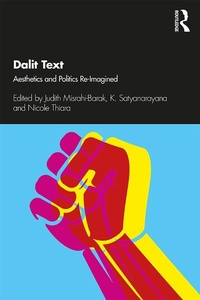
Dalit Text
Aesthetics and Politics Re-imagined
1st Edition
Published on 18. June 2019
262 pages
978-1-000-00013-9 (ISBN)
Description

This book, companion to the much-acclaimed Dalit Literatures in India, examines questions of aesthetics and literary representation in a wide range of Dalit literary texts. It looks at how Dalit literature, born from the struggle against social and political injustice, invokes the rich and complex legacy of oral, folk and performative traditions of marginalised voices. The essays and interviews systematically explore a range of literary forms, from autobiographies, memoirs and other testimonial narratives, to poems, novels or short stories, foregrounding the diversity of Dalit creation. Showcasing the interplay between the aesthetic and political for a genre of writing that has 'change' as its goal, the volume aims to make Dalit writing more accessible to a wider public, for the Dalit voices to be heard and understood. The volume also shows how the genre has revolutionised the concept of what literature is supposed to mean and define.
Effervescent first-person accounts, socially militant activism and sharp critiques of a little-explored literary terrain make this essential reading for scholars and researchers of social exclusion and discrimination studies, literature (especially comparative literature), translation studies, politics, human rights and culture studies.
Effervescent first-person accounts, socially militant activism and sharp critiques of a little-explored literary terrain make this essential reading for scholars and researchers of social exclusion and discrimination studies, literature (especially comparative literature), translation studies, politics, human rights and culture studies.
Reviews / Votes
"This book makes a critically important contribution to the growing, but still impoverished, field of Dalit literary studies in two key ways. First, the editors and contributors to Dalit Text refuse an engagement with Dalit literature's politics in lieu of its aesthetics, and in so doing, rightfully reject the all-too-common sociological approach to Dalit literature that blinds us to the meaningful employment of innovative narrative strategies that has been at the core of Dalit literary production from its earliest stages. Second, the book makes a commitment to highlighting several new voices of Dalit literature and literary criticism, voices that will emerge for the first time in an edited volume that will have extensive transnational reach. Such a political commitment to representing a diversity of voices - in several different languages - from within Dalit literary and scholarly circles in India and its diaspora will play a critical role in contributing to the growth and sophistication of the field of Dalit literary studies. This volume is desperately needed, and most welcome." - Laura Brueck, Associate Professor of South Asian Languages and Cultures, Northwestern University, Evanston, IL USA"This contribution to the extant body of scholarship on Dalits, now a recognized area of academic attention world-wide, forcefully intensifies the field and begins to widen it. Necessary reading for anyone interested in justice in its various forms. This book goes a long way to study newer aspects of Dalit studies."- Aniket Jaaware, Professor, English Department, Shiv Nadar University, Delhi, India
"A profound inquiry into the relation between the category 'Dalit' on the one hand and artistic and literary practice on the other, this landmark volume brings together writers, critics and translators to engage the force of Dalit writing in several Indian languages. The result of an international collaboration, this volume crucially brings questions of translation and universalization to the very untranslatability of the term 'Dalit.'" -- Simona Sawhney, Associate Professor, Humanities & Social Sciences, Indian Institute of Technology, Delhi, India "This book makes a critically important contribution to the growing, but still impoverished, field of Dalit literary studies in two key ways. First, the editors and contributors to Dalit Text refuse an engagement with Dalit literature's politics in lieu of its aesthetics, and in so doing, rightfully reject the all-too-common sociological approach to Dalit literature that blinds us to the meaningful employment of innovative narrative strategies that has been at the core of Dalit literary production from its earliest stages. Second, the book makes a commitment to highlighting several new voices of Dalit literature and literary criticism, voices that will emerge for the first time in an edited volume that will have extensive transnational reach. Such a political commitment to representing a diversity of voices - in several different languages - from within Dalit literary and scholarly circles in India and its diaspora will play a critical role in contributing to the growth and sophistication of the field of Dalit literary studies. This volume is desperately needed, and most welcome." - Laura Brueck, Associate Professor of South Asian Languages and Cultures, Northwestern University, Evanston, IL USA
"This contribution to the extant body of scholarship on Dalits, now a recognized area of academic attention world-wide, forcefully intensifies the field and begins to widen it. Necessary reading for anyone interested in justice in its various forms. This book goes a long way to study newer aspects of Dalit studies."- Aniket Jaaware, Professor, English Department, Shiv Nadar University, Delhi, India
"A profound inquiry into the relation between the category 'Dalit' on the one hand and artistic and literary practice on the other, this landmark volume brings together writers, critics and translators to engage the force of Dalit writing in several Indian languages. The result of an international collaboration, this volume crucially brings questions of translation and universalization to the very untranslatability of the term 'Dalit.'" -- Simona Sawhney, Associate Professor, Humanities & Social Sciences, Indian Institute of Technology, Delhi, India
More details
Edition
1. Auflage
Language
English
Place of publication
London
United Kingdom
Publishing group
Taylor & Francis Ltd
Illustrations
4 Halftones, black and white; 4 Illustrations, black and white
ISBN-13
978-1-000-00013-9 (9781000000139)
Copyright in bibliographic data and cover images is held by Nielsen Book Services Limited or by the publishers or by their respective licensors: all rights reserved.
Schweitzer Classification
Other editions
Additional editions
Judith Misrahi-Barak | K. Satyanarayana | Nicole Thiara
Dalit Text
Aesthetics and Politics Re-imagined
Book
06/2019
1st Edition
Routledge India
€230.65
Shipment within 10-20 days
Judith Misrahi-Barak | K. Satyanarayana | Nicole Thiara
Dalit Text
Aesthetics and Politics Re-imagined
Book
06/2019
1st Edition
Routledge India
€52.07
Shipment within 15-20 days
Persons
Judith Misrahi-Barak is an associate professor at University Paul Valery Montpellier 3, France. She has published widely on Caribbean and Indo- and Sino-Caribbean writers, and diaspora literatures. She is general editor of the series PoCoPages. She co-edited Dalit Literatures in India with Joshil K. Abraham (2015; 2nd edition 2018) and was co-investigator on the AHRC Research Network series 'Writing, Analysing, Translating Dalit Literature' (2014-16). She has written several entries on Dalit Literature and Dalit writers for the forthcoming Dictionnaire encyclopedique des litteratures indiennes (DELI).
K. Satyanarayana is a professor in the Department of Cultural Studies at the English and Foreign Language University, Hyderabad, India. He co-edited two volumes of new Dalit writing: No Alphabet in Sight (2011), Steel Nibs Are Sprouting (2013) and, most recently, Dalit Studies (2016). His research interests are in the fields of Dalit studies, literary history, and cultural theory. He is a regular commentator on Dalit issues in the media and public forums.
Nicole Thiara teaches postcolonial and contemporary literature at Nottingham Trent University, UK. She has written Salman Rushdie and Indian Historiography: Writing the Nation into Being (2009) and articles on Dalit literature, contemporary South Asian literature and the British Asian diaspora. She was the principal investigator on the AHRC Research Network series 'Writing, Analysing, Translating Dalit Literature' (2014-16).
K. Satyanarayana is a professor in the Department of Cultural Studies at the English and Foreign Language University, Hyderabad, India. He co-edited two volumes of new Dalit writing: No Alphabet in Sight (2011), Steel Nibs Are Sprouting (2013) and, most recently, Dalit Studies (2016). His research interests are in the fields of Dalit studies, literary history, and cultural theory. He is a regular commentator on Dalit issues in the media and public forums.
Nicole Thiara teaches postcolonial and contemporary literature at Nottingham Trent University, UK. She has written Salman Rushdie and Indian Historiography: Writing the Nation into Being (2009) and articles on Dalit literature, contemporary South Asian literature and the British Asian diaspora. She was the principal investigator on the AHRC Research Network series 'Writing, Analysing, Translating Dalit Literature' (2014-16).
Content
1. Introduction: Aesthetics and Politics Re-Imagined Judith Misrahi-Barak, K. Satyanarayana and Nicole Thiara Part I Speaking Out 2. Manoranjan Byapari Sipra Mukherjee 3. Kalyani Thakur Charal Jayati Gupta 4. Cho. Dharman R. Azhagarasan and R. Arul 5. Des Raj Kali Rajkumar Hans Part II Writing from Within: Genre and Gender 6. Author's Notes or Revisions? The Politics of Form in P. Sivakami's Two Novels Kanak Yadav 7. Of Subjecthood and Form: On Reading Two Dalit Short Stories from Gujarat, India Santosh Dash 8 Janu and Saleena Narrating Life: Subjects and Spaces Carmel Christy K. J. 9 Mother as Fucked: Reimagining Dalit Female Sexuality in Sahil Parmar's Poetry Gopika Jadeja 10 A Pox on Your House: Exploring Caste and Gender in Tulsi Ram's Murdahiya Shivani Kapoor Part III Reading Across 11 Dalit Literature in Translation: A Symptomatic Reading of Sharankumar Limbale's Akkarmashi in English Translation Arun Prabha Mukherjee 12 Translating Dalit Literature: Redrawing the Map of Cultural Politics Maya Pandit Part IV Looking Through 13 Notes on Questions of Dalit Art Deeptha Achar 14 (Re-)imaging Caste in Graphic Novels: A Study of A Gardener in the Wasteland and Bhimayana: Experiences of Untouchability Ruchika Bhatia and Devika Mehra 15 Dalits and the Spectacle of Victimhood in Telugu Cinema Chandra Sekhar
