

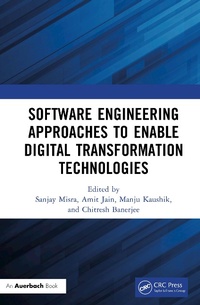
Software Engineering Approaches to Enable Digital Transformation Technologies
1st Edition
Published on 13. November 2023
196 pages
978-1-000-98704-1 (ISBN)
Description

Software Engineering Approaches to Enable Digital Transformation Technologies features contributions reflecting ideas and research in enabling digital transformation technologies through software engineering. To date, multiple, different approaches have been adopted to develop software solutions for a variety of different problems. Of all the available approaches, the main approaches are level-oriented, data flow-oriented, data structure-oriented, and object-oriented design approaches. The other focus of the book is digital transformation, which can be defined as the adoption of digital technology to improve efficiency, value, and innovation
Digitalization is more than just putting additional technological systems and services in place. Rather than improving conventional methods, a true digital transformation initiative includes radically rethinking company structures and procedures. There are four types of digital transformation: business process, business model, domain, and cultural and organizational. Companies are being challenged to develop new business models that consider and harness digitalization. From the standpoint of software engineering, digital transformation alters how software is built.
Current trends include the development of mobile applications, cloud applications, and Internet of Things (IoT) applications. Emerging trends are the development of digital twins, robotics, artificial intelligence, machine learning, augmented reality, and additive manufacturing. This book examines the challenges that arise due to digitization in society and presents plausible solutions that could be applied to counter these challenges and convert them into opportunities. These solutions may further be improvised and worked out for the software companies from the technological perspective, organizational perspective, and management perspective.
Digitalization is more than just putting additional technological systems and services in place. Rather than improving conventional methods, a true digital transformation initiative includes radically rethinking company structures and procedures. There are four types of digital transformation: business process, business model, domain, and cultural and organizational. Companies are being challenged to develop new business models that consider and harness digitalization. From the standpoint of software engineering, digital transformation alters how software is built.
Current trends include the development of mobile applications, cloud applications, and Internet of Things (IoT) applications. Emerging trends are the development of digital twins, robotics, artificial intelligence, machine learning, augmented reality, and additive manufacturing. This book examines the challenges that arise due to digitization in society and presents plausible solutions that could be applied to counter these challenges and convert them into opportunities. These solutions may further be improvised and worked out for the software companies from the technological perspective, organizational perspective, and management perspective.
More details
Edition
1. Auflage
Language
English
Place of publication
London
United Kingdom
Publishing group
Taylor & Francis Ltd
Target group
College/higher education
Illustrations
21 Tables, black and white; 92 Line drawings, black and white; 92 Illustrations, black and white
ISBN-13
978-1-000-98704-1 (9781000987041)
Copyright in bibliographic data and cover images is held by Nielsen Book Services Limited or by the publishers or by their respective licensors: all rights reserved.
Schweitzer Classification
Other editions
Additional editions
Sanjay Misra | Amit Jain | Manju Kaushik
Software Engineering Approaches to Enable Digital Transformation Technologies
Book
04/2025
1st Edition
Routledge
€85.30
Shipment within 10-20 days
Sanjay Misra | Amit Jain | Manju Kaushik
Software Engineering Approaches to Enable Digital Transformation Technologies
Book
11/2023
1st Edition
Routledge
€241.50
Shipment within 10-20 days
Persons
Prof. Sanjay Misra, PhD, is a scientist at the Department of Applied Data Science, Institute of Energy Technology, Halden, Norway. He is also a senior member of the Institute of Electrical and Electronics Engineers (IEEE).
Amit Jain, PhD, MBA, FDP, is vice chancellor, dean of the Faculty of Management Studies, and director of Amity Business School, Amity University, India.
Manju Kaushik, PhD, MCA, MTech CS, MSc, MBA, is a professor, Amity Institute of Information Technology, and the president of the Institute's Innovation Council, Amity University Rajasthan, India.
Prof. Chitresh Banerjee, PhD, MTech CS, MCA, B.Sc., GNIIT, is an associate professor, Amity Institute of Information Technology, and the vice president of the Institute's Innovation Council, Amity University Rajasthan, India. He is also a member of Machine Intelligence Research (MIR) Labs, United States.
.
Amit Jain, PhD, MBA, FDP, is vice chancellor, dean of the Faculty of Management Studies, and director of Amity Business School, Amity University, India.
Manju Kaushik, PhD, MCA, MTech CS, MSc, MBA, is a professor, Amity Institute of Information Technology, and the president of the Institute's Innovation Council, Amity University Rajasthan, India.
Prof. Chitresh Banerjee, PhD, MTech CS, MCA, B.Sc., GNIIT, is an associate professor, Amity Institute of Information Technology, and the vice president of the Institute's Innovation Council, Amity University Rajasthan, India. He is also a member of Machine Intelligence Research (MIR) Labs, United States.
.
Content
1. Precise Prediction of Water Level Using Naive Bayes Algorithm for Smart Irrigation in Pomegranate Farm 2. A Brief Review on Lightweight Practice of Docker Vulnerabilities 3. Deep Learning-Based Serverless Image Handler using Amazon Web Services 4. Ontology Based Delegation Enforcement in the Cloud Ecosystem 5. Applicability of Artificial Intelligence for Social Development in Rural and Urban Sectors 6. Disease Prediction Using Bayes' Theorem 7. Secure Voting System using Blockchain Technology 8. Malware Analysis: An Experimental Approach 9. Deployment of New Life Cycle Model for Applications of Web 10. The Future Possibilities of Artificial Intelligence In Modern Drapes 11. Mobile Application and Communication 12. Emerging and Growing Technologies in Blockchain Security.
