

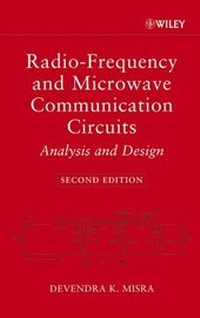
Radio-Frequency and Microwave Communication Circuits
Description

More details
Other editions
Additional editions
Person
Content
1.1 Microwave Transmission Lines.
1.2 Transmitter and Receiver Architectures.
2 Communication Systems.
2.1 Terrestrial Communication.
2.2 Satellite Communication.
2.3 Radio-Frequency Wireless Services.
2.4 Antenna Systems.
2.5 Noise and Distortion.
Suggested Reading.
Problems.
3 Transmission Lines.
3.1 Distributed Circuit Analysis of Transmission Lines.
3.2 Sending-End Impedance.
3.3 Standing Wave and Standing Wave Ratio.
3.4 Smith Chart.
Suggested Reading.
Problems.
4 Electromagnetic Fields and Waves.
4.1 Fundamental Laws of Electromagnetic Fields.
4.2 The Wave Equation and Uniform Plane Wave Solutions.
4.3 Boundary Conditions.
4.4 Uniform Plane Wave Incident Normally on an Interface.
4.5 Modified Maxwell's Equations and Potential Functions.
4.6 Construction of Solutions.
4.7 Metallic Parallel-Plate Waveguide.
4.8 Metallic Rectangular Waveguide.
4.9 Metallic Circular Waveguide.
Suggested Reading.
Problems.
5 Resonant Circuits.
5.1 Series Resonant Circuits.
5.2 Parallel Resonant Circuits.
5.3 Transformer-Coupled Circuits.
5.4 Transmission Line Resonant Circuits.
5.5 Microwave Resonators.
Suggested Reading.
Problems.
6 Impedance-Matching Networks.
6.1 Single Reactive Element or Stub Matching Networks.
6.2 Double-Stub Matching Networks.
6.3 Matching Networks Using Lumped Elements.
Suggested Reading.
Problems.
7 Impedance Transformers.
7.1 Single-Section Quarter-Wave Transformers.
7.2 Multisection Quarter-Wave Transformers.
7.3 Transformer with Uniformly Distributed Section Reflection Coefficients.
7.4 Binomial Transformers.
7.5 Chebyshev Transformers.
7.6 Exact Formulation and Design of Multisection Impedance Transformers.
7.7 Tapered Transmission Lines.
7.8 Synthesis of Transmission Line Tapers.
7.9 Bode-Fano Constraints for Lossless Matching Networks.
Suggested Reading.
Problems.
8 Two-Port Networks.
8.1 Impedance Parameters.
8.2 Admittance Parameters.
8.3 Hybrid Parameters.
8.4 Transmission Parameters.
8.5 Conversion of Impedance, Admittance, Chain, and Hybrid Parameters.
8.6 Scattering Parameters.
8.7 Conversion From Impedance, Admittance, Chain, and Hybrid Parameters to Scattering Parameters, or Vice Versa.
8.8 Chain Scattering Parameters.
Suggested Reading.
Problems.
9 Filter Design.
9.1 Image Parameter Method.
9.2 Insertion-Loss Method.
9.3 Microwave Filters.
Suggested Reading.
Problems.
10 Signal-Flow Graphs and Their Applications.
10.1 Definitions and Manipulation of Signal-Flow Graphs.
10.2 Signal-Flow Graph Representation of a Voltage Source.
10.3 Signal-Flow Graph Representation of a Passive Single-Port Device.
10.4 Power Gain Equations.
Suggested Reading.
Problems.
11 Transistor Amplifier Design.
11.1 Stability Considerations.
11.2 Amplifier Design for Maximum Gain.
11.3 Constant-Gain Circles.
11.4 Constant Noise Figure Circles.
11.5 Broadband Amplifiers.
11.6 Small-Signal Equivalent-Circuit Models of Transistors.
11.7 DC Bias Circuits for Transistors.
Suggested Reading.
Problems.
12 Oscillator Design.
12.1 Feedback and Basic Concepts.
12.2 Crystal Oscillators.
12.3 Electronic Tuning of Oscillators.
12.4 Phase-Locked Loop.
12.5 Frequency Synthesizers.
12.6 One-Port Negative Resistance Oscillators.
12.7 Microwave Transistor Oscillators.
Suggested Reading.
Problems.
13 Detectors and Mixers.
13.1 Amplitude Modulation.
13.2 Frequency Modulation.
13.3 Switching-Type Mixers.
13.4 Conversion Loss.
13.5 Intermodulation Distortion in Diode-Ring Mixers.
13.6 FET Mixers.
Suggested Reading.
Problems.
Appendix 1: Decibels and Neper.
Appendix 2" Characteristics of Selected Transmission Lines.
Appendix 3: Specifications of Selected Coaxial Lines and Waveguides.
Appendix 4: Some Mathematical Formulas.
Appendix 5: Vector Identities.
Appendix 6: Some Useful Network Transformations.
Appendix 7: Properties of Some Materials.
Appendix 8: Common Abbreviations.
Appendix 9: Physical Constants.
Index.
