

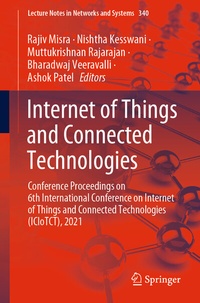
Internet of Things and Connected Technologies
Description

This book presents recent advances on IoT and connected technologies. We are currently in the midst of the Fourth Industrial Revolution, and IoT is having the most significant impact on our society. The recent adoption of a variety of enabling wireless communication technologies like RFID tags, BLE, ZigBee, etc., embedded sensor and actuator nodes, and various protocols like CoAP, MQTT, DNS, etc., has made the Internet of things (IoT) step out of its infancy. Internet of things (IoT) and connecting technologies are already having profound effects on the different parts of society like the government, health care, businesses, and personal lives.
6th International Conference on Internet of Things and Connected Technologies (ICIoTCT), 2021, was a platform to discuss and feature research on topics such as augmented reality, sensor networks, and wearable technology.This book is ideally designed for marketing managers, business professionals, researchers, academicians, and graduate-level students seeking to learn how IoT and connecting technologies increase the amount of data gained through devices, enhance customer experience, and widen the scope of IoT analytics in enhancing customer marketing outcomes.
More details
Other editions
Additional editions
Content
- Intro
- Preface
- Organization
- Program Chairs
- Contents
- Machine Learning Based Adaptive Auto-scaling Policy for Resource Orchestration in Kubernetes Clusters
- 1 Introduction
- 2 Problem Statement
- 3 Theory and Related Work
- 3.1 Kubernetes Architecture
- 3.2 Kubernetes Threshold-Based Auto-scaling Policies
- 3.3 Reinforcement Learning Scaling Policy
- 4 Proposed Predictive Autoscaler
- 5 Prediction Model
- 6 Experimental Evaluation
- 6.1 Dataset
- 6.2 Evaluation Metric
- 6.3 Prediction Results
- 6.4 Comparison of Predictive Autoscaler with Default Autoscaler
- 7 Conclusion
- References
- Transfer Learning Based Approach for Pneumonia Detection Using Customized VGG16 Deep Learning Model
- 1 Introduction
- 1.1 Motivation
- 1.2 Problem Statement
- 2 Related Work
- 3 Methodology
- 3.1 Dataset
- 3.2 Data Preprocessing and Splitting
- 3.3 Convolutional Neural Network and Transfer Learning
- 3.4 Convolutional Neural Network and Transfer Learning
- 3.5 Convolutional Neural Network and Transfer Learning
- 3.6 Evaluation Metrics
- 4 Experiments and Results
- 5 Conclusion and Future Work
- References
- Authenticate IoT Data for Health Care Applications Using ATSHA204 and Raspberry Pi
- 1 Introduction
- 2 Hardware Used
- 2.1 ATSHA204
- 2.2 Raspberry Pi
- 2.3 Oscilloscope
- 3 Proposed Methodology
- 4 Experimental Setup
- 5 Conclusion
- References
- Randomised Key Selection and Encryption of Plaintext Using Large Primes
- 1 Introduction
- 2 Proposed Methodology
- 3 Comparative Result Analysis
- 4 Conclusion and Feature Work
- References:
- Sustainable Smart Village Online Groundwater Level Monitoring System to Find the Recharging Capacity of Wells
- 1 Introduction
- 2 Literature Review
- 3 Proposed System Design
- 4 Results and Discussion
- 5 Conclusion
- References
- Stacked Generalization Based Ensemble Model for Classification of Coronary Artery Disease
- 1 Introduction
- 2 Material and Methodology
- 2.1 Data Sets
- 2.2 Data Partition
- 2.3 Classification Techniques
- 3 Classification Performance
- 4 Result and Discussion
- 5 Conclusion
- References
- Smart Waste Management System in Smart City
- 1 Introduction
- 2 Related Work
- 3 Smart Waste Management
- 4 Methodology
- 4.1 Waste Segregation Implementation
- 4.2 Transmission of Warning Message to the Respective Authority
- 5 Results
- 6 Conclusions
- References
- Carbon Rate Prediction Model Using Artificial Neural Networks (ANN)
- 1 Introduction
- 2 Related Work
- 3 Methodology
- 4 Data Preparation
- 5 Analysis
- 5.1 Carbon Rate Impact on Blast Furnace
- 5.2 Modeling
- 5.3 Prediction with Multiple Regression
- 5.4 Testing the Regression Model
- 5.5 Prediction with Artificial Neural Networks
- 6 Evaluation
- 7 Deployment
- 8 Conclusions
- 9 Future Scope
- References
- An Internet of Things Powered Model for Controlling Vehicle Induced Pollution in Cities
- 1 Introduction
- 2 Research Methodology
- 3 Related Work
- 4 Proposed ICT Model
- 5 Implementing and Testing the Model
- 5.1 Simulation Environment
- 5.2 Results and Discussion
- 6 Conclusions
- References
- Cloud Security as a Service Using Data Loss Prevention: Challenges and Solution
- 1 Introduction
- 2 Background and History
- 3 DLP Technology
- 3.1 DLP Elements
- 3.2 States of Data
- 3.3 Securing Application in the Cloud
- 3.4 Secure Cloud Solution Key Components
- 4 Software Architecture and Design
- 4.1 Algorithm
- 4.2 DLP Policy Overview
- 4.3 Proposed Design
- 4.4 Result
- 5 Conclusion and Future Work
- References
- Wireless Sensor Network Based Distribution and Prediction of Water Consumption in Residential Houses Using ANN
- 1 Introduction
- 2 Related Work
- 3 The Proposed Data Model Design
- 4 Proposed Model
- 5 Simulation and Result
- 6 Conclusion
- References
- An Approach for Energy-Efficient Lifetime Maximized Protocol for Wireless Sensor Networks
- 1 Introduction
- 1.1 Ad Hoc Protocols
- 2 Literature
- 2.1 LEACH Algorithm
- 2.2 "Energy Efficient Hierarchical Clustering
- 2.3 Hybrid Energy-Efficient Distributed Clustering
- 2.4 ANCAEE Algorithm
- 2.5 "LEACH-DC Routing Protocol"
- 3 Proposed Work
- 4 Simulation Results and Discussion
- 5 "Conclusion"
- References
- Real Time ModBus Telemetry for Internet of Things
- 1 Introduction
- 2 Modbus Protocol
- 2.1 Modbus Overview
- 3 System Description
- 3.1 Pilot Setup
- 4 Test Results
- 4.1 Serial Communication
- 4.2 ModBus TCP Server
- 4.3 ModBus TCP Client
- 4.4 Network Analysis
- 5 Conclusion
- References
- The Link Between Emotional Machine Learning and Affective Computing: A Review
- 1 Introduction
- 2 Discussion
- 2.1 Emotional Backpropagation Learning Algorithm
- 2.2 Testing Emotional Neural Networks for Credit Risk Evaluation
- 2.3 Prototype-Incorporated Emotional Neural Network
- 2.4 Beyond Emotional Neural Networks
- 3 Conclusions
- References
- Arduino Based Temperature, Mask Wearing and Social Distance Detection for COVID-19
- 1 Introduction
- 2 Literature Review
- 3 Components Used
- 3.1 Arduino Uno
- 3.2 Temperature Sensor (MLX90614)
- 4 Methodology
- 5 Conclusion
- References
- Precision Agricultural Management Information Systems (PAMIS)
- 1 Introduction
- 2 What is Precision Agriculture
- 2.1 Relevance to Botswana
- 3 Internet of Things (IoT)
- 4 IoT for Precision Agriculture
- 5 Using Digital Elevation Models (DEMs)
- 6 Practical Points to Ponder
- 7 Practical Issues in Field Farming
- 8 Exploiting Long-Term Analysis and Synthesis of Big Datasets
- 9 Privacy, Security and Legal Issues
- 10 Readying for Entomological Preventive Studies
- 11 Predicting Harvest Potentials Within 3-4 Weeks of Seedling Growth
- 12 Cloud Based Information Architectural Confluence of PAMIS
- 13 Parametric Performance Evaluation of the PAMIS Cloud
- 14 Conclusions
- References
- Vision for Eyes
- 1 Introduction
- 2 Literature Survey
- 3 Problem Identification and Objectives
- 4 System Methodology
- 5 Implementation
- 5.1 Hardware Requirement
- 5.2 Software Requirements
- 5.3 Setup
- 5.4 Execution Methodology
- 6 Testing
- 7 Results
- 8 Conclusion
- References
- Wheat Disease Severity Estimation: A Deep Learning Approach
- 1 Introduction
- 2 Methodology
- 2.1 Dataset
- 2.2 Image Pre-processing
- 2.3 Implementation
- 2.4 Model Developed
- 3 Results and Discussion
- 4 Conclusion
- References
- Credit Card Fraud Detection Using CNN
- 1 Introduction
- 2 Related Work
- 3 Proposed Method
- 3.1 Data Collection
- 3.2 Pre-processing (Balance Dataset)
- 3.3 Constructing CNN
- 4 Experiments and Result
- 4.1 Dataset
- 4.2 Importing Tensorflow and Keras
- 4.3 Balanced Dataset
- 4.4 Constructing CNN
- 4.5 Plotting Accuracy and Loss Graph
- 4.6 Adding Max-Pool
- 4.7 Confusion Matrix
- 4.8 Performance Metrics
- 5 Conclusion
- References
- Familial Analysis of Malicious Android Apps Controlling IOT Devices
- 1 Introduction
- 2 Android Application Package
- 3 Related Work
- 3.1 Static Analysis
- 3.2 Dynamic Analysis
- 3.3 Hybrid Analysis
- 3.4 Familial Analysis
- 4 Proposed Methodology
- 4.1 Dataset Collection
- 4.2 Static and Dynamic Analysis
- 4.3 Feature Extraction and Processing
- 5 Experimental Setup and Results
- 5.1 Experimental Setup
- 5.2 Evaluation Using RF
- 5.3 Evaluation Using DL
- 5.4 Familial Analysis of All Samples
- 6 Comparison with Related Work
- 7 Conclusions and Future Work
- References
- SERI: SEcure Routing in IoT
- 1 Introduction
- 2 Applications of IoT
- 3 Objective
- 4 Literature Survey
- 5 Proposed Approach
- 5.1 Experimental Setup
- 6 Result
- 7 Conclusion
- References
- A Review Paper on Machine Learning Based Trojan Detection in the IoT Chips
- 1 Introduction
- 2 Taxonomy of Hardware Trojan
- 3 Countermeasures for Hardware Trojan
- 4 Machine Learning Models for Trojan Detection
- 5 Results and Discussions
- 6 Conclusion
- References
- Diagnosis of Covid-19 Patient Using Hyperoptimize Convolutional Neural Network (HCNN)
- 1 Introduction
- 2 Related Work
- 3 Theory and Methodology
- 3.1 Deep Learning and Neural Networks
- 3.2 Convolutional Neural Network (CNN)
- 3.3 Hyper Parameter Optimization
- 3.4 Bayesian Optimization
- 4 Proposed Hyper CNN Model
- 5 Experiments and Results
- 5.1 Dataset Used for the Experiment
- 5.2 Accuracy Computed by Traditional CNN Model
- 5.3 Result Analysis of Proposed Approach HyperCNN
- 6 Conclusion
- References
- Comparison of Resampling Methods on Mobile Apps User Behavior
- 1 Introduction
- 2 Re-sampling Methods
- 3 Classifiers
- 4 Evaluation Metrics of Classifiers
- 5 Methods
- 6 Results
- 7 Conclusion
- References
- Author Index
