

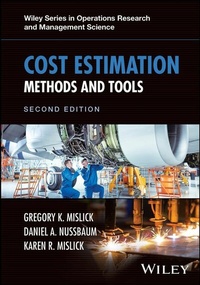
Cost Estimation
Description

Provides a practical guide to cost estimation tools, methods, and applications across complex projects
Cost estimation plays a pivotal role in informing investment and resource allocation decisions in government, industrial, and military projects. With increasingly complex systems, high-risk environments, and growing demands for accountability, the ability to develop accurate and justifiable cost models is critical. Cost Estimation: Methods and Tools is an essential, up-to-date introduction to the quantitative techniques that underpin effective cost analysis, ensuring readers gain both theoretical understanding and practical application skills.
This thoroughly revised second edition reflects the latest changes in regulations, directives, and reporting practices. It delivers clear, practical explanations of core cost estimation techniques, including regression analysis, inflation indices, learning curves, cost factors, and wrap rates. New coverage of Agile software methods highlights emerging practices and evolving needs across the field. The book equips readers to address the full spectrum of cost challenges-from research and development to production, deployment, operations and support, and finally disposal.
Combining methodological rigor and applied insight, the second edition of Cost Estimation:
- Explains fundamental cost estimation techniques through accessible, step-by-step examples
- Incorporates a "deeper dive" into data normalization and regression analysis
- Features numerous worked examples and end-of-chapter problem sets to reinforce comprehension
- Highlights the use of cost models in risk assessment and uncertainty analysis
- Introduces historical context and key terminology to build a solid foundation in cost estimation
- Includes updated examples that reflect real-world applications across both defense and industry sectors along with a real-world cost case study.
Written by experienced practitioners and educators, Cost Estimation: Methods and Tools, Second Edition is ideal for graduate students in Operations Research, Industrial Engineering, Systems Engineering, and Cost Estimation, particularly in courses such as Cost Estimating and Analysis or Engineering Economics. It is equally valuable as a reference for professional cost estimators, analysts, and decision makers working in government, defense, and industry.
More details
Other editions
Additional editions
Persons
GREGORY K. MISLICK is a Senior Lecturer in the Department of Operations Research at the Naval Postgraduate School (NPS), where he has taught since 2000. His expertise includes life cycle cost estimation, regression analysis, learning curves, data analysis, and optimization. He has advised numerous cost and aviation theses, was an Associate Dean at NPS and is the Program Manager of the Master's degree in Cost Estimating and Analysis curriculum.
DANIEL A. NUSSBAUM is a Professor in the Department of Operations Research at NPS and Chair of the Energy Academic Group. With four decades of experience in financial estimating and analysis for the U.S. Federal government, his research spans cost/benefit analysis, life cycle cost modeling, and financial modeling for strategic decision making.
KAREN R. MISLICK is a Senior Lecturer in the Department of Operations Research at NPS where she teaches cost estimating, scheduling, earned value management, Agile development, and data visualization and storytelling. She previously spent two decades at the Government Accountability Office, leading cost, schedule, and earned value analyses and over 250 audits across major federal programs. She is Level III certified in both cost estimating and financial management.
Content
Foreword xv
About the Authors xix
Preface xxi
Acronyms xxvii
CHAPTER 1 "Looking Back: Reflections on Cost Estimating" 1
CHAPTER 2 Introduction to Cost Estimating 13
CHAPTER 3 Non-DoW Acquisition and the Cost-Estimating Process 39
CHAPTER 4 Data Sources 71
CHAPTER 5 Data Normalization 95
CHAPTER 6 Statistics for Cost Estimators 131
CHAPTER 7 Single-Variable Linear Regression Analysis 149
CHAPTER 8 Multivariable Linear Regression Analysis 187
CHAPTER 9 Intrinsically Linear Regression 213
CHAPTER 10 Learning Curves: Unit Theory 231
CHAPTER 11 Learning Curves: Cumulative Average Theory 263
CHAPTER 12 Learning Curves: Production Breaks/Lost Learning 277
CHAPTER 13 Wrap Rates and Step-Down Functions 293
CHAPTER 14 Cost Factors and the Analogy Technique 305
CHAPTER 15 Software Cost Estimation 321
CHAPTER 16 Cost-Benefit Analysis and Risk and Uncertainty 337
CHAPTER 17 Epilogue 359
Index 1
Preface
How did this journey to write the textbook begin? After graduating from the US Naval Academy with a degree in Mathematics, I flew helicopters and served in the US Marine Corps for just under 26 years. I piloted the mighty CH-46E Sea Knight - known fondly as the "Battle Phrog" - during four overseas deployments. Along the way, I earned a master's degree in operations research (OR) from the Naval Postgraduate School (NPS) in Monterey, California. As a student, one of my favorite classes in the OR curriculum was in cost estimation because I was drawn to the usefulness and practicality of the subject: it was math with a purpose, focused on real-world decision-making. And the best part? I understood what the answers meant.
After graduation, I was assigned to the Marine Corps Research, Development and Acquisition Command (MCRDAC, now MARCORSYSCOM) in Quantico, Virginia, where I spent three years working in Program Support Analysis (PSA). There, I focused exclusively on cost estimation and test and evaluation. Those three years spent calculating costs, applying quantitative methods, and briefing senior leaders lit a lasting fire in me for this area of study.
I returned to the fleet and deployed a few more times over the next nine years before coming back to NPS in August 2000, this time as a military faculty member in the Operations Research Department. The cost estimation class I had taken as a student was now being taught by an active-duty Navy officer named Tim Anderson. Within a year, Tim retired from the Navy and the course was looking for a new instructor. Tim encouraged me to take over for him, and I willingly stepped up. I have been teaching it ever since, starting in 2001.
Each year, over 100 students take the course, either as resident students here in Monterey or through our distance learning class, including those in the Master of Cost Estimating and Analysis program. Over the years, I have continued to refine the material, shaped by student feedback, real-world application, and my own ongoing learning. This textbook is the result of those years of teaching, growing, and being passionate about a subject that sits at the intersection of analysis, policy, and decision-making.
While the cost estimation course had long been taught using detailed PowerPoint slides, many students asked for a textbook that offered more depth and detail to help fill in the occasional gaps. That interest sparked the idea for this book. Fortunately, publishers were eager to support the effort as there was very little information on cost estimating in the market! The primary goal of this book is to provide the tools a cost estimator needs to predict research and development, procurement, and operating and support costs or to estimate any element in a work breakdown structure across those acquisition phases.
While the original textbook took us about a year and a half to complete, many people contributed to it, either directly or indirectly. Anyone who has ever taught the cost estimation course here at NPS has played a role in shaping the slides that have been used over the years. The list of instructors includes Tim Anderson, Dan Boger, CDR Ron Brown (USN), CAPT Tom Hoivik (USN), CDR Steven E. Myers, (USN), and Mike Sovereign. Several others have also made significant contributions to the course materials, including Major Tom Tracht (USAF), Dr Steve Vandrew of DAU (later with NAVAIR), and the late Dr Steven Book of the Aerospace Corporation. Many thanks to all these individuals and our apologies if we have inadvertently missed anyone. Some examples in the textbook are drawn directly from the original slides, while most have been updated or expanded to better reflect today's context and applications.
Our goal when writing this textbook was to make it feel more like a "conversation" than a traditional textbook, as if we were in the same room together and talking to you about the topic. We hope we have achieved that! We have also aimed to make the material relevant not just to the Department of War (DoW) but to cost estimators and cost engineers across both government and commercial sectors, including internationally.
When I was a student, one of my pet peeves in the classroom was hearing an instructor say something like, "It's intuitively obvious from here that ." and then jumping from Step C to Step F, without explaining what happened in Steps D and E. Sure, it might be obvious if you have been in the field for 25 years(!), but for someone seeing the material for the first time, it's often anything but. Because of that experience, the quantitative chapters in this textbook include step-by-step calculations for nearly every example. If a step is not shown, it is only because a previous example has already walked through it in detail.
We also made a deliberate effort to steer clear of mathematical jargon - mostly avoiding phrases like "degrees of freedom" or calling something an "unbiased estimator of the variance." Instead, we explain concepts in plain English, using layman's terms that make more sense to first-time estimators. The book is organized as follows:
- Chapter 1: A historical perspective from Dr Daniel A. Nussbaum on three decades of cost estimation and the changes he has observed along the way.
- Chapter 2: Background information: An overview of what cost estimation is and why it matters, including the DoW acquisition process, program phases, acquisition categories, and key terminology used in the defense acquisition environment.
- Chapter 3: A look at the non-DoW acquisition process and the key terminology, processes, and methods used across the broader cost estimating field.
- Chapter 4: Once you are assigned a cost estimate, where do you find the data? This chapter covers key databases, websites and the major cost reports used in the field, as well as an introduction to Earned Value Management (EVM).
- Chapter 5: After you have gathered your data, how do you standardize it to make it relevant and usable? This chapter explains how to normalize for content, quantity, and inflation, with inflation adjustments being the most critical.
- Chapters 6-14: The "meat" of the book - covering the wide range of quantitative methods used in hardware cost estimation, including regression analysis, learning curves, cost factors, wrap rates, and the analogy technique.
- Chapter 15: An overview of software cost estimation, including its unique challenges, common methods, and key considerations.
- Chapter 16: A combined overview of Cost-Benefit Analysis (CBA), Net Present Value (NPV), and the significant role of risk and uncertainty in cost estimation.
- Chapter 17: A final summary that reinforces key concepts and ties together the major themes of the book.
The second edition came about because much has changed in the field of cost estimation since the original text was published in 2015. Over the past decade, we have seen the introduction of new terminology, updated monetary thresholds, redesigned or replaced data sources and websites, and continued evolution in DoW acquisition guidance. We have also gained 10 more years of experience - both in the classroom and in applying the mathematics of cost estimation in real-world settings. This new edition reflects those changes. It includes updated examples and figures, revised content to align with current standards and practices, and refreshed discussions to capture today's environment - while maintaining the same accessible, practical approach that defined the original.
There are many people I would like to thank for their help during the original textbook endeavor. First, my sincere thanks to Anne Ryan and Jae Marie Barnes for generously volunteering to review several chapters and offering thoughtful ideas, suggestions, and recommendations on what to keep and what to change. Thanks also to Kory Fierstine for keeping me updated on DoW policy and always being there to listen and help when questions arose, and to both Dr Sam Buttrey (our Jeopardy champion from NPS) and the late Dr Robert Koyak for their patient and insightful answers to my many statistical questions. Bob, you are greatly missed. I am also deeply grateful to the many students I have had over the years - your questions, ideas, and feedback have helped me learn just as much from you as I hope you've learned from me.
For this second edition, I am most indebted to my wife, Karen - a fellow cost estimator and coauthor - for her thoughtful editing and invaluable insights into what to keep, add, or revise from the first edition. I am also grateful for her patience and understanding during the many weekend hours devoted to this update. As you will read in the pages ahead, Karen is a highly accomplished cost estimator who previously served as an auditor with the Government Accountability Office (GAO). She was also the primary author of the widely used "GAO Cost Estimating and Assessment Guide," which is referenced literally around the world. I will save further accolades so that I do not steal her thunder as she deserves the spotlight in her own words! Needless to say, her ideas and fingerprints are all over this new edition.
On a familial note, I would like to thank my two sisters, Bobbi and Hope, for their love and encouragement over the years. I only wish my mom and dad were still here to read this book. While they might not have understood much about cost estimation, I know they would have been two of my biggest...
