

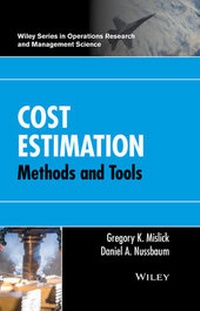
Cost Estimation
Description

Reviews / Votes
"This book is a manual of how to effectively internally manage a company, and maximise operational external efficiency of a contractor. On this basis it is essential reading for anyone in a decision-taking role, even if only a relatively minor role in bringing productions to market." (Chromatographia 2016)More details
Other editions
Additional editions
Persons
Content
Foreword xiii
About the Authors xvii
Preface xix
Acronyms xxiii
1 "Looking Back: Reflections on Cost Estimating" 1
Reference 10
2 Introduction to Cost Estimating 11
2.1 Introduction 11
2.2 What is Cost Estimating? 11
2.3 What Are the Characteristics of a Good Cost Estimate? 13
2.4 Importance of Cost Estimating in DoD and in Congress. Why Do We Do Cost Estimating? 14
2.4.1 Importance of Cost Estimating to Congress 16
2.5 An Overview of the DoD Acquisition Process 17
2.6 Acquisition Categories (ACATs) 23
2.7 Cost Estimating Terminology 24
Summary 30
References 31
Applications and Questions 31
3 Non-DoD Acquisition and the Cost Estimating Process 32
3.1 Introduction 32
3.2 Who Practices Cost Estimation? 32
3.3 The Government Accountability Office (GAO) and the 12-Step Process 33
3.4 Cost Estimating in Other Non-DoD Agencies and Organizations 38
3.4.1 The Intelligence Community (IC) 38
3.4.2 National Aeronautics and Space Administration (NASA) 38
3.4.3 The Federal Aviation Administration (FAA) 39
3.4.4 Commercial Firms 39
3.4.5 Cost Estimating Book of Knowledge (CEBOK) 40
3.4.6 Federally Funded Research and Development Centers (FFRDCs) 41
3.4.7 The Institute for Defense Analysis (IDA) 41
3.4.8 The Mitre Corporation 42
3.4.9 Rand Corporation 42
3.5 The Cost Estimating Process 43
3.6 Definition and Planning. Knowing the Purpose of the Estimate 43
3.6.1 Definition and Planning. Defining the System 47
3.6.2 Definition and Planning. Establishing the Ground Rules and Assumptions 48
3.6.3 Definition and Planning. Selecting the Estimating Approach 49
3.6.4 Definition and Planning. Putting the Team Together 51
3.7 Data Collection 52
3.8 Formulation of the Estimate 52
3.9 Review and Documentation 53
3.10 Work Breakdown Structure (WBS) 53
3.10.1 Program Work Breakdown Structure 53
3.10.2 Military-Standard (MIL-STD) 881C 56
3.11 Cost Element Structure (CES) 56
Summary 58
References 59
Applications and Questions 59
4 Data Sources 61
4.1 Introduction 61
4.2 Background and Considerations to Data Collection 61
4.2.1 Cost Data 63
4.2.2 Technical Data 63
4.2.3 Programmatic Data 64
4.2.4 Risk Data 64
4.3 Cost Reports and Earned Value Management (EVM) 65
4.3.1 Contractor Cost Data Reporting (CCDR) 65
4.3.2 Contract Performance Report (CPR) 66
4.3.3 EVM Example 70
4.4 Cost Databases 74
4.4.1 Defense Cost and Resource Center (DCARC) 75
4.4.2 Operating and Support Costs Databases 75
4.4.3 Defense Acquisition Management Information Retrieval (DAMIR) 76
Summary 76
Reference 77
Applications and Questions 77
5 Data Normalization 78
5.1 Introduction 78
5.2 Background to Data Normalization 78
5.3 Normalizing for Content 80
5.4 Normalizing for Quantity 81
5.5 Normalizing for Inflation 83
5.6 DoD Appropriations and Background 87
5.7 Constant Year Dollars (CY$) 88
5.8 Base Year Dollars (BY$) 90
5.9 DoD Inflation Indices 91
5.10 Then Year Dollars (TY$) 95
5.11 Using the Joint Inflation Calculator (JIC) 97
5.12 Expenditure (Outlay) Profile 99
Summary 103
References 103
Applications and Questions 103
6 Statistics for Cost Estimators 105
6.1 Introduction 105
6.2 Background to Statistics 105
6.3 Margin of Error 106
6.4 Taking a Sample 109
6.5 Measures of Central Tendency 110
6.6 Dispersion Statistics 113
6.7 Coefficient of Variation 117
Summary 119
References 119
General Reference 119
Applications and Questions 119
7 Linear Regression Analysis 121
7.1 Introduction 121
7.2 Home Buying Example 121
7.3 Regression Background and Nomenclature 126
7.4 Evaluating a Regression 132
7.5 Standard Error (SE) 133
7.6 Coefficient of Variation (CV) 134
7.7 Analysis of Variance (ANOVA) 135
7.8 Coefficient of Determination (R2) 137
7.9 F-Statistic and t-Statistics 138
7.10 Regression Hierarchy 140
7.11 Staying Within the Range of Your Data 142
7.12 Treatment of Outliers 143
7.12.1 Handling Outliers with Respect to X (The Independent Variable Data) 143
7.12.2 Handling Outliers with Respect to Y (The Dependent Variable Data) 144
7.13 Residual Analysis 146
7.14 Assumptions of Ordinary Least Squares (OLS) Regression 149
Summary 149
Reference 150
Applications and Questions 150
8 Multi-Variable Linear Regression Analysis 152
8.1 Introduction 152
8.2 Background of Multi-Variable Linear Regression 152
8.3 Home Prices 154
8.4 Multi-Collinearity (MC) 158
8.5 Detecting Multi-Collinearity (MC) Method #1: Widely Varying Regression Slope Coefficients 159
8.6 Detecting Multi-Collinearity Method #2: Correlation Matrix 160
8.7 Multi-Collinearity Example #1: Home Prices 161
8.8 Determining Statistical Relationships between Independent Variables 163
8.9 Multi-Collinearity Example #2: Weapon Systems 164
8.10 Conclusions of Multi-Collinearity 167
8.11 Multi-Variable Regression Guidelines 168
Summary 169
Applications and Questions 170
9 Intrinsically Linear Regression 172
9.1 Introduction 172
9.2 Background of Intrinsically Linear Regression 172
9.3 The Multiplicative Model 173
9.4 Data Transformation 174
9.5 Interpreting the Regression Results 178
Summary 178
Reference 179
Applications and Questions 179
10 Learning Curves: Unit Theory 180
10.1 Introduction 180
10.2 Learning Curve Scenario #1 180
10.3 Cumulative AverageTheory Overview 182
10.4 UnitTheory Overview 182
10.5 UnitTheory 185
10.6 Estimating Lot Costs 188
10.7 Fitting a Curve Using Lot Data 191
10.7.1 Lot Midpoint 192
10.7.2 Average Unit Cost (AUC) 194
10.8 UnitTheory Final Example (Example 10.5) 197
10.9 Alternative LMP and Lot Cost Calculations 200
Summary 202
References 202
Applications and Questions 202
11 Learning Curves: Cumulative Average Theory 204
11.1 Introduction 204
11.2 Background of Cumulative AverageTheory (CAT) 204
11.3 Cumulative AverageTheory 206
11.4 Estimating Lot Costs 210
11.5 Cumulative AverageTheory Final Example 210
11.6 UnitTheory vs. Cumulative AverageTheory 214
11.6.1 Learning Curve Selection 215
Summary 216
Applications and Questions 216
12 Learning Curves: Production Breaks/Lost Learning 218
12.1 Introduction 218
12.2 The Lost Learning Process 219
12.3 Production Break Scenario 219
12.4 The Anderlohr Method 220
12.5 Production Breaks Example 221
12.6 The Retrograde Method Example 12.1 (Part 2) 224
Summary 229
References 229
Applications and Questions 230
13 Wrap Rates and Step-Down Functions 231
13.1 Introduction 231
13.2 Wrap Rate Overview 231
13.3 Wrap Rate Components 232
13.3.1 Direct Labor Rate 233
13.3.2 Overhead Rate 233
13.3.3 Other Costs 234
13.4 Wrap Rate Final Example (Example 13.2) 235
13.5 Summary of Wrap Rates 236
13.6 Introduction to Step-Down Functions 236
13.7 Step-Down Function Theory 237
13.8 Step-Down Function Example 13.1 238
13.9 Summary of Step-Down Functions 240
Reference 240
Applications and Questions 240
14 Cost Factors and the Analogy Technique 242
14.1 Introduction 242
14.2 Cost Factors Scenario 242
14.3 Cost Factors 243
14.4 Which Factor to Use? 246
14.5 Cost Factors Handbooks 246
14.6 Unified Facilities Criteria (UFC) 247
14.7 Summary of Cost Factors 248
14.8 Introduction to the Analogy Technique 248
14.9 Background of Analogy 249
14.10 Methodology 250
14.11 Example 14.1 Part 1: The Historical WBS 250
14.12 Example 14.1 Part 2: The New WBS 253
14.13 Summary of the Analogy Technique 255
Reference 256
Applications and Questions 256
15 Software Cost Estimation 257
15.1 Introduction 257
15.2 Background on Software Cost Estimation 257
15.3 What is Software? 258
15.4 The WBS Elements in a typical Software Cost Estimating Task 259
15.5 Software Costing Characteristics and Concerns 260
15.6 Measuring Software Size: Source Lines of Code (SLOC) and Function Points (FP) 261
15.6.1 Source Lines of Code: (SLOC) 261
15.6.2 Function Point (FP) Analysis 263
15.7 The Software Cost Estimating Process 264
15.8 Problems with Software Cost Estimating: Cost Growth 265
15.9 Commercial Software Availability 267
15.9.1 COTS in the Software Environment 268
15.10 Post Development Software Maintenance Costs 268
Summary 269
References 269
16 Cost Benefit Analysis and Risk and Uncertainty 270
16.1 Introduction 270
16.2 Cost Benefit Analysis (CBA) and Net Present Value (NPV) Overview 270
16.3 Time Value of Money 273
16.4 Example 16.1. Net Present Value 277
16.5 Risk and Uncertainty Overview 281
16.6 Considerations for Handling Risk and Uncertainty 283
16.7 How do the Uncertainties Affect our Estimate? 284
16.8 Cumulative Cost and Monte Carlo Simulation 287
16.9 Suggested Resources on Risk and Uncertainty Analysis 289
Summary 290
References 290
Applications and Questions 290
17 Epilogue: The Field of Cost Estimating and Analysis 291
Answers to Questions 295
Index 309
Preface
How did this journey to write a textbook begin? After graduating from the US Naval Academy with a degree in Mathematics, I flew helicopters and served in the US Marine Corps for 26 years, piloting the mighty CH-46E Sea Knight (the "Battle Phrog") during four overseas deployments. Along the way I earned my primary Masters Degree in Operations Research from the Naval Postgraduate School. One of my favorite classes while there was in cost estimation, and in particular I liked the usefulness and practicality of the subject matter. After graduation, I was fortunately assigned to the Marine Corps Research, Development and Acquisition Command (MCRDAC, now MARCORSYSCOM) in Quantico, Virginia for three years in Program Support Analysis (PSA), where I exclusively concentrated on Cost Estimation and Test and Evaluation. Those three years calculating costs, utilizing numerous quantitative methods, briefing seniors on the analysis and results found, very much stoked the fire in me for this area of study. I returned to the fleet and flew and deployed a few more times over the next nine years, and then returned to NPS as a military faculty member in the Operations Research Department in August 2000. When I arrived, the cost estimation class was being taught by Tim Anderson. Within a year, Tim retired from the US Navy and the course was seeking a new instructor. I eagerly volunteered to teach the class and have been doing so since 2001. At this time, approximately 250 students take the class each year, either as a resident student or as a distance learning, non-resident student.
While the cost estimation course had been taught with very detailed PowerPoint slides for many years before Dr. Daniel A. Nussbaum and I arrived, numerous students requested a textbook because they wanted either more detail or some "gaps" filled in and thus the idea for this textbook was born. Fortunately, publishers were very interested because little information like this existed on the market! The primary goal of this book is to help provide the tools that a cost estimator needs to predict the research and development, procurement, and/or operating and support costs or for any elements in a work breakdown structure in those phases.
While this textbook took 1.5 years to complete, many people have helped to provide information for it, either directly or indirectly. Anyone who has ever taught the cost estimation class here at NPS has had a hand in developing the slides that have been used for many years. The list of instructors at NPS includes Tim Anderson, Dan Boger, CDR Ron Brown (USN), CAPT Tom Hoivik (USN), CDR Steven E. Myers, (USN), and Mike Sovereign. In addition, a few others who provided significantly to the slides include: Major Tom Tracht (USAF), Dr Steve Vandrew of DAU (now NAVAIR), and the late Dr. Steven Book of the Aerospace Corporation. Thanks to all of these individuals and our apologies in advance if we have missed anyone! A few of the examples in the textbook are exactly from the original slides, while most others have been revamped or upgraded to align with the times.
Our goal when writing this textbook was to make it sound more like a "conversation" than a textbook, as if we were in the same room together and we were speaking to you about the topic. We hope that we have achieved that goal! We have also tried to make this textbook applicable to both DoD and non-DoD entities and organizations, to their cost estimators, and to those involved in Cost Engineering.
When I was a student, a pet peeve of mine was when an instructor would say something like "It is intuitively obvious that ..." and would then proceed from Step A to
Step D without explaining what was happening in Steps B and C! Well, of course, it is intuitively obvious if you have been working in the field for twenty-five years! But for those of us who are reading about a subject for the first time and are just being introduced to the subject matter, maybe it is not so intuitively obvious. Consequently, in the quantitative chapters in this textbook, you will see calculations provided to almost every problem. If the calculations are not provided, it is only because a previous example already went through the same steps.
It was also our intent to try to stay away from really technical math terms like "degrees of freedom" and describing a term as an "unbiased estimator for the variance." Instead, our goal is to provide explanations in layman's terms in easy-to-understand language that "just makes sense." The book is organized as follows:
- Chapter 1: A historical perspective from Dr. Daniel A. Nussbaum on the past thirty years in cost estimation and changes he has observed along the way.
- Chapter 2: Background information on what cost estimation is and why it is important, the DoD acquisition process and the phases and acquisition categories of developmental programs and the key terminologies used in the acquisition environment.
- Chapter 3: The non-DoD acquisition process and the key terminologies, processes and methods used in the cost estimating field.
- Chapter 4: Once you are assigned a cost estimate, where do you get your data from? This chapter discusses many data bases, websites and the most significant cost reports used in cost estimating, as well as providing an introduction to Earned Value Management (EVM).
- Chapter 5: Once you have your data, how do you normalize it so you can accurately use it? You must normalize for content, quantity, and inflation, with normalizing for inflation being the most important of the three.
- Chapters 6-14: The "meat" of the book, involving the myriad quantitative methods utilized in the field of cost estimation, including regression analysis, learning curves, cost factors, wrap rates, and the analogy technique.
- Chapter 15: An overview of software cost estimation.
- Chapter 16: An overview of both Cost Benefit Analysis/Net Present Value, and Risk and Uncertainty.
- Chapter 17: Summary.
There are a number of people whom I would like to thank for their help in this textbook endeavor. First, I would like to thank Anne Ryan and Jae Marie Barnes for volunteering to review a number of the chapters in this text and offering ideas, suggestions, and recommendations on what to keep and what to change; Kory Fierstine for keeping me updated on DoD policy and always being there to listen and help when I had questions; Dr. Sam Buttrey for patient answers to my statistical questions; and I would like to thank many of my former students whom I have had in class along the way - your questions, suggestions, and ideas have helped me learn as much from you as I hope you learned from me. I would also like to thank my two sisters, Hope and Barbara, and my mom for their love and support over the years. I wish my dad were still alive to read the book. He may not have understood too much of this subject, but he still would have been one of my biggest supporters along the way!
I owe my biggest thanks to my co-author Dr. Daniel A. Nussbaum, for being such a great friend and mentor over the past ten years that we have worked together. Dan has never hesitated to answer a question, share his knowledge in any subject area that I perhaps needed help in, and provide sanity checks to ideas. We also started the Masters in Cost Estimating and Analysis (MCEA) degree program here at NPS in 2010. It has been a fun journey together.
Gregory K. Mislick
After completing a Ph.D. in theoretical mathematics and teaching mathematics to undergraduates, I was invited to attend a postdoctoral Fellowship in applied mathematics, and within one year I was tackling operations research projects for the US Army Concepts Analysis Agency (now Center for Army Analysis). A few years later, I transferred to the headquarters of US Army Europe, in Germany, in order to head a division called the Economic Analysis and Systems division. The issues facing a major command often required projections of the impact of budget cuts, cost estimates in the ever-changing multiple currency environment, and many other demands for cost estimation and analysis.
Shortly after returning to the US, I began working for the US Navy. Ever since, I have been specializing in cost estimation projects and problems inside the Department of Defense and outside the DoD with other US government agencies, other nations, and with private organizations. In 2004, I was invited to return to teaching at the Naval Postgraduate School, where, together with Greg Mislick and others, we developed the first dedicated Master's degree program in cost estimating and analysis.
It has been clear to me for many years that a textbook would be helpful to students who are learning this discipline, along with its underlying mathematical and analytical principles and methods. I was delighted to join Greg Mislick in developing this text and I appreciate the hard work he has put into it. He and I have also teamed up successfully, with others, to be awarded the prestigious Cost Analysis and Management Sciences Community Award presented by the Assistant Secretary of the Navy for Financial Management and Comptroller in 2010, and the 2014 Military Operations Research Society's Barchi prize, awarded to recognize the best paper given at their Symposium.
There are numerous professional heroes who provided me guidance and wisdom through the years and I would like to briefly recognize and thank them for all they have done while I have...
