

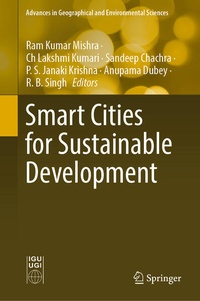
Smart Cities for Sustainable Development
1st Edition
Published on 25. May 2022
XV, 359 pages
978-981-16-7410-5 (ISBN)
Description

This book reviews the structure, applications, technologies, governance, environmental sustainability, smart communities, gender space and other issues related to smart cities. The book is divided into four parts. The first one entails the conceptual background, growth and development. The second part presents diverse issues on smart cities in terms of environmental sustainability, the role of the community, and gender space, among others. The third part revolves around economic and technological issues, and the fourth is a compilation of case studies in connection with smart cities. This collection of diverse issues from different locations presents a holistic view of smart cities contributed by authors who have undertaken research projects and implemented their own unique perspectives and methods. A variety of innovative concepts such as digital governance, polycentric structures, geodata repositories, geoweb services and advanced geospatial technologies in smart city planning, urbanmicroclimatic parameters, and urban heat islands provide invaluable knowledge for researchers and practitioners in these fields.
More details
Series
Language
English
Place of publication
Singapore
Singapore
Publishing group
Springer Singapore
Target group
Professional and scholarly
Product notice
Reflowable
Illustrations
XV, 359 p. 92 illus., 88 illus. in color.
File size
8,49 MB
ISBN-13
978-981-16-7410-5 (9789811674105)
DOI
10.1007/978-981-16-7410-5
Schweitzer Classification
Other editions
Additional editions
Ram Kumar Mishra | Ch Lakshmi Kumari | Sandeep Chachra
Smart Cities for Sustainable Development
Book
05/2022
Springer
€160.49
Shipment within 3-4 weeks
Persons
Ram Kumar Mishra is the Director of the Institute of Public Enterprise, Hyderabad. He has carried out research and taught at the London Business School; Fondation Maison des Sciences de l'Hommes, Paris; the University of Bradford, UK; and the UN Center on Promotional Enterprises, Ljubljana; as well as the University of Ljubljana, Slovenia. He is a member of the UN Task Force on Standards of Excellence for Public Administration Education and Training, and he is on the steering committees of several national and international bodies. Prof. Mishra has also been a researcher for planning commissions, finance commissions, the Economic Advisory Council to the Prime Minister, the Bureau of Public Enterprises, financial institutions and banks. He has published several books, journal articles and reports. Ch. Lakshmi Kumari is an Associate Professor in economics at the Institute of Public Enterprise, Hyderabad. She is also a Post -Doctoral Fellow funded by IndianCouncil of Social Science Research. She has been associated with the institute in various activities such as teaching, training, research and consultancy assignments. Dr. Kumari has worked on several projects for at the national and international levels and has published many books. Her areas of interest include economics, environmental impact analysis, sustainable development, public enterprises, privatisation strategies, restructuring and turnaround management issues, and financial performance analysis. She is currently coordinating the Centre on Sustainable Development at the institute. She is the recipient of the Best Teacher Award from the Government of Telangana for the year 2016-2017. Sandeep Chachra serves as the Executive Director of ActionAid Association and is a social anthropologist by training. As a human rights activist, he has been advancing rights, justice and development agendas for the last three decades in India as well asin other parts of Asia and Africa. He is the Managing Editor of a leading global political economy journal called Agrarian South and is one of founders of Agrarian South Network - a network serving the interests of peasants and workers, globally. Sandeep Chachra also Co-Chairs the World Urban Campaign of UN-HABITAT. P.S. Janaki Krishna is a Professor and Coordinator at the Centre for Sustainable Development, Institute of Public Enterprise, Hyderabad. She is a Gold Medalist from Andhra University and has research stints with Timiryajev Institute of Plant Physiology, Moscow, Russia, and an awardee of the Netherlands Fellowship Programme. She has vast experience in research, teaching, technology transfer, projects identification, monitoring, and evaluation. She is experienced in dealing with multi-stakeholder groups and organizations. She has handled a number of national and international projects and presented papers in various forums.She published a number of news reports in Information Systems for Biotechnology (ISB) News Report, published by Virginia Polytech and State University, USA, and is a Member of the "e-agriculture community" of the Food and Agriculture Organization (FAO) and Third World Organization of Women in Science (TWOWS). Dr. Janaki Krishna has authored books as well as several papers in national and international journals. Her areas of interest are science, technology and society, climate change, sustainable development, and its goals, and public-private partnerships.
Dr. Anupama Dubey is an assistant professor at the Institute of Public Enterprise. She is a post-graduate of Allahabad University and holds M.Phil, Ph.D. in the area of water conservation and management from the Delhi School of Economics, Delhi University. She is also a Post -Doctoral Fellow funded by Indian Council of Social Science Research. She has experience of more than eleven years in teaching, research and training. She has been on the faculty of Geography at undergraduate colleges of Delhi University and also has worked as a senior research analyst at the National Council of Educational Research and Training (NCERT, Delhi) on Sarva Shiksha Abhiyan (Project of the Ministry of Human Resource Development). She has wide experience in heading and contributing to various research and consultancy projects funded by the Indian Council of Social Science Research (ICSSR, India); the University Grant Commission (UGC); the Indian Institute of Management, Bangalore (IIMB); the National Bank for Agriculture and Rural Development (NABARD, India); the International Developmental Research Centre (IDRC, Canada); the World Health Organisation; and the University of North Carolina (USA). Her papers have been published and presented in national and international journals and conferences. She has chaired national and international conferences and organized national and international level conferences and workshops. She authored two books published by Academic Foundation in 2019 and an edited book published by Springer in 2021.
R. B. Singh was a professor and head of geography, Delhi School of Economics, University of Delhi. He is the first Indian and second Asian to be elected secretary-general and treasurer of the International Geographical Union. At present he is chair of the Research Council for Scientific and Industrial Research (CSIR)-Central Food Technological Research Institute (CFTRI), Government of India. He is also a member of the International Science Council (ISC) Scientific Committee, elected president of the Earth System Science Section of the Indian Science Congress Association (ISCA). Earlier, he was awarded a Japan Society for the Promotion of Science Research (JSPS) Fellowship and has visited more than 45 countries. He is credited with 15 books, 39 edited volumes, and more than 245 research papers in journals. He has supervised 38 Ph.D. and 81 M.Phil. students. UNESCO/ISSC (Paris) awarded him the Research and Study Grants Award in Social and Human Sciences. He was also awarded a prestigious Japan Society for Promotion of Science (JSPS) Research Fellowship at Hiroshima in 2013 and several travel fellowships, and he has received other forms of support from the United Nations Environment Programme (UNEP), the United Nations Institute for Training and Research (UNITAR), and the United Nations International Strategy for Disaster Reduction (UNISDR), among others.
Dr. Anupama Dubey is an assistant professor at the Institute of Public Enterprise. She is a post-graduate of Allahabad University and holds M.Phil, Ph.D. in the area of water conservation and management from the Delhi School of Economics, Delhi University. She is also a Post -Doctoral Fellow funded by Indian Council of Social Science Research. She has experience of more than eleven years in teaching, research and training. She has been on the faculty of Geography at undergraduate colleges of Delhi University and also has worked as a senior research analyst at the National Council of Educational Research and Training (NCERT, Delhi) on Sarva Shiksha Abhiyan (Project of the Ministry of Human Resource Development). She has wide experience in heading and contributing to various research and consultancy projects funded by the Indian Council of Social Science Research (ICSSR, India); the University Grant Commission (UGC); the Indian Institute of Management, Bangalore (IIMB); the National Bank for Agriculture and Rural Development (NABARD, India); the International Developmental Research Centre (IDRC, Canada); the World Health Organisation; and the University of North Carolina (USA). Her papers have been published and presented in national and international journals and conferences. She has chaired national and international conferences and organized national and international level conferences and workshops. She authored two books published by Academic Foundation in 2019 and an edited book published by Springer in 2021.
R. B. Singh was a professor and head of geography, Delhi School of Economics, University of Delhi. He is the first Indian and second Asian to be elected secretary-general and treasurer of the International Geographical Union. At present he is chair of the Research Council for Scientific and Industrial Research (CSIR)-Central Food Technological Research Institute (CFTRI), Government of India. He is also a member of the International Science Council (ISC) Scientific Committee, elected president of the Earth System Science Section of the Indian Science Congress Association (ISCA). Earlier, he was awarded a Japan Society for the Promotion of Science Research (JSPS) Fellowship and has visited more than 45 countries. He is credited with 15 books, 39 edited volumes, and more than 245 research papers in journals. He has supervised 38 Ph.D. and 81 M.Phil. students. UNESCO/ISSC (Paris) awarded him the Research and Study Grants Award in Social and Human Sciences. He was also awarded a prestigious Japan Society for Promotion of Science (JSPS) Research Fellowship at Hiroshima in 2013 and several travel fellowships, and he has received other forms of support from the United Nations Environment Programme (UNEP), the United Nations Institute for Training and Research (UNITAR), and the United Nations International Strategy for Disaster Reduction (UNISDR), among others.
Content
Smart Cities for Sustainable Development : An Introduction.- Monocentric City Plans to Polycentric Structures.- Intelligent Communities - Towards a New Ontology of Practice.- Digital Governance for Smart City and Future Community Construction: From Concept to Application.- Smart cities or Smart People: The Role of Stakeholders to Achieve Integrative Vision.- Smart City Initiatives in Japan: Their Achievements and Remaining Issues.- Smart Cities and Urban Deprived Communities: A Reflection on the Need to Re-think.- Environmental Sustainability of Smart Cities: Cues from Ebenezer Howard's Garden City Movement.- Linking Sustainability of Smart Cities to Education and Health: A Study in Smart City Mission, India.- Celebration of Public Festivals Towards Sustainable Development: A Perceptual Study.- Gendered Spaces: A Spatial Perspective of Women's Fear of Violence and Smart Cities Rhetoric.- Crowdsourcing for Sustainable Smart Cities and their ICT Practices.- Online Geodata Repositories, Geoweb Services and Emerging Geospatial Technologies in Smart City Planning.- Assessment of Urban Microclimatic Parameters in Various Urban Landscape Settings using Computational Fluid Dynamics (CFD).- Foreign Investment in Energy - Mix: An Assessment of Sustainable Indian Cities.- Understanding Economic Activities of Smart and Amrut Cities of Telangana State.- Urban Heat Island (UHI) Assessment using the Satellite Data: A Case Study of Varanasi city, India.- SWOT Analysis to Determine the Feasibility for Guwahati Smart City in North East India.- Smart City Surat: A Case Study for Urban Health System and Climate Resilience.- Industrial Pollution and Soil Quality: A Case Study from Industrial Area, Visakhapatnam, Andhra Pradesh, India.- Analyzing Urban Extension and Land Use Changes in Kalimpong Municipality, West Bengal Using Remote Sensing and GIS.- A Comparative Analysis of Emerging Water Consumption Pattern in Indian Smart Cities.
