

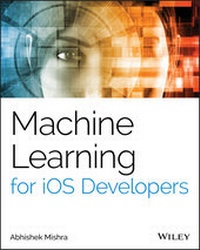
Machine Learning for iOS Developers
Description

Machine earning (ML) is the science of getting computers to act without being explicitly programmed. A branch of Artificial Intelligence (AI), machine learning techniques offer ways to identify trends, forecast behavior, and make recommendations. The Apple iOS Software Development Kit (SDK) allows developers to integrate ML services, such as speech recognition and language translation, into mobile devices, most of which can be used in multi-cloud settings. Focusing on Apple's ML services, Machine Learning for iOS Developers is an up-to-date introduction to the field, instructing readers to implement machine learning in iOS applications.
Assuming no prior experience with machine learning, this reader-friendly guide offers expert instruction and practical examples of ML integration in iOS. Organized into two sections, the book's clearly-written chapters first cover fundamental ML concepts, the different types of ML systems, their practical uses, and the potential challenges of ML solutions. The second section teaches readers to use models--both pre-trained and user-built--with Apple's CoreML framework. Source code examples are provided for readers to download and use in their own projects. This book helps readers:
* Understand the theoretical concepts and practical applications of machine learning used in predictive data analytics
* Build, deploy, and maintain ML systems for tasks such as model validation, optimization, scalability, and real-time streaming
* Develop skills in data acquisition and modeling, classification, and regression.
* Compare traditional vs. ML approaches, and machine learning on handsets vs. machine learning as a service (MLaaS)
* Implement decision tree based models, an instance-based machine learning system, and integrate Scikit-learn & Keras models with CoreML
Machine Learning for iOS Developers is a must-have resource software engineers and mobile solutions architects wishing to learn ML concepts and implement machine learning on iOS Apps.
More details
Other editions
Additional editions
Person
Content
Chapter 1
Introduction to Machine Learning
WHAT'S IN THIS CHAPTER
- Introduction to the basics of machine learning
- Tools commonly used by data scientists
- Applications of machine learning
- Types of machine learning systems
Hello, and welcome to the exciting world of machine learning. If you have never heard of machine learning until now, you may be tempted to think that it is a recent innovation in computer science that will result in sentient computer programs, significantly more intelligent than humans that will one day make humans obsolete. Fortunately, there is very little truth in that idea of machine learning. For starters, it is not a recent development; computer scientists have been researching for decades ways to make computers more intelligent by attempting to find ways to teach computers to make generalizations and predictions much like humans do. However, intelligence is not just about recognizing things, and even the best machine learning systems today are not capable of reasoning like human beings. The machine learning systems that exist today are essentially pattern recognizers and can, for instance, examine a picture and detect a cup of tea close to the edge of a table. They cannot, however, reason that the cup could accidentally fall off the table, as it is too close to the edge.
Machine learning specifically deals with the problem of creating computer programs that can generalize and predict information reliably, quickly, and with accuracy resembling what a human would do with similar information. Machine learning algorithms require a lot of processing and storage space and until recently were only possible to deploy in large companies or in academic institutions. Recent advances in storage, processor, and GPU technology have provided the processing power required to build and deploy machine learning systems at scale and get results in real time.
In the past, lack of quality data was also a factor that prevented widespread adoption of machine learning. With the advent of social media and analytics applications, developers have access to lot more data about their customers than they did in the past.
Another factor that has contributed to the recent increase in machine learning applications is the availability of excellent tools and frameworks such as Core ML, Create ML, Pandas, Matplotlib, TensorFlow, Scikit-learn, PyTorch, and Jupyter Notebooks, which have made it possible for newcomers to start building real-world machine learning applications without having to delve into the complex underlying mathematical concepts. In this chapter, you will learn about what machine learning is, how machine learning systems are classified, and examples of real-world applications of machine learning.
What Is Machine Learning?
Machine learning is a discipline within artificial intelligence that deals with creating algorithms that learn from data. Machine learning traces its roots to a computer program created in 1959 by a computer scientist Arthur Samuel while working for IBM. Samuel's program could play a game of checkers and was based on assigning each position on the board a score that indicated the likelihood of leading toward winning the game. The positional scores were refined by having the program play against itself, and with each iteration, the performance of the program improved. The program was in effect learning from experience, and the field of machine learning was born.
A machine learning system can be described as a set of algorithms based on mathematical principles that can mine data to find patterns in the data and then make predictions on new data as it is encountered. Rule-based systems can also make predictions on new data; however, rule-based systems and machine learning systems are not the same. A rule-based system requires a human to find patterns in the data and define a set of rules that can be applied by the algorithm. The rules are typically a series of if-then-else statements that are executed in a specific sequence. A machine learning system, on the other hand, discovers its own patterns and can continue to learn with each new prediction on unseen data.
Tools Commonly Used by Data Scientists
As an iOS developer, Core ML is likely to be your framework of choice when it comes to deploying a machine learning model in your app. Training a machine learning model, on the other hand, involves several steps and, except for the simplest of cases, is performed offline and using a different set of tools. Apple provides a number of tools to train Core ML models and convert pre-trained models built using other frameworks such as Scikit-learn and Keras to the Core ML format. The reason you may want to use a non-Apple framework like Scikit-learn or Keras to train a model is because the library may provide an implementation of a model that is not possible to train using Apple's toolset or may simply be updated more frequently.
Depending on the type of model you are trying to build, there may be a lot of steps involved even before you get to the point when you can start training-such as data preprocessing, feature engineering, and data visualization. Data scientists frequently use a set of tools to assist them with these steps. In this section, you will learn about some of the tools commonly used by data scientists to build machine learning solutions.
Although R has historically been the language of choice for statisticians, most data scientists and machine learning engineers today work in Python. The popularity of Python in the machine learning space is due to the abundance of machine learning-specific libraries that assist with all steps of the machine learning process from preparing data, feature engineering, information visualization, to training models with the latest algorithms. Where Python code is presented, this book will use Python 3.6.5. The following are the most popular Python machine learning tools:
- Jupyter Notebook: This is a popular web-based interactive development environment for data science projects. A notebook combines code, execution results, and visualization results all in a single document. Jupyter Notebook is a successor to an older project called IPython Notebook. You can find out more about Jupyter Notebooks at
http://jupyter.org. Appendix A contains instructions on installing Anaconda Navigator and setting up Jupyter Notebooks on your own computer. - Anaconda Navigator: This is a commonly used package manager for data scientists. It allows users to conveniently install and manage Python libraries and quickly switch between different sets of libraries and Python versions. It also includes popular tools such as Jupyter Notebooks and Spyder Python IDE. You can find more information on Anaconda at
https://www.anaconda.com. - Scikit-learn: This is a Python library that provides implementations of several machine learning algorithms for classification, regression, and clustering applications. It also provides powerful data preprocessing and dimensionality reduction capabilities. You can find more information on Scikit-learn at
https://www.scikit-learn.org. - NumPy: This is a Python library that is commonly used for scientific computing applications. It contains several useful operations such as random number generation and Fourier transforms. The most popular NumPy features for data scientists are N-dimensional data arrays (known as ndarrays) and functions that manipulate these arrays. NumPy ndarrays allow you to perform vector and matrix operations on arrays, which is significantly faster than using loops to perform element-wise mathematical operations. You can find more information on NumPy at
https://www.numpy.org. - Pandas: This is a Python library that provides a number of tools for data analysis. Pandas builds upon the NumPy ndarray and provides two objects that are frequently used by data scientists-the series and the dataframe. You can find more information on Pandas at
https://pandas.pydata.org. - Matplotlib: This is a popular 2D plotting library. It is used by data scientists for data visualization tasks. You can find more information on Matplotlib at
https://matplotlib.org. - Pillow: This is a library that provides a variety of functions to load, save, and manipulate digital images. It is used when the machine learning system needs to work with images. You can find more information on Pillow at
https://python-pillow.org. - Google TensorFlow: This is a Python library for numerical computation. It was developed by Google and eventually released as an open source project in 2015. Google TensorFlow is commonly used to build deep learning systems. It uses a unique computation graph-based approach and requires users to build a computation graph where each node in the graph represents a mathematical operation and the connections between the nodes represent data (tensors). You can find out more information on TensorFlow at
https://www.tensorflow.org. - Keras: This is another popular Python library for training and using deep learning networks. It was designed to facilitate rapid experimentation with neural networks and acts like a higher-level abstraction to popular deep learning frameworks like Google TensorFlow. As of TensorFlow 2.0, Keras is included with TensorFlow.
