

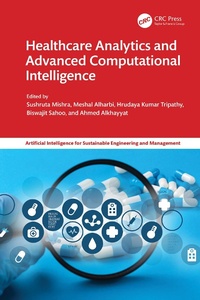
Healthcare Analytics and Advanced Computational Intelligence
1st Edition
Published on 31. July 2024
236 pages
978-1-040-04989-1 (ISBN)
Description

This book aims to apply state-of-the-art advanced computational intelligence frameworks in healthcare. It presents recent and real-life applications of computationally intelligent healthcare. It also discusses problems and solutions to remote healthcare and emergency healthcare services. Healthcare Analytics and Advanced Computational Intelligence highlights modern ambient intelligence-enabled healthcare models along with advanced topics like quantum computing in healthcare and cryptomedical systems.
Healthcare Analytics and Advanced Computational Intelligence examines designing the latest medical systems and models that will allow the societal acceptance of ambiance computing in healthcare, medical imaging, health analytics, machine intelligence, sensory computing, medical data analytics, disease detection, telemedicine, and their applications. It includes diverse case studies dealing with various clinical-based applications. These intelligent models are primarily structured to deal with complex real-world issues in clinical data analytics, by means of state-of-the-art techniques with general implementation, domain-specific solutions, or hybrid methods which integrate computational intelligence with conventional statistical methods.
The book is written for researchers and academicians in diverse areas. Engineers from technical disciplines such as computer engineering are likely to purchase the book. Various sub-streams such as machine learning, big data analytics, healthcare analytics, and computational intelligence will find the book significant for their curriculum.
Healthcare Analytics and Advanced Computational Intelligence examines designing the latest medical systems and models that will allow the societal acceptance of ambiance computing in healthcare, medical imaging, health analytics, machine intelligence, sensory computing, medical data analytics, disease detection, telemedicine, and their applications. It includes diverse case studies dealing with various clinical-based applications. These intelligent models are primarily structured to deal with complex real-world issues in clinical data analytics, by means of state-of-the-art techniques with general implementation, domain-specific solutions, or hybrid methods which integrate computational intelligence with conventional statistical methods.
The book is written for researchers and academicians in diverse areas. Engineers from technical disciplines such as computer engineering are likely to purchase the book. Various sub-streams such as machine learning, big data analytics, healthcare analytics, and computational intelligence will find the book significant for their curriculum.
More details
Series
Edition
1. Auflage
Language
English
Place of publication
London
United Kingdom
Publishing group
Taylor & Francis Ltd
Target group
Professional and scholarly
Illustrations
10 Tables, black and white; 71 Line drawings, black and white; 5 Halftones, black and white; 76 Illustrations, black and white
ISBN-13
978-1-040-04989-1 (9781040049891)
Copyright in bibliographic data and cover images is held by Nielsen Book Services Limited or by the publishers or by their respective licensors: all rights reserved.
Schweitzer Classification
Other editions
Additional editions
Sushruta Mishra | Meshal Alharbi | Hrudaya Kumar Tripathy
Healthcare Analytics and Advanced Computational Intelligence
Book
05/2026
1st Edition
CRC Press
€66.00
Shipment within 10-20 days
Sushruta Mishra | Meshal Alharbi | Hrudaya Kumar Tripathy
Healthcare Analytics and Advanced Computational Intelligence
Book
07/2024
1st Edition
CRC Press
€176.00
Shipment within 10-20 days
Persons
Sushruta Mishra is working as an Assistant Professor in the School of Computer Engineering, KIIT University, Bhubaneswar, Odisha, India. He pursued his MTech from IIIT, Bhubaneswar, Odisha, India, and has completed his PhD in Computer Science from KIIT University, India. Dr Mishra has more than 11 years of teaching experience in various educational institutions. He has handled many subjects such as Computer Networks, Data Mining, the Internet of Things, Software Engineering, and Machine Learning, among others, during his academic experience. He has a research experience of around ten years, and his research interest includes Image Processing, Machine Learning, the Internet of Things, and Cognitive Computing. He has published more than 150 research articles in reputed indexed international journals, edited books, and conferences.
Meshal Alharbi is an Assistant Professor of Artificial Intelligence in the Department of Computer Science at Prince Sattam Bin Abdulaziz University in the Kingdom of Saudi Arabia. He received PhD degree in Computer Science from Durham University, UK, in 2020, and an MSc degree in Computer Science from Wayne State University, USA, in 2014. He has ten years of experience in teaching/research/industry. His research interests lie in Artificial Intelligence Applications and Algorithms, Agent-Based Modelling and Simulation Applications, Disaster/Emergency Management and Resilience, Optimization Applications, and Machine Learning.
Hrudaya Kumar Tripathy is working as an Associate Professor in the School of Computer Engineering, KIIT University, Bhubaneswar, Odisha, India. Dr Tripathy is from Odisha and is an Indian by birth. He has received his PhD degree in Computer Science from Berhampur University, Berhampur, Odisha, India, in Computer Science in 2010. He completed his post-doctoral research at Utara Universiti, Malaysia, in 2016. He has an academic experience of around 20 years. He has handled various subjects like Software Engineering, Machine Learning, Business Intelligence, etc. His research interests include Neural Networks, Pattern Recognition, Software Engineering, Machine Learning, and Big Data. He has published several research papers in various journals and conferences. He has sound knowledge in the domain of autism spectrum disorder (ASD) analysis. He was involved in aggregating data records from many regional autistic centers. He has participated in few seminars and talks in autistic centers and NGOs related to the risks and disorders associated with autism. He has published three research papers in Scopus indexed publications. He also successfully led a project on behavioral analysis of autistic students at KIIT University.
Biswajit Sahoo is Director General and Professor at the School of Computer Engineering, Kalinga Institute of Industrial Technology, Deemed to be University, Bhubaneswar, Odisha, India. Graduated from NIT, Durgapur, West Bengal, with a Bachelor of Engineering in Electronics & Communication Engineering, he earned a Master of Engineering in Computer Science & Engineering from IIEST Sibpur, West Bengal. Having successfully completed his doctorate, Dr Sahoo holds PhD degree from the Utkal University, Bhubaneswar, Odisha. With a three-year of industrial experience as a Chip Level Maintenance Engineer at Bells Control, Calcutta, he has expert knowledge of telecom equipment and computers. Moreover, Dr Sahoo has 25 years of experience in teaching both UG and PG courses at different colleges and universities in Odisha. The research work of Dr Sahoo has been published in more than 30 national and international journals and conferences in repute. His research interests include Algorithms, Bioinformatics, and Parallel Computing.
Ahmed Alkhayyat received BSc degree in Electrical Engineering from Al Kufa University, Najaf, Iraq, in 2007, MSc degree from the Dehradun Institute of Technology, Dehradun, India, in 2010, and the PhD degree from Cankaya University, Ankara, Turkey, in 2015. He is currently the Dean of International Relationship and the Manager for the world ranking with The Islamic University, Najaf. His research interests include the IoT in Healthcare Systems, Software-Defined Networking (SDN), Network Coding, Cognitive Radio, Efficient-Energy Routing Algorithms and Efficient-Energy Media Access Control (MAC) Protocol in Cooperative Wireless Networks, Wireless Body Area Networks, and Cross-Layer Designing for Self-Organized Networks. He contributed to organizing several IEEE conferences, workshops, and special sessions. To serve the community, he acted as a reviewer for several journals and conferences.
Meshal Alharbi is an Assistant Professor of Artificial Intelligence in the Department of Computer Science at Prince Sattam Bin Abdulaziz University in the Kingdom of Saudi Arabia. He received PhD degree in Computer Science from Durham University, UK, in 2020, and an MSc degree in Computer Science from Wayne State University, USA, in 2014. He has ten years of experience in teaching/research/industry. His research interests lie in Artificial Intelligence Applications and Algorithms, Agent-Based Modelling and Simulation Applications, Disaster/Emergency Management and Resilience, Optimization Applications, and Machine Learning.
Hrudaya Kumar Tripathy is working as an Associate Professor in the School of Computer Engineering, KIIT University, Bhubaneswar, Odisha, India. Dr Tripathy is from Odisha and is an Indian by birth. He has received his PhD degree in Computer Science from Berhampur University, Berhampur, Odisha, India, in Computer Science in 2010. He completed his post-doctoral research at Utara Universiti, Malaysia, in 2016. He has an academic experience of around 20 years. He has handled various subjects like Software Engineering, Machine Learning, Business Intelligence, etc. His research interests include Neural Networks, Pattern Recognition, Software Engineering, Machine Learning, and Big Data. He has published several research papers in various journals and conferences. He has sound knowledge in the domain of autism spectrum disorder (ASD) analysis. He was involved in aggregating data records from many regional autistic centers. He has participated in few seminars and talks in autistic centers and NGOs related to the risks and disorders associated with autism. He has published three research papers in Scopus indexed publications. He also successfully led a project on behavioral analysis of autistic students at KIIT University.
Biswajit Sahoo is Director General and Professor at the School of Computer Engineering, Kalinga Institute of Industrial Technology, Deemed to be University, Bhubaneswar, Odisha, India. Graduated from NIT, Durgapur, West Bengal, with a Bachelor of Engineering in Electronics & Communication Engineering, he earned a Master of Engineering in Computer Science & Engineering from IIEST Sibpur, West Bengal. Having successfully completed his doctorate, Dr Sahoo holds PhD degree from the Utkal University, Bhubaneswar, Odisha. With a three-year of industrial experience as a Chip Level Maintenance Engineer at Bells Control, Calcutta, he has expert knowledge of telecom equipment and computers. Moreover, Dr Sahoo has 25 years of experience in teaching both UG and PG courses at different colleges and universities in Odisha. The research work of Dr Sahoo has been published in more than 30 national and international journals and conferences in repute. His research interests include Algorithms, Bioinformatics, and Parallel Computing.
Ahmed Alkhayyat received BSc degree in Electrical Engineering from Al Kufa University, Najaf, Iraq, in 2007, MSc degree from the Dehradun Institute of Technology, Dehradun, India, in 2010, and the PhD degree from Cankaya University, Ankara, Turkey, in 2015. He is currently the Dean of International Relationship and the Manager for the world ranking with The Islamic University, Najaf. His research interests include the IoT in Healthcare Systems, Software-Defined Networking (SDN), Network Coding, Cognitive Radio, Efficient-Energy Routing Algorithms and Efficient-Energy Media Access Control (MAC) Protocol in Cooperative Wireless Networks, Wireless Body Area Networks, and Cross-Layer Designing for Self-Organized Networks. He contributed to organizing several IEEE conferences, workshops, and special sessions. To serve the community, he acted as a reviewer for several journals and conferences.
Content
Chapter 1: Human-Computer Interaction and Healthcare: A Deep Insight. Chapter 2: Deep Dive into Cognitive Assisted Ambient Intelligent System for Quality Healthcare. Chapter 3: Emergence of Telemedicine Applications using Machine Learning. Chapter 4: Prospective of Internet of Medical Things in Revolutionizing Connected Healthcare. Chapter 5: A Comparison Analysis of Cryptographic Methods in Sustainable Healthcare. Chapter 6: Integration of Quantum Computing in Healthcare Using Machine learning models. Chapter 7: Enhancing Communication by using Sign Language Recognition. Chapter 8: Intelligent Ambulance Services Management: A Comprehensive Medical Service for Emergency Healthcare. Chapter 9: A Comparative Study of Machine Learning and Deep Learning Methods for Detecting Thyroid Disease: An Experimental Investigation. Chapter 10: Sensory Smart Pills for Precision Drug Delivery. Chapter 11: Smart and Assertable Approach for Brain Tumor Detection. Chapter 12: Cardiac Disease Risks Pattern Recognition using Advanced Predictive Analytics. Chapter 13: Design of a Novel Medical Chatbot to Simulate User Interactions. Chapter 14: Significance of Vehicular Ad Hoc Networks (VANETs) in Smart Healthcare: Research Challenges and Case Studies
