

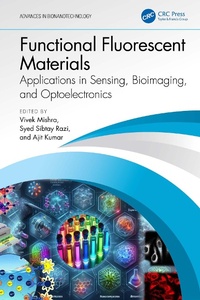
Functional Fluorescent Materials
Applications in Sensing, Bioimaging, and Optoelectronics
1st Edition
Published on 17. June 2024
346 pages
978-1-040-03677-8 (ISBN)
Description

Functional Fluorescent Materials: Applications in Sensing, Bioimaging, and Optoelectronics explains functional molecular probes (organic/inorganic materials, polymers, nanomaterials), with a focus on those that represent spectroscopic properties with detection of different analytes and specific roles in molecular recognition and their applications. It broadly covers molecular recognition to applications of fluorescence reporters, starting from optoelectronic properties of materials, detection of heavy metals, through biological macromolecules, and further to a living cell, tissue imaging, and theranostics.
Features:
* Covers different aspects of fluorescence spectroscopy ranging from chemical, physical, and biological aspects along with optoelectronic properties, mechanisms, and applications.
* Describes all types of chemical and functionalized fluorescent nanomaterials.
* Provides additional information on different kinds of fluorescence reporters.
* Explains the concept of fluorescence spectroscopy and its role in human health care.
* Discusses changes in static and dynamic properties of fluorescent probes and molecular recognitions.
This book is aimed at graduate students and researchers in materials, chemical engineering, and engineering physics.
Features:
* Covers different aspects of fluorescence spectroscopy ranging from chemical, physical, and biological aspects along with optoelectronic properties, mechanisms, and applications.
* Describes all types of chemical and functionalized fluorescent nanomaterials.
* Provides additional information on different kinds of fluorescence reporters.
* Explains the concept of fluorescence spectroscopy and its role in human health care.
* Discusses changes in static and dynamic properties of fluorescent probes and molecular recognitions.
This book is aimed at graduate students and researchers in materials, chemical engineering, and engineering physics.
More details
Series
Edition
1. Auflage
Language
English
Place of publication
London
United Kingdom
Publishing group
Taylor & Francis Ltd
Target group
College/higher education
Illustrations
11 Tables, black and white; 119 Line drawings, black and white; 13 Halftones, black and white; 132 Illustrations, black and white
ISBN-13
978-1-040-03677-8 (9781040036778)
Copyright in bibliographic data and cover images is held by Nielsen Book Services Limited or by the publishers or by their respective licensors: all rights reserved.
Schweitzer Classification
Other editions
Additional editions
Vivek Mishra | Syed Sibtay Razi | Ajit Kumar
Functional Fluorescent Materials
Applications in Sensing, Bioimaging, and Optoelectronics
Book
12/2025
1st Edition
CRC Press
€88.20
Shipment within 10-20 days
Vivek Mishra | Syed Sibtay Razi | Ajit Kumar
Functional Fluorescent Materials
Applications in Sensing, Bioimaging, and Optoelectronics
Book
06/2024
1st Edition
CRC Press
€205.00
Shipment within 10-20 days
Persons
Vivek Mishra is currently working as an Assistant Professor (grade III) in the Amity Institute of Click Chemistry Research and Studies (AICCRS) under the umbrella of Amity University Noida Campus. Before this, he joined the Department of Chemistry as a DST SERB-National Post-Doctoral Fellow in July 2017 from the Science and Engineering Research Board, New Delhi, Government of India. Dr. Mishra has completed his Ph.D. in Chemistry at the Institute of Science-Banaras Hindu University (BHU) in 2012. After that, he was offered three postdoctoral fellowships: one from the Indian Institute of Technology (IIT) Indore, MP, India and the other two are from South Korea. He was a postdoctoral research associate under the Brain Korea-21 programme at the University of Ulsan, Ulsan, South Korea and a Specialist (PDF) at the Korea Institute of Industrial Technology, Cheonan-si, South Korea for 2 years. Dr. Mishra research is mainly focused on synthesis and characterization of polymers with selected functionality, composition, and molecular architecture. His research focuses on drug delivery, hydrogel and nanogel synthesis, stimuli-responsive polymers, magnetic nanoparticles for water remediation, catalysis, dye removal and degradation, and biowaste/plastic waste utilization for the fruitful by-products. He has published 52 papers in international journals of high repute with an H index of 20 and an i-10 index of 25, and also presented a dozens of papers in national and international symposia/conferences.
Syed Sibtay Razi has been an Assistant Professor since 2017 in the Department of Chemistry, Gaya College Gaya, Magadh University Bodhgaya, Bihar, India. His main research interests are the design and synthesis of organic triplet sensitizers, focused on the intersystem crossing (ISC) and triplet excited state, photophysics and photochemistry of organic compounds, and application as triplet-triplet annihilation. The research in the group is based on synthetic chemistry, steady-state and time-resolved transient optical spectroscopy, theoretical computations, fluorescent materials, and biological applications. Electron transfer, energy transfer, photodynamic therapy, and photogenetics of organic compounds are the main research in the group. Dr. Syed Sibtay Razi earned his Bachelor's, Master's, and Ph.D. degrees in Chemistry at Banaras Hindu University, Varanasi. He has been awarded Ph.D. degree from Banaras Hindu University in the year 2015. The topic of his research work was "Synthesis, Photophysical Behaviour and Application of Some Organic Scaffolds." During his research work, he has synthesized various molecular organic scaffolds based on anthracene, naphthalene, benzothiazole, benzimidazole, azo dye, coumarin, and pyrene systems. He studied meticulously the photophysical behaviour of these molecules in different medium and utilized some of these molecules as chemosensors in the recognition of hazardous and biologically important ions as well as biomolecules. He has published 28 papers in international journals of high repute with an H index of 16 and an i-10 index of 19, and also presented a dozen papers in national and international symposia/conferences. He already got the best oral presentation award in the International Symposium on Functional Materials (ISFM-2018): Energy and Biomedical Applications, at Chandigarh, India, organized by the University of Illinois and IIT Kanpur. He recently got Prof. Anisuddin Malik Memorial Award for the best oral presentation in the 2nd International Conference on Chemistry, Industry and Environment-2019 at Aligarh Muslim University, India. He has established Photochemistry Research Lab at Gaya College, Gaya and got a UGC-startup grant for starting his own independent research. Currently, Syed's group has close collaboration with international groups in the UK, the USA, Japan, Korea, and China.
Ajit Kumar obtained his B.Sc. and M.Sc. degrees from Ranchi University, Ranchi and received a Ph.D. degree in Chemistry from Banaras Hindu University, Varanasi. He has worked at the National Institute of Foundry & Forge Technology, Ranchi as a DST Young Scientist Fellow. He has published 50 papers in international journals of high repute with an H index of 18 and an i-10 index of 28, and also presented a dozen papers in national and international symposia/conferences. His research interests include exploration of some new moieties for the development of efficient synthetic optical receptors for ionic analytes.
Syed Sibtay Razi has been an Assistant Professor since 2017 in the Department of Chemistry, Gaya College Gaya, Magadh University Bodhgaya, Bihar, India. His main research interests are the design and synthesis of organic triplet sensitizers, focused on the intersystem crossing (ISC) and triplet excited state, photophysics and photochemistry of organic compounds, and application as triplet-triplet annihilation. The research in the group is based on synthetic chemistry, steady-state and time-resolved transient optical spectroscopy, theoretical computations, fluorescent materials, and biological applications. Electron transfer, energy transfer, photodynamic therapy, and photogenetics of organic compounds are the main research in the group. Dr. Syed Sibtay Razi earned his Bachelor's, Master's, and Ph.D. degrees in Chemistry at Banaras Hindu University, Varanasi. He has been awarded Ph.D. degree from Banaras Hindu University in the year 2015. The topic of his research work was "Synthesis, Photophysical Behaviour and Application of Some Organic Scaffolds." During his research work, he has synthesized various molecular organic scaffolds based on anthracene, naphthalene, benzothiazole, benzimidazole, azo dye, coumarin, and pyrene systems. He studied meticulously the photophysical behaviour of these molecules in different medium and utilized some of these molecules as chemosensors in the recognition of hazardous and biologically important ions as well as biomolecules. He has published 28 papers in international journals of high repute with an H index of 16 and an i-10 index of 19, and also presented a dozen papers in national and international symposia/conferences. He already got the best oral presentation award in the International Symposium on Functional Materials (ISFM-2018): Energy and Biomedical Applications, at Chandigarh, India, organized by the University of Illinois and IIT Kanpur. He recently got Prof. Anisuddin Malik Memorial Award for the best oral presentation in the 2nd International Conference on Chemistry, Industry and Environment-2019 at Aligarh Muslim University, India. He has established Photochemistry Research Lab at Gaya College, Gaya and got a UGC-startup grant for starting his own independent research. Currently, Syed's group has close collaboration with international groups in the UK, the USA, Japan, Korea, and China.
Ajit Kumar obtained his B.Sc. and M.Sc. degrees from Ranchi University, Ranchi and received a Ph.D. degree in Chemistry from Banaras Hindu University, Varanasi. He has worked at the National Institute of Foundry & Forge Technology, Ranchi as a DST Young Scientist Fellow. He has published 50 papers in international journals of high repute with an H index of 18 and an i-10 index of 28, and also presented a dozen papers in national and international symposia/conferences. His research interests include exploration of some new moieties for the development of efficient synthetic optical receptors for ionic analytes.
Content
Chapter 1. Fluorescence Spectroscopy: An Overview Chapter 2. Fluorescence Probes to Detect Transition Metal ions Chapter 3. Alkali and Alkaline Earth Metal-Based Fluorescent Probes Chapter 4. Lanthanide Metal Ions Detection: Mechanism and Applications Chapter 5. Optimized Dyes for Actinide Metal Ions Detection and Applications Chapter 6. Functionalized Fluorescent Tags for Protein Labeling in Biotechnology Chapter 7. Fluorescent Polymer-Based Molecular Recognition and Application Chapter 8. Biomolecular Fluorescent Probes for Hazardous Ion Detection and Application Chapter 9. Protein Labelling for Molecular Recognition and Application Chapter 10. Organic-Inorganic Nanohybrids for Sensing and Optoelectronics Applications Chapter 11. Role of Triplet-Triplet Annihilation Mechanism in Molecular Recognition Chapter 12. Fluorescent Sensors/Materials to Detect Analytes and Their Applications Chapter 13. Fluorescent Nanomaterials and Their Optoelectronic Properties
Chapter 14. The Applications of Molecular Biosensors in Biotechnology Chapter 15. Polymer Nanocomposites Applications in Molecular Recognition Chapter 16. Biological Images and Application of Multiple Fluorescent Materials
Chapter 14. The Applications of Molecular Biosensors in Biotechnology Chapter 15. Polymer Nanocomposites Applications in Molecular Recognition Chapter 16. Biological Images and Application of Multiple Fluorescent Materials
