

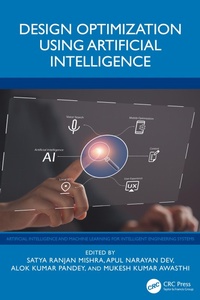
Design Optimization Using Artificial Intelligence
Published on 24. June 2025
298 pages
978-1-040-35749-1 (ISBN)
Description

Design Optimization Using Artificial Intelligence serves as an insightful resource for understanding the transformative role of Artificial Intelligence (AI) in optimizing design processes across a variety of fields. This book explores foundational concepts, advanced methodologies, and real-world applications, offering a comprehensive guide to leveraging AI for innovative design solutions.
Covering a broad spectrum of topics, the book examines algorithmic advancements, machine learning techniques, and optimization strategies that enhance design efficiency and accuracy. It delves into AI's applications in sustainable energy systems, biomedical innovations, image processing, cyber-security, and other critical domains, showcasing its ability to solve complex challenges with precision and creativity.
The content bridges theoretical foundations with practical implementations, incorporating case studies that highlight successful applications of AI-driven design optimization. Readers will gain valuable insights into state-of-the-art tools, programming techniques, and frameworks that drive advancements in intelligent design systems.
Features:
Explores AI-driven methodologies for enhancing design accuracy and efficiency
Discusses advanced machine learning techniques and optimization algorithms
Highlights AI's applications in diverse fields such as energy systems, healthcare, image processing, and cyber-security
Includes in-depth case studies to illustrate real-world implementations of AI in design optimization
Investigates future trends and the potential of AI to transform traditional design processes
Targeted at researchers, engineers, and students in the fields of artificial intelligence, computational science, and engineering, this book is an essential reference for anyone seeking to understand and utilize AI in the realm of design optimization. It provides the tools and knowledge necessary to harness AI's power for innovative, efficient, and intelligent design solutions.
Covering a broad spectrum of topics, the book examines algorithmic advancements, machine learning techniques, and optimization strategies that enhance design efficiency and accuracy. It delves into AI's applications in sustainable energy systems, biomedical innovations, image processing, cyber-security, and other critical domains, showcasing its ability to solve complex challenges with precision and creativity.
The content bridges theoretical foundations with practical implementations, incorporating case studies that highlight successful applications of AI-driven design optimization. Readers will gain valuable insights into state-of-the-art tools, programming techniques, and frameworks that drive advancements in intelligent design systems.
Features:
Explores AI-driven methodologies for enhancing design accuracy and efficiency
Discusses advanced machine learning techniques and optimization algorithms
Highlights AI's applications in diverse fields such as energy systems, healthcare, image processing, and cyber-security
Includes in-depth case studies to illustrate real-world implementations of AI in design optimization
Investigates future trends and the potential of AI to transform traditional design processes
Targeted at researchers, engineers, and students in the fields of artificial intelligence, computational science, and engineering, this book is an essential reference for anyone seeking to understand and utilize AI in the realm of design optimization. It provides the tools and knowledge necessary to harness AI's power for innovative, efficient, and intelligent design solutions.
More details
Series
Language
English
Place of publication
London
United Kingdom
Publishing group
Taylor & Francis Ltd
Target group
College/higher education
Professional and scholarly
Illustrations
42 Tables, black and white; 54 Line drawings, black and white; 15 Halftones, black and white; 69 Illustrations, black and white
File size
13,46 MB
ISBN-13
978-1-040-35749-1 (9781040357491)
Copyright in bibliographic data and cover images is held by Nielsen Book Services Limited or by the publishers or by their respective licensors: all rights reserved.
Schweitzer Classification
Other editions
Additional editions
Satya Ranjan Mishra | Apul Narayan Dev | Alok Kumar Pandey
Design Optimization Using Artificial Intelligence
Book
06/2025
1st Edition
CRC Press
€177.50
Shipment within 10-20 days
Persons
Satya Ranjan Mishra is currently working as a Professor in the Department of Mathematics at Siksha O Anusandhan Deemed to be University. He has 19 years of teaching experience at both the postgraduate and undergraduate levels. He has completed his doctoral studies at Siksha O Anusandhan in 2013 and has been actively engaged in research since then. His areas of interest include Heat Transfer, Magnetohydrodynamics, Porous Media, etc., within the broader field of Fluid Dynamics. He has published nearly 250 papers in international journals of repute, which are either SCI or Scopus indexed and can be found in various databases such as Scopus, ResearchGate, Google Scholar, etc. Due to the significant citation of his work, he was recognized as one of the Top 2% World Scientists by Stanford University, USA, for four consecutive years (2020-2023). He has also guided 13 research scholars, with six more students currently working under his guidance. Dr. Mishra has delivered several lectures at various conferences and faculty development programs, including one organized by Rajasthan Technical University, Rajasthan, in 2019 on the topic "Introduction to MATLAB," an FDP organized by Poornima Group of Institutions, Rajasthan, on the topic "Numerical Solutions using the Scientific Tool MAPLE" in 2020 (online), and a Summer Instructional School organized by NIT Arunachal Pradesh in 2020 on the topic "Linear Algebra." He is the series editor for a book series at Springer Nature and has also edited a book under it in the year 2020. He is also an editor/associate editor for several reputed international journals. Dr. Mishra has authored a book titled Learning Numerical Methods using MATLAB and is expected to be released soon.
Apul Narayan Dev is currently working as an Professor, Department of Mathematics, Siksha 'O' Anusandhan Deemed to be University, Bhubaneswar. He has 14 years of teaching experience at both the postgraduate and undergraduate levels. He has completed his MPhil and PhD from Gauhati University in 2011 and 2016, respectively. His areas of interest include the basic study of theoretical plasmas, degenerate and non-degenerate plasmas, mathematical methods, and fluid flow, with a broad focus on plasmas and fluid dynamics. He has published nearly 48 papers in reputable international journals, all of which are either SCI or Scopus indexed, and can be accessed through databases like Scopus, ResearchGate, Google Scholar, etc. He also published a book titled Shock Wave Phenomena in Dusty Plasma which is available on Amazon. Dr. Dev has guided one research scholar, with four more students working under his guidance. Additionally, he has organized Three international conferences (AMSE-2019, AMSE-2022, AMSE-2024) and two international webinars (Maple-2020, Mathematica-2020), and edited a Scopus-indexed conference proceeding published by a reputed publisher in 2022 as the leading editor.
Alok Kumar Pandey is an Assistant Professor in the Department of Mathematics at Graphic Era (Deemed to be University), Dehradun, Uttarakhand, India. He obtained his PhD from Govind Ballabh Pant University of Agriculture and Technology, Pantnagar, Uttarakhand, India. His research area is Computational Fluid Dynamics. He has published over 60 research articles in international journals and was included in the World's Top 2% Scientists 2023 list by Stanford University. In 2018, he was awarded the Publons Peer Review Award. He is a certified reviewer for more than 100 international journals and currently serves as an editor for Open Physics and Journal of Engineering Researcher and Lecturer, associate editor for the Journal of Advanced Research in Numerical Heat Transfer and Journal of Advanced Research in Micro and Nano Engineering, and a member of the editorial board for journals like Teknomekanik and SCIREA Journal of Mathematics. His scientific metrics, according to Google Scholar, show an h-index of 30, 2,126 citations, and an i10-index of 43.
Mukesh Kumar Awasthi completed his PhD, and his thesis is titled "Viscous Correction for the Potential Flow Analysis of Capillary and Kelvin-Helmholtz Instability." He is currently an Assistant Professor in the Department of Mathematics at Babasaheb Bhimrao Ambedkar University, Lucknow. Dr. Awasthi specializes in the mathematical modeling of flow problems. He has taught courses in Fluid Mechanics, Discrete Mathematics, Partial Differential Equations, Abstract Algebra, Mathematical Methods, and Measure Theory to postgraduate students. He has extensive knowledge of mathematical modeling in fluid dynamics and can solve flow problems analytically and numerically. His areas of expertise include viscous potential flow, electro-hydrodynamics, magneto-hydrodynamics, heat, and mass transfer. Dr. Awasthi has excellent communication skills and leadership qualities and is self-motivated, responding to suggestions in a constructive manner. He qualified the National Eligibility Test (NET) conducted by the Council of Scientific and Industrial Research (CSIR) in 2008, earning a Junior Research Fellowship (JRF) and Senior Research Fellowship (SRF). He has published over 125 research publications, including journal articles, books, book chapters, and conference papers, in national and international journals and conferences. He has also published 10 books and is a series editor for Artificial Intelligence and Machine Learning for Intelligent Engineering Systems, published by CRC Press (Taylor & Francis, USA). He has attended numerous symposia, workshops, and conferences in mathematics and fluid mechanics. Dr. Awasthi received "Research Awards" consecutively from 2013 to 2016 from the University of Petroleum and Energy Studies, Dehradun, India, and has also received a start-up research fund from the UGC, New Delhi, for his project titled "Nonlinear Study of the Interface in Multilayer Fluid Systems." He has been recognized as one of the top 2% influential researchers globally by Stanford University for 2022 and 2023. His ORCID is 0000-0002-6706-5226, and his Google Scholar and ResearchGate profiles can be accessed at Google Scholar and ResearchGate, respectively.
Apul Narayan Dev is currently working as an Professor, Department of Mathematics, Siksha 'O' Anusandhan Deemed to be University, Bhubaneswar. He has 14 years of teaching experience at both the postgraduate and undergraduate levels. He has completed his MPhil and PhD from Gauhati University in 2011 and 2016, respectively. His areas of interest include the basic study of theoretical plasmas, degenerate and non-degenerate plasmas, mathematical methods, and fluid flow, with a broad focus on plasmas and fluid dynamics. He has published nearly 48 papers in reputable international journals, all of which are either SCI or Scopus indexed, and can be accessed through databases like Scopus, ResearchGate, Google Scholar, etc. He also published a book titled Shock Wave Phenomena in Dusty Plasma which is available on Amazon. Dr. Dev has guided one research scholar, with four more students working under his guidance. Additionally, he has organized Three international conferences (AMSE-2019, AMSE-2022, AMSE-2024) and two international webinars (Maple-2020, Mathematica-2020), and edited a Scopus-indexed conference proceeding published by a reputed publisher in 2022 as the leading editor.
Alok Kumar Pandey is an Assistant Professor in the Department of Mathematics at Graphic Era (Deemed to be University), Dehradun, Uttarakhand, India. He obtained his PhD from Govind Ballabh Pant University of Agriculture and Technology, Pantnagar, Uttarakhand, India. His research area is Computational Fluid Dynamics. He has published over 60 research articles in international journals and was included in the World's Top 2% Scientists 2023 list by Stanford University. In 2018, he was awarded the Publons Peer Review Award. He is a certified reviewer for more than 100 international journals and currently serves as an editor for Open Physics and Journal of Engineering Researcher and Lecturer, associate editor for the Journal of Advanced Research in Numerical Heat Transfer and Journal of Advanced Research in Micro and Nano Engineering, and a member of the editorial board for journals like Teknomekanik and SCIREA Journal of Mathematics. His scientific metrics, according to Google Scholar, show an h-index of 30, 2,126 citations, and an i10-index of 43.
Mukesh Kumar Awasthi completed his PhD, and his thesis is titled "Viscous Correction for the Potential Flow Analysis of Capillary and Kelvin-Helmholtz Instability." He is currently an Assistant Professor in the Department of Mathematics at Babasaheb Bhimrao Ambedkar University, Lucknow. Dr. Awasthi specializes in the mathematical modeling of flow problems. He has taught courses in Fluid Mechanics, Discrete Mathematics, Partial Differential Equations, Abstract Algebra, Mathematical Methods, and Measure Theory to postgraduate students. He has extensive knowledge of mathematical modeling in fluid dynamics and can solve flow problems analytically and numerically. His areas of expertise include viscous potential flow, electro-hydrodynamics, magneto-hydrodynamics, heat, and mass transfer. Dr. Awasthi has excellent communication skills and leadership qualities and is self-motivated, responding to suggestions in a constructive manner. He qualified the National Eligibility Test (NET) conducted by the Council of Scientific and Industrial Research (CSIR) in 2008, earning a Junior Research Fellowship (JRF) and Senior Research Fellowship (SRF). He has published over 125 research publications, including journal articles, books, book chapters, and conference papers, in national and international journals and conferences. He has also published 10 books and is a series editor for Artificial Intelligence and Machine Learning for Intelligent Engineering Systems, published by CRC Press (Taylor & Francis, USA). He has attended numerous symposia, workshops, and conferences in mathematics and fluid mechanics. Dr. Awasthi received "Research Awards" consecutively from 2013 to 2016 from the University of Petroleum and Energy Studies, Dehradun, India, and has also received a start-up research fund from the UGC, New Delhi, for his project titled "Nonlinear Study of the Interface in Multilayer Fluid Systems." He has been recognized as one of the top 2% influential researchers globally by Stanford University for 2022 and 2023. His ORCID is 0000-0002-6706-5226, and his Google Scholar and ResearchGate profiles can be accessed at Google Scholar and ResearchGate, respectively.
Content
1. Recent Developments in AI-Powered Mechanical Design and Optimization. 2. Fundamentals of Machine Learning for Design Optimization. 3. Case Studies in Machine Learning for Design Optimization. 4. Artificial Intelligence in Manufacturing and Production. 5. Enhancing Text Classification through Algorithmic Modifications with a Comparative Study on AI-Driven Optimization Techniques. 6. Enhancing performance of a deep neural network utilizing anova based feature selection for drought prediction. 7. Protein-Protein Interaction Prediction using Extended Natural Vector Representation of Proteins and Comparison with Natural Vector Method. 8. Utilizing an optimized CHPNN model for covid-19 cases prediction. 9. An Optimized Filter Design using Fractional Anisotropic Diffusion Technique for Image Denoising in AI Environment. 10. Role of Enhanced Visual Cryptography Algorithm in Cyber security. 11. Effective Classification of Brain Tumor using i-vector Based Radial Basis Function Network. 12. Enhancing Breast Cancer Detection: A Deep Transfer Learning Approach with AlexNet. 13. Brain Tumor Identification using DenseNet-201 Deep Learning Model. 14. IoT Empowered Video Surveillance: Enhancing Security with WiMAX Technology. 15. Automatic Gender Detection: An AI Perspective. 16. Optimal Dynamic Contraflow with Intermediate Storage by Anti-parallel Path Decomposition. 17. Heart Disease Prognosis using Machine Learning Classifier with Hyperparameter Optimization.
