

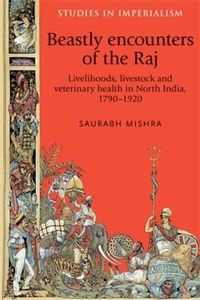
Beastly Encounters of the Raj
Livelihoods, Livestock and Veterinary Health in North India, 1790-1920
1st Edition
Published on 1. March 2017
184 pages
978-0-7190-9801-7 (ISBN)
Description

This is the first full-length monograph to examine the history of colonial medicine in India from the perspective of veterinary health. The history of human health in the subcontinent has received a fair amount of attention in the last few decades, but nearly all existing texts have completely ignored the question of animal health. This book will not only fill this gap, but also provide fresh perspectives and insights that might challenge existing arguments.
At the same time, this volume is a social history of cattle in India. Keeping the question of livestock at the centre, it explores a range of themes such as famines, agrarian relations, urbanisation, middle-class attitudes, caste formations etc. The overall aim is to integrate medical history with social history in a way that has not often been attempted. -- .
At the same time, this volume is a social history of cattle in India. Keeping the question of livestock at the centre, it explores a range of themes such as famines, agrarian relations, urbanisation, middle-class attitudes, caste formations etc. The overall aim is to integrate medical history with social history in a way that has not often been attempted. -- .
Reviews / Votes
'This is an immensely informative book, based on exemplary research, conceptual clarity and preciseness of expression. It admirably fulfils its main task of integrating the larger social history of livestock with veterinary medicine by bringing into focus several unfamiliar histories and connecting a number of seemingly disengaged plots and themes. In doing so, it produces a broader definition of public in India health to include veterinary medicine. Beastly Encounters is an original, unique and introspective book. It makes us think about veterinary history from an entirely new perspective as it links histories of caste, urban consumerism and famines with that of animal health.'Pratik Chakrabarti, Centre for the History of Science Technology and Medicine University of Manchester, Studies in History -- .
All prices
More details
Series
Language
English
Place of publication
Manchester
United Kingdom
Edition type
Digital original
Illustrations
Illustrations, black & white
Illustrations, black & white
ISBN-13
978-0-7190-9801-7 (9780719098017)
Copyright in bibliographic data and cover images is held by Nielsen Book Services Limited or by the publishers or by their respective licensors: all rights reserved.
Schweitzer Classification
Other editions
Additional editions
Saurabh Mishra
Beastly Encounters of the Raj
Livelihoods, Livestock and Veterinary Health in North India, 1790-1920
Book
03/2015
Manchester University Press
€124.90
Shipment within 15-20 days
Persons
Content
Introduction
Part I
Veterinary Health and the Colonial State
1. Horse Breeding and the Ideologies of the Early Colonial State
2. Beasts, Murrains and Veterinary Health
3. Ticks, Germs and Bacteriological Research
Part II
Caste, Class and Cattle
4. Cattle, Famines and the Colonial State
5. Food Adulteration, Public Health and Middle Class Anxieties
6. Cattle-Poisoning and the Chamar Identity
Conclusion
Bibliography
Index -- .
Part I
Veterinary Health and the Colonial State
1. Horse Breeding and the Ideologies of the Early Colonial State
2. Beasts, Murrains and Veterinary Health
3. Ticks, Germs and Bacteriological Research
Part II
Caste, Class and Cattle
4. Cattle, Famines and the Colonial State
5. Food Adulteration, Public Health and Middle Class Anxieties
6. Cattle-Poisoning and the Chamar Identity
Conclusion
Bibliography
Index -- .
