

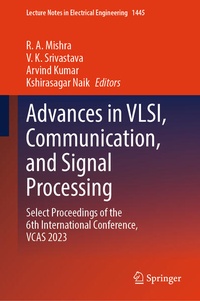
Advances in VLSI, Communication, and Signal Processing
Description

This book contains select peer-reviewed proceedings from the International Conference on VLSI, Communication, and Signal Processing (VCAS 2023). It focuses on the latest research in various domains of electronics and communication engineering, particularly microelectronics and VLSI design, communication systems and networks, and signal and image processing. The book explores emerging applications of novel tools and techniques in image, video, and multimedia signal processing. It will be valuable to students, researchers, and professionals in electronics and communication.
More details
Other editions
Additional editions

Persons
Prof. V. K. Srivastava received his BE from Govt. Engineering College Rewa, his M.Tech from IIT BHU, and his Ph.D. from IIT Kanpur. He joined MNNIT Allahabad in 1992 and became a Professor in 2010. With about thirty years of experience, his research interests include image compression, digital watermarking, and digital signal processing. He has published over 100 papers and reviews for several journals.
Dr. Arvind Kumar received his B.E. from MMMEC Gorakhpur, his M.E. from MNNIT Allahabad, and his Ph.D. from MNNIT Allahabad. He is currently an Associate Professor at MNNIT Allahabad with over 21 years of teaching experience. His research interests include embedded systems, digital design, and wireless networks. He has published over 50 papers and supervised numerous students.
Prof. Kshirasagar Naik is a Senior Member of IEEE and a Professor at the University of Waterloo. He received his Ph.D. from Concordia University and has worked at the University of Aizu and Carleton University. His research interests include computer network protocols, wireless communication systems, and sensor networks. He has served as a Guest Editor and Associate Editor for several journals.
Content
Deep Learning Models for Automatic Image Segmentation of Low Velocity Impact Damage in CFRP Composites.- Discerning Microstructure of CMC Minicomposites from Micro-CT Imaging Data Using Machine Learning.- Effect of Fiber Angle on the Radial Stress in Hybrid Aluminum/Composite Tubes.- Development of Data-Driven Surrogate Models for Rapid Simulation of Fibre Reinforced Composites in Progressive Fracture Tests.- Development of Auxetic Composite Materials for Improved Impact Properties.- Bayesian Calibration and Uncertainty Quantification of Cohesive Zone Parameters at an Adhesively Bonded Textile and Fabric Interface.- Efficient Design of Laminate Composites Using Ensemble Kalman Inversion Method.- Using Neural Network to Improve Failure Predictions.- Reliability-Based Design and Certification of Hybrid Composites.- Integrated Process and Failure Analysis in Composites Using Multi-Fidelity Simulations and Machine Learning.- Optimized Design Workflow for Patient-Customized Composite Orthotics.- Interlaminar Shear Strength of Carbon/Epoxy Laminates Containing Magnetically Aligned Nickel-Coated, Diazotized Carbon Nanotubes.- etc.
