

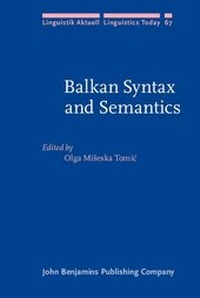
Balkan Syntax and Semantics
1st Edition
Published on 22. July 2004
XVI, 499 pages
978-90-272-9539-2 (ISBN)
Description

The book deals with some syntactic and semantic aspects of the shared Balkan Sprachbund properties. In a comprehensive introductory chapter, Tomic offers an overview of the Balkan Sprachbund properties. Sobolev, displaying the areal distribution of 65 properties, argues for dialect cartography. Friedman, on the example of the evidentials, argues for typologically informed areal explanation of the Balkan properties. The other contributions analyze specific phenomena: polidefinite DPs in Greek and Aromanian (Campos and Stavrou), Balkan constructions in which datives combine with impersonal clitics or non-active morphology (Rivero), Balkan optatives (Ammann and Auwera), imperative force in the Balkan languages (Isac and Jakab), clitic placement in Greek imperatives (Boskovic), focused constituents in Romanian and Bulgarian (Hill), synthetic and analytic tenses in Romanian (D'Hulst, Coene and Avram), "purpose-like" modification in a number of Balkan languages (Buzarovska), Balkan modal existential "wh"-constructions (Grosu), child and adult strategies in interpreting empty subjects in Serbian/Croatian (Stojanovic and Marelj), conditional sentences in Judeo-Spanish (Montoliu and Auwera).
More details
Other editions
Additional editions
Olga Miseska Tomic
Balkan Syntax and Semantics
Book
07/2004
John Benjamins Publishing Co
€148.40
Shipment within 10-15 days
Person
Content
- Balkan Syntax and Semantics
- Editorial page
- Title page
- LCC page
- Table of contents
- Preface
- Notes
- Map of the Balkans
- List of abbreviations
- The Balkan Sprachbund properties
- 1. Overview
- 1.1. Origin
- 1.2. Membership
- 1.3. Shared properties
- 2. Nominal cases and articles
- 2.1. Vocative case forms
- 2.2. Accusative case forms and case markers
- 2.3. Dative/genitive case forms and case markers
- 2.4. Position and use of the definite articles
- 3. Pronominal clitics
- 3.1. Pronominal clitics functioning in the clause
- 3.2. Clitic doubling
- 3.3. Impersonal pronominal clitics
- 3.4. Possessive pronominal clitics
- 4. Subjunctives
- 4.1. Subjunctives as complements of modal and intentional verbs
- 4.2. Subjunctive constructions as modifiers
- 4.3. Bare subjunctive constructions
- 4.4. Future tenses
- 5. Evidentials
- 5.1. Balkan Slavic
- 5.2. Albanian
- 5.3. Balkan Romance
- 5.4. Confirmative and nonconfirmative evidentials
- 6. Concluding remarks
- Notes
- References
- Spread of the Balkan Sprachbund morpho-syntactic properties
- On the areal distribution of syntactic properties in the languages of the Balkans
- 1. The goal of Balkan linguistics
- 2. Critics of the concepts Balkanism and Balkan Sprachbund
- 3. Between the normal Slavic type and the standard average European type
- 4. Standard Language versus dialect
- 5. The Balkan Language Atlas
- 5.1. History of the project
- 5.2. The Small Dialectological Atlas of the Balkan Languages
- 6. The areal distribution of some syntactic properties in the languages of the Balkans
- 7. Conclusion
- Notes
- References
- Appendix: Maps
- The typology of Balkan evidentiality and areal linguistics
- 1. Introduction
- 2. General considerations
- 3. Balkan Slavic
- 4. Albanian
- 5. Balkan Romance
- 6. Romani
- 7. Greek
- 8. Explanations
- Notes
- References
- The nominal phrase
- Polydefinite constructions in Modern Greek and in Aromanian
- 1. Introduction
- 2. Some background information
- 3. Differences between polydefinite and monadic constructions
- 3.1. Syntactic differences
- 3.2. Semantic differences
- 3.3. Phonological/Prosodic differences
- 3.4. Polydefinites and the direct/indirect-modification distinction
- 4. Other syntactic analyses
- 4.1. Tredinnick (1992)
- 4.2. Androutsopoulou (1995)
- 4.3. Kolliakou (1999)
- 4.4. Alexiadou and Wilder (1998)
- 4.5. Campos (2000)
- 4.6. Manolessou (2000)
- 5. A proposal for polydefinite structures
- 5.1. Articled adjectives and predicativity
- 5.2. A structure for the polydefinite construction
- 6. Summary
- Notes
- References
- Balkan possessive clitics
- 1. Overview
- 2. Background
- 3. Possessive clitics - dative or genitive?
- 3.1. The morpho-phonological identity of possessive and indirect object clitics
- 3.2. Historical considerations
- 3.3. Possessor raising of clitics
- 3.4. Possessive clitics, non-clitic pronouns, and non-pronominal DPs
- 3.5. Clitic doubling
- 3.6. Summary of case issues
- 4. Heads or arguments?
- 5. Conclusions
- Notes
- References
- Optional movement of Bulgarian possessive clitics to I
- 1. Introduction
- 2. Movement of possessive clitics to the head of IP
- 3. Binding, complementarity, and locality
- 4. Movement of possessive clitics - implications for locality constraints on binding
- 5. Locality constraints on binding in Bulgarian
- 6. Conclusion
- Notes
- References
- The root clause
- Datives and the non-active voice
- 1. Introduction
- 2. Dative Existential Disclosure
- 2.1. Balkan D-Disclosure constructions
- 3. The analysis of D-Disclosure
- 4. The E-Strategy
- 4.1. The E-Strategy and Argument Saturation (passives/impersonals)
- 4.2. The E-Strategy and Argument Suppression (anticausatives)
- 4.3. The Syntactic distribution of D-Disclosure and the E-Strategy
- 4.4. The E-Strategy and compositionality
- 5. Summary and conclusions
- Notes
- References
- On the clitic switch in Greek imperatives
- 1. Introduction
- 2. Imperatives
- 3. Accusative-dative clitic switch
- 4. Conclusion
- Notes
- References
- Complementizer-headed main clauses for volitional moods in the languages of South-Eastern Europe
- 1. The phenomenon
- 2. Terminology for the volitional moods
- 3. Labeling the functions of complementizer-headed main clauses in a Balkan language: Albanian
- 4. Optative-hortatives in Europe and beyond
- 5. The makeup of the independent modal complementizer clauses in the languages of the Eastern half of Southern Europe
- 6. Change in complementation in the languages of South-Eastern Europe
- 7. Retracing the development of modal complementation
- 8. Conclusion
- Notes
- References
- Mood and force features in the languages of the Balkans
- 1. Introduction
- 2. The Mood head in the languages of the Balkans
- 3. Two classes of imperatives
- 4. True Balkan imperatives and clitics
- 4.1. [Imperative V + Cl] orders
- 4.2. The subjunctive particle
- 4.3. [Cl + Imperative V] orders
- 5. Balkan imperatives and negation
- 5.1. The nature of the negative marker
- 5.2. The type of checking mechanism involved
- 5.3. The exact head that checks the imperative force in Mood
- 6. Conclusion
- Notes
- References
- On left periphery and focus
- 1. Introduction
- 2. Word order in Romanian and Bulgarian
- 2.1. Topic-Focus in root clauses
- 2.2. Topic and Focus in embedded clauses
- 2.3. Preverbal subjects
- 2.4. Adjacency between Focus and Verb
- 3. Syncretism of [focus/tense]
- 3.1. Indicative complements
- 3.2. Subjunctives
- 3.3. Infinitives
- 4. Targets for Focus
- 5. Summary and conclusion
- Notes
- References
- Syncretic and analytic tenses in Romanian
- 1. Introduction
- 2. Giorgi and Pianesi's (1997) framework: From Latin to Romance
- 3. Early Romanian futures
- 4. Contrasts between Modern Romanian and Western Romance
- 5. T1 and T2 in modern Romanian
- 6. AgrS in modern Romanian
- 7. Subjunctive and sa in modern Romanian
- 8. Back to the future
- 9. Conclusions: Future in the Past
- Notes
- References
- The complex sentence
- Subjunctive relatives in Balkan languages
- 1. Introduction
- 2. Syntactic properties of object subjunctive relatives
- 3. Semantic structure of object subjunctive relatives
- 4. Functions and properties of OSR
- 4.1. Lexical and modal semantics of the matrix verb
- 4.2. Reference relations: Humanness and reference constraints
- 4.3. Aspectual semantics of the verb in the subjunctive relative
- 5. Irrealis propositional modalities
- 6. Purpose - modification continuum
- 6.1. The graphic representation of scalarity in meaning
- 6.2. Balkan illustrations of scalarity between modification and purpose
- 7. Possessive vs. existential subjunctive relatives
- 7.1. Bleaching of possessive meaning
- 7.2. Negated possessive `have'
- 7.3. Existential subjunctive relatives
- 8. Subject control
- 8.1. Predicative subjunctive relatives
- 8.2. Subject subjunctive relatives
- 9. Conclusion
- Notes
- References
- The syntax-semantics of modal existential wh constructions
- 1. Introduction
- 2. The bare CP status of MECs
- 3. Similarities and differences between MECs and interrogatives
- 4. Properties of MECs and their analysis
- 4.1. Properties of MECs
- 5. Summary and conclusions
- Notes
- References
- Interpreting empty subjects in nontensed complement clauses
- 1. Introduction
- 2. Control theory
- 3. Crosslinguistic variation and the acquisition of control
- 4. Control in Serbian and Croatian
- 5. Interpretation of empty subjects in (non)-finite complement clauses in Serbian and Croatian
- 5.1. Experimental design
- 5.2. Results
- 6. Discussion
- Notes
- References
- On Judeo-Spanish conditionals
- 1. Introduction
- 2. Conditionals in Spanish and Judeo-Spanish
- 3. Conditionals in Greek and Turkish
- 4. Conclusion
- Notes
- References
- Author index
- Index of languages, dialects and toponyms
- Subject index
- The series Linguistik Aktuell/Linguistics Today
