

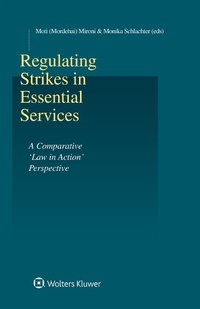
Regulating Strikes in Essential Services
A Comparative 'Law in Action' Perspective
Published on 9. November 2018
618 pages
978-90-411-9018-5 (ISBN)
Description

Designing a fair, effective and acceptable regime that will reconcile public interest and the public's need for an uninterrupted flow of essential services on the one hand, while maintaining the freedom of collective bargaining on the other, is an ever more difficult public policy challenge. This book, the first detailed comparative analysis of existing legal and practical approaches across a spectrum of key national jurisdictions, provides a structured and insightful overview of the law and practice of regulating strikes in essential services. As such it can be of great value for public policy debate and the enhancement of national law in the field.
The editors have assembled experts from fourteen countries who describe and analyse their respective country's experience with strikes in essential services and the legislative and judicial as well as informal approaches towards regulating and intervening in such strikes. Departing from legal theory with systematic comparative 'law in action' research, the contributors offer innumerable valuable insights into a broad array of issues and topics as the following:
- - mechanisms aiming at compensating employees for encroaching on their collective bargaining rights;
- - public accountability and responsible management of public finance;
- - role of international conventions;
- - effects of globalization and advances in technology;
- - privatization, outsourcing and the decline of unions and workers' solidarity;
- - growing popular intolerance towards strikes in essential services;
- - effect of human rights-related court decisions;
- - convergence and divergence among contemporary legal regimes in defining and approaching strikes in essential services;
- - dispute process design and dispute resolution processes (mediation, conciliation and arbitration); and
- - substantive and procedural restrictions on the right to organize, bargain collectively and strike.
The country reports are preceded by a detailed analysis of the inherent normative policy dilemma and a conceptual framework for designing and evaluating models of regulation. The concluding chapter presents a comparative overview of the insights gained.
With its comparative perspective on one of the most sensitive areas of industrial relations and labour law, and its contextually relevant options for strategic choice and public policy debate, this incomparable volume will be welcomed by labour lawyers, legislators, policy makers, judicial bodies and researchers in the field of collective labour relations and fundamental human rights of workers on the national as well as international level.
The editors have assembled experts from fourteen countries who describe and analyse their respective country's experience with strikes in essential services and the legislative and judicial as well as informal approaches towards regulating and intervening in such strikes. Departing from legal theory with systematic comparative 'law in action' research, the contributors offer innumerable valuable insights into a broad array of issues and topics as the following:
- - mechanisms aiming at compensating employees for encroaching on their collective bargaining rights;
- - public accountability and responsible management of public finance;
- - role of international conventions;
- - effects of globalization and advances in technology;
- - privatization, outsourcing and the decline of unions and workers' solidarity;
- - growing popular intolerance towards strikes in essential services;
- - effect of human rights-related court decisions;
- - convergence and divergence among contemporary legal regimes in defining and approaching strikes in essential services;
- - dispute process design and dispute resolution processes (mediation, conciliation and arbitration); and
- - substantive and procedural restrictions on the right to organize, bargain collectively and strike.
The country reports are preceded by a detailed analysis of the inherent normative policy dilemma and a conceptual framework for designing and evaluating models of regulation. The concluding chapter presents a comparative overview of the insights gained.
With its comparative perspective on one of the most sensitive areas of industrial relations and labour law, and its contextually relevant options for strategic choice and public policy debate, this incomparable volume will be welcomed by labour lawyers, legislators, policy makers, judicial bodies and researchers in the field of collective labour relations and fundamental human rights of workers on the national as well as international level.
More details
Other editions
Additional editions
Moti (Mordehai) Mironi | Monika Schlachter
Regulating Strikes in Essential Services
A Comparative 'Law in Action' Perspective
Book
11/2018
Kluwer Law International
€183.04
Shipment within 10-20 days
Content
- Intro
- Editors
- Contributors
- Preface
- Acknowledgement
- PART I Theoretical Infrastructure
- CHAPTER 1 Introduction: Theory, Conceptualization and Methodology
- PART II International Law on Strikes in Essential Services
- CHAPTER 2 Regulating Strikes in Essential Services from an International Law Perspective
- PART III Country Report
- CHAPTER 3 Australia
- CHAPTER 4 Brazil
- CHAPTER 5 Canada
- CHAPTER 6 France
- CHAPTER 7 Germany
- CHAPTER 8 Japan
- CHAPTER 9 Israel
- CHAPTER 10 Italy
- CHAPTER 11 Poland
- CHAPTER 12 Russia
- CHAPTER 13 South Africa
- CHAPTER 14 Sweden
- CHAPTER 15 United Kingdom
- CHAPTER 16 United States
- PART IV Conclusion
- CHAPTER 17 Comparative Analysis
- Index
- 1 The Normative Dilemma of Regulating Strikes in Essential Services
- 2 The Increasing Relevance of Strikes in Essential Services
- 3 The Study: Its Objectives and Structure
- 3.1 Objectives
- 3.2 Structure
- 4 Research Methodology
- 4.1 Selecting the Participating Countries
- 4.2 Constructing the Research Instruments
- 4.3 The National Experts as a Collaborating Working Group
- 5 Regulating Strikes in Essential Services: A Conceptual Framework
- 5.1 The Source of Regulation
- 5.1.1 External or Exogenous Regulation
- 5.1.2 Bilateral Autonomous Regulation
- 5.1.3 Unilateral Autonomous Regulation
- 5.1.4 Hybrid or Mixed Mode Regulation
- 5.2 The Definition of Essential Service
- 5.2.1 The Scope Dimension: General and Fixed Versus Selective
- 5.2.2 The Timing Dimension: Ex-Ante Versus Ad-Hoc
- 5.2.3 The Matrix
- 5.3 The Menu of Restrictions
- 5.3.1 Substantive Restrictions
- 5.3.2 Procedural Restrictions
- 5.4 Alternative Means to Promote and Protect Employees' Interests
- 6 Evaluative Framework
