

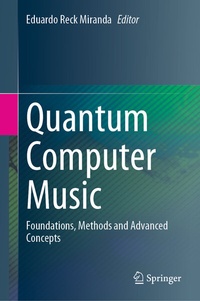
Quantum Computer Music
Description

This book explores music with respect to quantum computing, a nascent technology that is advancing rapidly. There is a long history of research into using computers for music since the 1950s.
Nowadays, computers are essential for the music economy. Therefore, it is very likely that quantum computers will impact the music industry in the time to come. Consequently, a new area of research and development is emerging: Quantum Computer Music.
This unprecedented book presents the new field of Quantum Computer Music. It introduces the fundamentals of quantum computing for musicians and the latest developments by pioneering practitioners.Reviews / Votes
"I thoroughly enjoyed reading this book, which is targeted for music composers, computer scientists, engineers (who work on music), and musicologists, especially computational musicologists." (Soubhik Chakraborty, Computing Reviews, July 14, 2025)
More details
Other editions
Additional editions
Person
Professor Eduardo Reck Miranda (M.Sc., Ph.D.) is a composer and artificial intelligence (AI) scientist. He is a professor in Computer Music at the University of Plymouth, UK, where he is a director of the Interdisciplinary Centre for Computer Music Research. He is championing research into brain-computer interfaces, AI and unconventional computing applied to Music Technology.
Before moving to the University of Plymouth, Eduardo worked at Edinburgh Parallel Computing Centre, where he developed pioneering work on using supercomputers in musical composition. He subsequently worked for Sony Computer Science Laboratory Paris for several years, developing AI applied to music and linguistics. In 2006, he was appointed Edgar Varese Guest Professor at the Technical University of Berlin.
His previous publications include the Springer titles 'Handbook of Artificial Intelligence for Music', 'Guide to Unconventional Computing for Music', 'Guide to Brain-Computer Music Interfacing'and 'Guide to Computing for Expressive Music Performance'.