

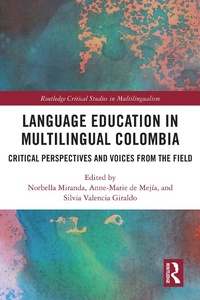
Language Education in Multilingual Colombia
Critical Perspectives and Voices from the Field
1st Edition
Published on 4. August 2022
328 pages
978-1-000-61009-3 (ISBN)
Description

This collection brings together cutting-edge research and theoretical discussions on the linguistic, cultural, and political forces that shape multilingual Colombia, highlighting the country's unique sociolinguistic landscape and offering new insights into multilingualism in the Global South.
The volume outlines the changing dynamics of multilingualism in Colombia, where Spanish, Spanish-based and English-based Creoles, the linguistic and cultural heritages of Indigenous communities and migrant groups, and the prevalence of English in language education policy intersect. The chapters explore the implications of policy making on language policy discourse and especially on language teacher education for those working on the margins in urban and rural areas. They also explore existing understandings of interculturality and the work of academics and local communities in minority language revitalization efforts.
Problematizing essentialized views of language and culture and raising awareness around the complex relationship between language, identity, and interculturality in the Global South, this book will be of interest to scholars in multilingualism, sociolinguistics, language education, teacher education, and applied linguistics.
The volume outlines the changing dynamics of multilingualism in Colombia, where Spanish, Spanish-based and English-based Creoles, the linguistic and cultural heritages of Indigenous communities and migrant groups, and the prevalence of English in language education policy intersect. The chapters explore the implications of policy making on language policy discourse and especially on language teacher education for those working on the margins in urban and rural areas. They also explore existing understandings of interculturality and the work of academics and local communities in minority language revitalization efforts.
Problematizing essentialized views of language and culture and raising awareness around the complex relationship between language, identity, and interculturality in the Global South, this book will be of interest to scholars in multilingualism, sociolinguistics, language education, teacher education, and applied linguistics.
Reviews / Votes
"In bringing together previously diverse research traditions and consolidating a platform from which to discuss multilingualism and language education in a broad sense, this volume makes an important contribution both locally and globally...In the dialogue around language education and multilingualism, the volume should be read as a much overdue long-turn from Colombian scholars, and we would all do well to listen to what they have to tell us." - Peter Browning, University of Birmingham, UK, Journal of English as a Lingua FrancaMore details
Series
Edition
1. Auflage
Language
English
Place of publication
London
United Kingdom
Publishing group
Taylor & Francis Ltd
Target group
Professional and scholarly
College/higher education
Product notice
Reflowable
Illustrations
2 Tables, black and white; 2 Line drawings, black and white; 14 Halftones, black and white; 16 Illustrations, black and white
ISBN-13
978-1-000-61009-3 (9781000610093)
Copyright in bibliographic data and cover images is held by Nielsen Book Services Limited or by the publishers or by their respective licensors: all rights reserved.
Schweitzer Classification
Other editions
Additional editions
Norbella Miranda | Anne-Marie de Mejia | Silvia Valencia Giraldo
Language Education in Multilingual Colombia
Critical Perspectives and Voices from the Field
Book
05/2024
1st Edition
Routledge
€64.20
Shipment within 15-20 days
Norbella Miranda | Anne-Marie de Mejia | Silvia Valencia Giraldo
Language Education in Multilingual Colombia
Critical Perspectives and Voices from the Field
Book
08/2022
1st Edition
Routledge
€208.30
Shipment within 15-20 days
Persons
Norbella Miranda is Assistant Professor in the School of Language Sciences at Universidad del Valle, Cali, Colombia. She holds a PhD in Educational Sciences from Universidad del Quindiio, Armenia, Colombia. Her research and publications focus on educational language policies, bi/multilingualism and curriculum development for language education. She is a member of the EILA research group (Equipo de Investigacion en Lingueistica Aplicada) of Universidad del Valle. Her publications include: Appropriation of Colombian ELT policy in a targeted school: The creation of an "elite" yet still needy school in the public education system (book chapter, Routledge, 2021).
Anne-Marie de Mejia is Professor in the area of Bilingualism and Bilingual Education at the School of Education at Universidad de los Andes, Bogota. She holds a Ph.D in Linguistics from Lancaster University, U.K. Her research interests include teacher empowerment, interculturality, language and education policy, and bilingual teacher development.
Silvia Valencia Giraldo is Professor in the area of Sociolinguistics and Bilingualism in the School of Education at Universidad del Quindiio, Armenia, Colombia. She received her Ph.D from the University of Wales, Aberystwyth, UK., in the area of bilingualism. Her research interests include bilingual classroom interaction, language policy, and literacy.
Anne-Marie de Mejia is Professor in the area of Bilingualism and Bilingual Education at the School of Education at Universidad de los Andes, Bogota. She holds a Ph.D in Linguistics from Lancaster University, U.K. Her research interests include teacher empowerment, interculturality, language and education policy, and bilingual teacher development.
Silvia Valencia Giraldo is Professor in the area of Sociolinguistics and Bilingualism in the School of Education at Universidad del Quindiio, Armenia, Colombia. She received her Ph.D from the University of Wales, Aberystwyth, UK., in the area of bilingualism. Her research interests include bilingual classroom interaction, language policy, and literacy.
Content
Contents
List of illustrations
Acknowledgements
Critical perspectives on language education in multilingual Colombia: An introduction ANNE-MARIE DE MEJIA, SILVIA VALENCIA GIRALDO AND NORBELLA MIRANDA
Multilingual Colombia: Dimensions of linguistic and cultural diversity
SILVIA VALENCIA GIRALDO, NORBELLA MIRANDA AND ANNE-MARIE DE MEJIA
SECTION I
Creole and Indigenous Languages in Colombia
Decolonizing multilingual practices: Lessons from Colombia
MARIO E. LOPEZ-GOPAR
Preserving the Creole language of the Caribbean archipelago of San Andres and Providence: An ecolinguistic approach to multilingualism in Colombia
RAQUEL SANMIGUEL ARDILA
Between chants, games and elders (Andi Kanto, jarocheria ku tata ri mae mi). Local strategies for the strengthening of the Palenquero language among young people in San Basilio de Palenque (Bolivar-Colombia)
LUIS RICARDO NAVARRO DIAZ, SEBASTIAN SALGADO REYES AND RODOLFO PALOMINO CASSIANI
Colombia on the path of linguistic revitalization. Some thoughts from Cauca
LILIA TRIVINO GARZON AND TULIO ROJAS CURIEUX
SECTION II
Language education policy: Discourses, ideologies and local practices
Marginalizing discourses and teacher resilience in Colombian language policy and education
DAVID CASSELS JOHNSON
English in education policy in Colombia: Two decades of policy discourse and appropriation
NORBELLA MIRANDA AND SILVIA VALENCIA GIRALDO
English language teaching in rural Colombia amidst the armed conflict: A case study of teacher positioning vis-a-vis policy, practice and the profession
FERNEY CRUZ ARCILA
Late capitalism and the commodification of English in Colombia: The shaping of language education policy and practice
YECID ORTEGA
Colombian teachers of English as agents in the implementation of English language policies in a multilingual country: Villains or heroes?
ADRIANA GONZALEZ
SECTION III
Interculturality and pedagogy
Interculturality in languages and cultures education
ANTHONY J. LIDDICOAT
Transemiotizing and re-sourcing resources in language education: Towards a multimodal social semiotic perspective on intercultural communication
JOSE ALDEMAR ALVAREZ VALENCIA
Building intercultural language education in Colombia: Insights from research with English language teachers
BEATRIZ PENA DIX
Focusing on dimensions of interculturality in the context of language teacher education: Insights from a case study in Colombia
ISABEL TEJADA-SANCHEZ AND ANNE MARIE DE MEJIA
SECTION IV
Reimagining teacher education: Taking account of diversities and inequalities
Decolonizing and decentering language teacher education in Multilingual Colombia
JUDY SHARKEY
Nurturing language teacher education in Colombia from a multilingual perspective
FANNY HERNANDEZ GAVIRIA AND MARTHA BERDUGO-TORRES
Contesting the hegemony of English in a country declared to be multilingual: The outcome of research with English language teachers in an in-service program
CARMEN HELENA GUERRERO NIETO AND ALVARO QUINTERO-POLO
Crossing linguistic boundaries with community literacies: A collaborative, place-based ethnography in two urban localities in Bogota
AMPARO CLAVIJO-OLARTE AND THERESA Y. AUSTIN
Views on writing and pedagogic practices: A systematic review of the research literature on bilingual (Spanish/English) teaching in Colombia
NEIRA LOAIZA VILLALBA AND CLAUDIA ORTIZ RUIZ
Afterword: Decolonizing Multilingual Colombia
NANCY H. HORNBERGER
Contributors
List of illustrations
Acknowledgements
Critical perspectives on language education in multilingual Colombia: An introduction ANNE-MARIE DE MEJIA, SILVIA VALENCIA GIRALDO AND NORBELLA MIRANDA
Multilingual Colombia: Dimensions of linguistic and cultural diversity
SILVIA VALENCIA GIRALDO, NORBELLA MIRANDA AND ANNE-MARIE DE MEJIA
SECTION I
Creole and Indigenous Languages in Colombia
Decolonizing multilingual practices: Lessons from Colombia
MARIO E. LOPEZ-GOPAR
Preserving the Creole language of the Caribbean archipelago of San Andres and Providence: An ecolinguistic approach to multilingualism in Colombia
RAQUEL SANMIGUEL ARDILA
Between chants, games and elders (Andi Kanto, jarocheria ku tata ri mae mi). Local strategies for the strengthening of the Palenquero language among young people in San Basilio de Palenque (Bolivar-Colombia)
LUIS RICARDO NAVARRO DIAZ, SEBASTIAN SALGADO REYES AND RODOLFO PALOMINO CASSIANI
Colombia on the path of linguistic revitalization. Some thoughts from Cauca
LILIA TRIVINO GARZON AND TULIO ROJAS CURIEUX
SECTION II
Language education policy: Discourses, ideologies and local practices
Marginalizing discourses and teacher resilience in Colombian language policy and education
DAVID CASSELS JOHNSON
English in education policy in Colombia: Two decades of policy discourse and appropriation
NORBELLA MIRANDA AND SILVIA VALENCIA GIRALDO
English language teaching in rural Colombia amidst the armed conflict: A case study of teacher positioning vis-a-vis policy, practice and the profession
FERNEY CRUZ ARCILA
Late capitalism and the commodification of English in Colombia: The shaping of language education policy and practice
YECID ORTEGA
Colombian teachers of English as agents in the implementation of English language policies in a multilingual country: Villains or heroes?
ADRIANA GONZALEZ
SECTION III
Interculturality and pedagogy
Interculturality in languages and cultures education
ANTHONY J. LIDDICOAT
Transemiotizing and re-sourcing resources in language education: Towards a multimodal social semiotic perspective on intercultural communication
JOSE ALDEMAR ALVAREZ VALENCIA
Building intercultural language education in Colombia: Insights from research with English language teachers
BEATRIZ PENA DIX
Focusing on dimensions of interculturality in the context of language teacher education: Insights from a case study in Colombia
ISABEL TEJADA-SANCHEZ AND ANNE MARIE DE MEJIA
SECTION IV
Reimagining teacher education: Taking account of diversities and inequalities
Decolonizing and decentering language teacher education in Multilingual Colombia
JUDY SHARKEY
Nurturing language teacher education in Colombia from a multilingual perspective
FANNY HERNANDEZ GAVIRIA AND MARTHA BERDUGO-TORRES
Contesting the hegemony of English in a country declared to be multilingual: The outcome of research with English language teachers in an in-service program
CARMEN HELENA GUERRERO NIETO AND ALVARO QUINTERO-POLO
Crossing linguistic boundaries with community literacies: A collaborative, place-based ethnography in two urban localities in Bogota
AMPARO CLAVIJO-OLARTE AND THERESA Y. AUSTIN
Views on writing and pedagogic practices: A systematic review of the research literature on bilingual (Spanish/English) teaching in Colombia
NEIRA LOAIZA VILLALBA AND CLAUDIA ORTIZ RUIZ
Afterword: Decolonizing Multilingual Colombia
NANCY H. HORNBERGER
Contributors
