

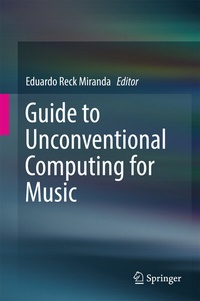
Guide to Unconventional Computing for Music
Description

This pioneering text/reference explores how innovative new modes of computation may provide exciting new directions for future developments in the music industry, guiding the reader through the latest research in this emerging, interdisciplinary field. This work includes coverage of electronic music compositions and performances that incorporate unconventional interfacing, hacking and circuit bending. Features: presents an introduction to unconventional computing in music; discusses initiatives involving biophysical electronic music, the work of self-styled silicon luthiers, and the intersection of music and quantum computing; introduces the memristor, a new electronic component with the potential to revolutionize how computers are built; reviews experiments and practical applications of biological memristors in music; describes IMUSIC, an unconventional tone-based programming language, which enables the programming of computers using musical phrases; includes review questions at the end of each chapter.
More details
Other editions
Additional editions
Person
Prof. Eduardo Reck Miranda is a composer and Professor in Computer Music at Plymouth University, UK, where he is Director of the Interdisciplinary Centre for Computer Music Research (ICCMR). His previous publications include the Springer titles Guide to Brain-Computer Music Interfacing and G uide to Computing for Expressive Music Performance .
Content
Introduction to Unconventional Computing.- On Unconventional Computing for Sound and Music.- On Biophysical Music.- The Transgressive Practices of Silicon Luthiers.- Experiments in Sound and Music Quantum Computing.- Memristor in a Nutshell.- Physarum Inspired Audio: From Oscillatory Sonification to Memristor Music.- An Approach to Building Musical Bioprocessors with Physarum polycephalum Memristors.- Towards a Musical Programming Language.
