

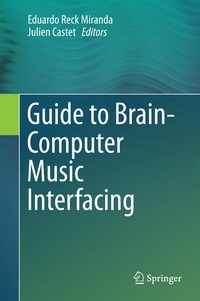
Guide to Brain-Computer Music Interfacing
Description

This book presents a world-class collection of Brain-Computer Music Interfacing (BCMI) tools. The text focuses on how these tools enable the extraction of meaningful control information from brain signals, and discusses how to design effective generative music techniques that respond to this information. Features: reviews important techniques for hands-free interaction with computers, including event-related potentials with P300 waves; explores questions of semiotic brain-computer interfacing (BCI), and the use of machine learning to dig into relationships among music and emotions; offers tutorials on signal extraction, brain electric fields, passive BCI, and applications for genetic algorithms, along with historical surveys; describes how BCMI research advocates the importance of better scientific understanding of the brain for its potential impact on musical creativity; presents broad coverage of this emerging, interdisciplinary area, from hard-core EEG analysis to practical musical applications.
More details
Other editions
Additional editions
Persons
Content
Brain-Computer Music Interfacing.- Electroencephalogram-Based Brain-Computer Interface.- Contemporary Approaches to BCMI Using P300 Event Related Potentials.- Prospective View on Sound Synthesis BCI Control in Light of Two Paradigms of Cognitive Neuroscience.- Machine Learning to Identify Neural Correlates of Music and Emotions.- Emotional Responses During Music Listening.- A Tutorial on EEG Signal Processing Techniques for Mental State Recognition in Brain-Computer Interfaces.- An Introduction to EEG Source Analysis with an Illustration of a Study on Error-Related Potentials.- Feature Extraction and Classification of EEG Signals.- On Mapping EEG Information into Music.- Retroaction Between Music and Physiology.- Creative Music Neurotechnology with Symphony of Minds Listening.- Passive Brain-Computer Interfaces
