

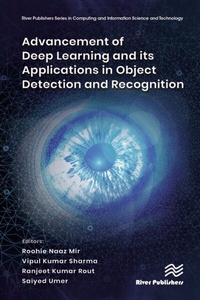
Advancement of Deep Learning and its Applications in Object Detection and Recognition
1st Edition
Published on 10. May 2023
318 pages
978-1-000-88043-4 (ISBN)
Description

Object detection is a basic visual identification problem in computer vision that has been explored extensively over the years. Visual object detection seeks to discover objects of specific target classes in a given image with pinpoint accuracy and apply a class label to each object instance. Object recognition strategies based on deep learning have been intensively investigated in recent years as a result of the remarkable success of deep learning-based image categorization.
In this book, we go through in detail detector architectures, feature learning, proposal generation, sampling strategies, and other issues that affect detection performance.
The book describes every newly proposed novel solution but skips through the fundamentals so that readers can see the field's cutting edge more rapidly. Moreover, unlike prior object detection publications, this project analyses deep learning-based object identification methods systematically and exhaustively, and also gives the most recent detection solutions and a collection of noteworthy research trends.
The book focuses primarily on step-by-step discussion, an extensive literature review, detailed analysis and discussion, and rigorous experimentation results. Furthermore, a practical approach is displayed and encouraged.
In this book, we go through in detail detector architectures, feature learning, proposal generation, sampling strategies, and other issues that affect detection performance.
The book describes every newly proposed novel solution but skips through the fundamentals so that readers can see the field's cutting edge more rapidly. Moreover, unlike prior object detection publications, this project analyses deep learning-based object identification methods systematically and exhaustively, and also gives the most recent detection solutions and a collection of noteworthy research trends.
The book focuses primarily on step-by-step discussion, an extensive literature review, detailed analysis and discussion, and rigorous experimentation results. Furthermore, a practical approach is displayed and encouraged.
More details
Edition
1. Auflage
Language
English
Place of publication
London
United Kingdom
Publishing group
Taylor & Francis Ebooks
Target group
College/higher education
Professional and scholarly
Product notice
Reflowable
Illustrations
48 Tables, black and white; 25 Line drawings, color; 11 Line drawings, black and white; 63 Halftones, color; 12 Halftones, black and white; 88 Illustrations, color; 23 Illustrations, black and white
ISBN-13
978-1-000-88043-4 (9781000880434)
Copyright in bibliographic data and cover images is held by Nielsen Book Services Limited or by the publishers or by their respective licensors: all rights reserved.
Schweitzer Classification
Other editions
Additional editions
Roohie Naaz Mir | Vipul Kumar Sharma | Ranjeet Kumar Rout
Advancement of Deep Learning and its Applications in Object Detection and Recognition
Book
05/2023
1st Edition
River Publishers
€172.10
Article not available for order
Persons
Dr. Roohie N Mir is a professor in the Department of Computer Science & Engineering at NIT Srinagar, INDIA. She received her B.Eng. (Hons) in Electrical Engineering from University of Kashmir (India) in 1985, her M.Eng. in Computer Science & Engineering from IISc Bangalore (India) in 1990 and Ph.D. from University of Kashmir (India) in 2005. She is a fellow of IEI and IETE India, a senior member of IEEE and a member of IACSIT and IAENG. She is the author of many scientific publications in international journals and conferences. Her current research interests include reconfigurable computing and architecture, mobile and pervasive computing, security and routing in wireless ad hoc, and sensor networks.
Dr. Vipul Sharma is working as an Assistant Professor (Grade-II) in the department of Computer Science Engineering & Information Technology, Jaypee University of Information Technology, Solan, India. He received his Ph.D. in Computer Vision with Deep Learning from National Institute of Technology Srinagar, INDIA in the year 2021. He received his B.Tech (Hons) degree in Computer Science & Engineering from Lovely Professional University, Punjab in 2011. His research interests include pattern recognition, deep learning, steganography, digital image processing, pattern recognition, and machine learning.
Dr. Ranjeet Kumar Rout is currently serving as Assistant Professor in the Department of Computer Science and Engineering, National Institute of Technology Srinagar, Hazratbal, India. He received his Ph.D. degree from the Department of Information Technology of Indian Institute of Engineering Science and Technology Shibpur, West Bengal, India in 2018. Prior to working at NIT Srinagar, Dr. Ranjeet had some useful research and teaching experience at the National Institute of Technology Jalandhar, Punjab. Dr. Ranjeet has also worked as research personnel at Indian Statistical Institute, Kolkata. His research interests include machine learning, deep learning, visual cryptography, and computational biology. He holds three patents and has published several papers in peer-reviewed international and scientific journals in the field of non-linear Boolean functions and computational biology and affective computing.
Dr. Saiyed Umer received his B.Sc. (Hons) degree in Mathematics from Vidyasagar University, India in 2005. He earned a Master of Computer Application from the West Bengal University of Technology, India in 2008, an M.Tech. from the University of Kalyani, India in 2012, and a Ph.D. from the Department of Information Technology at Jadavpur University, Kolkata, India. He was part of the research personnel at Indian Statistical Institute (ISI), Kolkata, India, from November 2012 to April 2017. Currently, he has joined as an Assistant Professor in the Department of Computer Science and Engineering, Aliah University (Govt. of West Bengal, India), Kolkata, India. His research interests include computer vision, machine learning, deep learning, and business data analytics.
Dr. Vipul Sharma is working as an Assistant Professor (Grade-II) in the department of Computer Science Engineering & Information Technology, Jaypee University of Information Technology, Solan, India. He received his Ph.D. in Computer Vision with Deep Learning from National Institute of Technology Srinagar, INDIA in the year 2021. He received his B.Tech (Hons) degree in Computer Science & Engineering from Lovely Professional University, Punjab in 2011. His research interests include pattern recognition, deep learning, steganography, digital image processing, pattern recognition, and machine learning.
Dr. Ranjeet Kumar Rout is currently serving as Assistant Professor in the Department of Computer Science and Engineering, National Institute of Technology Srinagar, Hazratbal, India. He received his Ph.D. degree from the Department of Information Technology of Indian Institute of Engineering Science and Technology Shibpur, West Bengal, India in 2018. Prior to working at NIT Srinagar, Dr. Ranjeet had some useful research and teaching experience at the National Institute of Technology Jalandhar, Punjab. Dr. Ranjeet has also worked as research personnel at Indian Statistical Institute, Kolkata. His research interests include machine learning, deep learning, visual cryptography, and computational biology. He holds three patents and has published several papers in peer-reviewed international and scientific journals in the field of non-linear Boolean functions and computational biology and affective computing.
Dr. Saiyed Umer received his B.Sc. (Hons) degree in Mathematics from Vidyasagar University, India in 2005. He earned a Master of Computer Application from the West Bengal University of Technology, India in 2008, an M.Tech. from the University of Kalyani, India in 2012, and a Ph.D. from the Department of Information Technology at Jadavpur University, Kolkata, India. He was part of the research personnel at Indian Statistical Institute (ISI), Kolkata, India, from November 2012 to April 2017. Currently, he has joined as an Assistant Professor in the Department of Computer Science and Engineering, Aliah University (Govt. of West Bengal, India), Kolkata, India. His research interests include computer vision, machine learning, deep learning, and business data analytics.
Content
1. Recent Advances in Video Captioning with Object Detection 2. A Deep Learning-based Framework for COVID-19 Identification using Chest X-Ray Images 3. Faster Region-based Convolutional Neural Networks for the Detection of Surface Defects in Aluminum Tubes 4. Real Time Face Detection-based Automobile Safety System Using Computer Vision and Supervised Machine Learning 5. Texture Feature Descriptors for Analyzing Facial Patterns in Facial Expression Recognition System 6. A Texture Features-based Method to Detect Face Spoofing 7. Enhanced Tal Hassner and Gil Levi Approach for Prediction of Age and Gender with Mask and Mask less 8. A Brief Overview of Recent Techniques in Crowd Counting and Density Estimation 9. Recent Trends in 2D Object Detection and Applications in Video Event Recognition 10. Survey on Vehicle Detection, Identification and Count using CNN-based YOLO Architecture and Related Applications 11. An Extensive Study on Object Detection and Recognition using Deep Learning Techniques 12. A Comprehensive Review on State-Of-The-Art Techniques of Image Inpainting 13. Hybrid Leaf Generative Adversarial Networks Scheme For Classification of Tomato Leaves-Early Blight Disease or Healthy
