

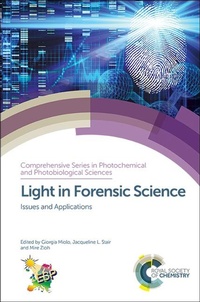
Light in Forensic Science
Issues and Applications
1st Edition
Published on 16. April 2018
431 pages
978-1-78801-034-4 (ISBN)
Description

The identification and quantification of material present and collected at a crime scene are critical requirements in investigative analyses. Forensic analysts use a variety of tools and techniques to achieve this, many of which use light. Light is not always the forensic analyst's friend however, as light can degrade samples and alter results.
This book details the analysis of a range of molecular systems by light-based techniques relevant to forensic science, as well as the negative effects of light in the degradation of forensic evidence, such as the breakage of DNA linkages during DNA profiling. The introductory chapters explain how chemiluminescence and fluorescence can be used to visualise samples and the advantages and limitations of available technologies. They also discuss the limitations of our knowledge about how light could alter the physical nature of materials, for example by breaking DNA linkages during DNA profiling or by modifying molecular structures of polymers and illicit drugs. The book then explains how to detect, analyse and interpret evidence from materials such as illicit drugs, agents of bioterrorism, and textiles, using light-based techniques from microscopy to surface enhanced Raman spectroscopy.
Edited by active photobiological and forensic scientists, this book will be of interest to students and researchers in the fields of photochemistry, photobiology, toxicology and forensic science.
This book details the analysis of a range of molecular systems by light-based techniques relevant to forensic science, as well as the negative effects of light in the degradation of forensic evidence, such as the breakage of DNA linkages during DNA profiling. The introductory chapters explain how chemiluminescence and fluorescence can be used to visualise samples and the advantages and limitations of available technologies. They also discuss the limitations of our knowledge about how light could alter the physical nature of materials, for example by breaking DNA linkages during DNA profiling or by modifying molecular structures of polymers and illicit drugs. The book then explains how to detect, analyse and interpret evidence from materials such as illicit drugs, agents of bioterrorism, and textiles, using light-based techniques from microscopy to surface enhanced Raman spectroscopy.
Edited by active photobiological and forensic scientists, this book will be of interest to students and researchers in the fields of photochemistry, photobiology, toxicology and forensic science.
More details
Series
Language
English
Place of publication
Cambridge
United Kingdom
Target group
Professional and scholarly
College/higher education
File size
29,59 MB
ISBN-13
978-1-78801-034-4 (9781788010344)
DOI
10.1039/9781788010344
Copyright in bibliographic data and cover images is held by Nielsen Book Services Limited or by the publishers or by their respective licensors: all rights reserved.
Schweitzer Classification
Other editions
Additional editions
Book
04/2018
Royal Society of Chemistry
€231.50
Shipment within 3-4 weeks
E-Book
04/2018
1st Edition
Royal Society of Chemistry
€249.99
Available for download
Persons
Content
Light for Crime Scene Examination;
Degradation and Damage due to Exposure to Light in Trace Evidence;
Use of Light in the Detection of Genetic Variation of Forensic Importance;
Use of Light in Fingerprint Detection;
Light as an Ionizing Agent in Mass Spectrometry. Microbial Identification by Matrix Assisted Laser Desorption Ionization-Mass Spectrometry;
The Use of Light in Forensic Glass Analysis;
A Review on Analytical Techniques Used for Forensic Fiber Analysis;
Novel Psychoactive Substances (NPS) and Recent Scenarios: Epidemiological, Anthropological and Clinical Pharmacological Issues;
Raman Spectroscopy for the Analysis of Novel Psychoactive Substances (NPS);
Light in Forensic Science: Microcrystalline Tests of New Psychoactive Substances Using Light Microscopy;
Optical Detection of NPS Internet Products via HPLC-DAD Systems: A Selective Review;
Supramolecular Approach in Detecting Drugs of Abuse: Optical Sensors;
Photodegradation of Drugs/Illicit Drugs in Water;
Photodegradation of Drugs of Abuse in Hair
Degradation and Damage due to Exposure to Light in Trace Evidence;
Use of Light in the Detection of Genetic Variation of Forensic Importance;
Use of Light in Fingerprint Detection;
Light as an Ionizing Agent in Mass Spectrometry. Microbial Identification by Matrix Assisted Laser Desorption Ionization-Mass Spectrometry;
The Use of Light in Forensic Glass Analysis;
A Review on Analytical Techniques Used for Forensic Fiber Analysis;
Novel Psychoactive Substances (NPS) and Recent Scenarios: Epidemiological, Anthropological and Clinical Pharmacological Issues;
Raman Spectroscopy for the Analysis of Novel Psychoactive Substances (NPS);
Light in Forensic Science: Microcrystalline Tests of New Psychoactive Substances Using Light Microscopy;
Optical Detection of NPS Internet Products via HPLC-DAD Systems: A Selective Review;
Supramolecular Approach in Detecting Drugs of Abuse: Optical Sensors;
Photodegradation of Drugs/Illicit Drugs in Water;
Photodegradation of Drugs of Abuse in Hair
