

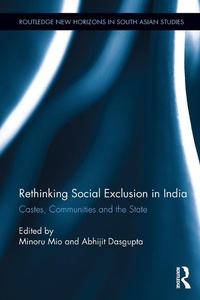
Rethinking Social Exclusion in India
Castes, Communities and the State
1st Edition
Published on 7. August 2017
186 pages
978-1-351-98322-8 (ISBN)
Description

In recent years exclusionary policies of the Indian state have raised questions concerning social harmony and economic progress. During the last few decades the emergence of identity politics has given new lease of life to exclusionary practices in the country. Castes, communities and ethnic groups have re-emerged in almost every sphere of social life.
This book analyses different aspects of social exclusion in contemporary India. Divided into three sections - 1. New Forms of Inclusion and Exclusion in Contemporary India; 2. Religious Identities and Dalits; 3. Ethnicity and Politics of Inclusion and Exclusion in the North-eastern Frontier - the book shows that a shift has taken place in the discourse on inclusion and exclusion. Chapters by experts in their fields explore issues of inclusion and exclusion that merit special attention such as dalit identity, ethnicity, territoriality and minorities. Authors raise questions about developmental programmes of the state aimed at making India more inclusive and discuss development projects initiated to alleviate socio-economic conditions of the urban poor in the cities. As far as North-east region is concerned, the authors argue that there is a tendency to highlight the homogenizing nature of the Indian culture by stressing one history, one language, one social ethos. Diversity is hardly accepted as a social reality, which has adversely affected the inclusive nature of the state. Against this development the final part of the book looks at questions regarding ethnic minorities in the northeast.
Offering new insights into the debate surrounding social exclusion in contemporary India, this book will be of interest to academics studying anthropology, sociology, politics and South Asian Studies.
This book analyses different aspects of social exclusion in contemporary India. Divided into three sections - 1. New Forms of Inclusion and Exclusion in Contemporary India; 2. Religious Identities and Dalits; 3. Ethnicity and Politics of Inclusion and Exclusion in the North-eastern Frontier - the book shows that a shift has taken place in the discourse on inclusion and exclusion. Chapters by experts in their fields explore issues of inclusion and exclusion that merit special attention such as dalit identity, ethnicity, territoriality and minorities. Authors raise questions about developmental programmes of the state aimed at making India more inclusive and discuss development projects initiated to alleviate socio-economic conditions of the urban poor in the cities. As far as North-east region is concerned, the authors argue that there is a tendency to highlight the homogenizing nature of the Indian culture by stressing one history, one language, one social ethos. Diversity is hardly accepted as a social reality, which has adversely affected the inclusive nature of the state. Against this development the final part of the book looks at questions regarding ethnic minorities in the northeast.
Offering new insights into the debate surrounding social exclusion in contemporary India, this book will be of interest to academics studying anthropology, sociology, politics and South Asian Studies.
More details
Series
Edition
1. Auflage
Language
English
Place of publication
London
United Kingdom
Publishing group
Taylor & Francis Ltd
Target group
College/higher education
Product notice
Reflowable
Illustrations
8 Tables, black and white; 12 Line drawings, black and white; 10 Halftones, black and white; 22 Illustrations, black and white
File size
3,07 MB
ISBN-13
978-1-351-98322-8 (9781351983228)
Copyright in bibliographic data and cover images is held by Nielsen Book Services Limited or by the publishers or by their respective licensors: all rights reserved.
Schweitzer Classification
Other editions
Additional editions
Book
12/2019
1st Edition
Routledge
€64.70
Shipment within 15-20 days
Book
08/2017
1st Edition
Routledge
€230.65
Shipment within 10-20 days
Persons
Minoru Mio is Associate Professor at the Centre for Research Development and Director of the Centre for Contemporary India Area Studies at the National Museum of Ethnology, Japan.
Abhijit Dasgupta is Professor of Sociology at the Delhi School of Economics, University of Delhi, India.
Abhijit Dasgupta is Professor of Sociology at the Delhi School of Economics, University of Delhi, India.
Content
Introduction, Minoru Mio and Abhijit Dasgupa
Part I: New Forms of Inclusion and Exclusion in Contemporary India
1. Conditions of 'Developmental Democracy: New Logic of Inclusion and Exclusion in Globalizing India, Akio Tanabe
2. Streets as Space of Social Inclusion and Exclusion: The Case of Street Vendors in Ahmadabad, Ayako Iwatani
3. The Inclusion and Exclusion of Minorities in India: The Case of Gujarati Muslims, Kazuya Nakamizo
Part II: Religious Identities and Dalits
4. Belonging and Being: Unpacking Dalit Christian Identity, Anderson H. M. Jeremiah
5. Excluding Themselves? Dalits Converting to Buddhism, Kenta Funahashi
6. Affirmative Action and Exclusion of the Muslim Outcastes in West Bengal, Abhijit Dasgupta
7. Marginalization and Subversive Religious Rites: Worship of Dharmathakur in West Bengal, Rita Banerjee
Part III: Ethnicity and Politics of Inclusion and Exclusion in the North-eastern Frontier
8. The Forest as a Site of Conflict: Struggles over Indigenous Territory in the Bodo Areas of Assam, Makiko Kimura
9. Between NREGA and a Hard Place: Insurgency, Citizenship and Entitlements among Indian Migrant Labourers in Nagaland, Michael Heneise
10. Moral Geographies: The Problem of Sovereignty and Indigeneity amongst the Nagas, Arko Longkumer
Part I: New Forms of Inclusion and Exclusion in Contemporary India
1. Conditions of 'Developmental Democracy: New Logic of Inclusion and Exclusion in Globalizing India, Akio Tanabe
2. Streets as Space of Social Inclusion and Exclusion: The Case of Street Vendors in Ahmadabad, Ayako Iwatani
3. The Inclusion and Exclusion of Minorities in India: The Case of Gujarati Muslims, Kazuya Nakamizo
Part II: Religious Identities and Dalits
4. Belonging and Being: Unpacking Dalit Christian Identity, Anderson H. M. Jeremiah
5. Excluding Themselves? Dalits Converting to Buddhism, Kenta Funahashi
6. Affirmative Action and Exclusion of the Muslim Outcastes in West Bengal, Abhijit Dasgupta
7. Marginalization and Subversive Religious Rites: Worship of Dharmathakur in West Bengal, Rita Banerjee
Part III: Ethnicity and Politics of Inclusion and Exclusion in the North-eastern Frontier
8. The Forest as a Site of Conflict: Struggles over Indigenous Territory in the Bodo Areas of Assam, Makiko Kimura
9. Between NREGA and a Hard Place: Insurgency, Citizenship and Entitlements among Indian Migrant Labourers in Nagaland, Michael Heneise
10. Moral Geographies: The Problem of Sovereignty and Indigeneity amongst the Nagas, Arko Longkumer
