

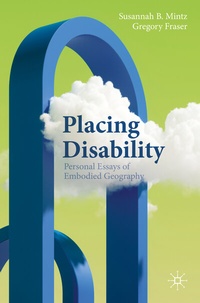
Placing Disability
Description

Placing Disability presents an international collection of personal essays that address the experience of disability in particular geographical locations. Each chapter engages the question of what it means to be disabled in a specific place, exploring issues of movement, work and play, community and activism, artistic production, love and marriage, access and social services, family and friendship, memory and aging-all informed by the places that people inhabit. The book is organized in terms of topographies and vistas, rather than being bound by the map, to emphasize the defining, constitutive effects of place. The authors included in Placing Disability hail from different countries, neighborhoods, climates, and landscapes; from various backgrounds and professions; from a range of disciplinary perspectives and strategies. They are trained as academics, literary critics, poets, students, public speakers, memoirists, educators, philosophers, administrators, and activists. Their essays refine our understanding of the complex dynamic between self and circumstance as they survey the impact of geographical region on their life experiences. This book is intended to be useful in creative-writing workshops, Disability Studies seminars, and classes on environmental literature, and to appeal to general readers of memoir as well as to scholars of contemporary body theory or the Anthropocene.
Reviews / Votes
"Placing Disability is an engaging compilation of disability memoirs that offers important insight into the intersection between embodiment and emplacement. Each essay-from established disability activists and writers as well as a range of new voices-presents a thoughtfully-crafted reflection on how the authors' disabilities shaped their experience with and attachment to the places they inhabit. An important and much-needed addition to the fields of disability studies, environmental humanities, and life writing."
-Associate Professor of English at Shippensburg University and Director of the Interdisciplinary Minor in Disability Studies
More details
Other editions
Additional editions
Persons
Susannah B. Mintz is Professor of English at Skidmore College. Her books include the memoir Love Affair in the Garden of Milton (2021) and four scholarly volumes on disability and literature. She is also the co-editor of four collections of work on disability issues, including Disability Experiences (2019, with G. Thomas Couser).
Gregory Fraser is Professor of English at the University of West Georgia. He is the author of four poetry collections, most recently Little Armageddon (2021), and co-author of two writing textbooks. Fraser's poetry has appeared in journals including The New Yorker, The Paris Review , The Southern Review , and Ploughshares . He is the recipient of several awards, including grants from the National Endowment for the Arts and the Guggenheim Foundation.
Content
1. Preface; Susannah B. Mintz and Gregory Fraser.- 2. Disability and Memoir; G. Thomas Couser.- 3. Disability and Space; Rob Imrie.- Part 1: Into the Wide Open .- 4. Learning the Camino Real-Disability and the Desert; Sheila Black.- 5. Headlamps and Fireside Light; Rachel Kolb.- 6. A Sense of Place and Cyberspace: The Hybrid Way I Live, Work, and Play; Gyasi Burks-Abbott.- 7. Ad Astra Per Aspera (To the Stars Through Difficulties); Brenda Jo Brueggemann.- Part 2: Metro-Geographies .- 8. Peaks and Valleys: A Collaborative Essay about Disability in the Bronx; Annette Serrano, Cindy Hernandez, Andrew Whyte, Sonia Gonzalez, Jovan Campbell, and Mary Morfe (with an introduction by Julia Miele Rodas).- 9. Blindness and Dyslexia in the Movements of Everyday Life in Toronto; Rod Michalko and Tanya Titchkosky.- 10. Disability in New York City Schools and Preparing Teachers to Work in Them; Laurie Rabinowitz.- 11. Drenched Lands, Blood Compost: Disability, Land, and the Asylum Project; Petra Kuppers.- Part 3: Liminal (Dis)locations .- 12. A Tide in the River: Auditory Ecologies of Dyarubbin; Nicole Matthews.- 13. Hydra, New Hampshire; Stephen Kuusisto.- 14. Between Places; Leigh A. Neithardt.- 15. The Lie of the Land; Annmaree Watharow.- 16. Body Workers; Ellen Samuels.- 17. Never in one Place: On Waking in a Different Body; Anand Prahlad.
