

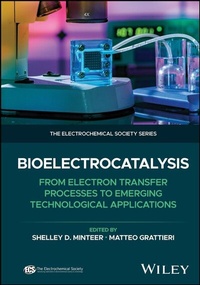
Bioelectrocatalysis
Description

An authoritative resource introducing the fundamentals of enzymatic and microbial electrocatalysis
In Bioelectrocatalysis: From Electron Transfer Processes to Emerging Technological Applications, a team of distinguished researchers delivers an up-to-date discussion of fundamental concepts in bioelectrocatalysis and its applications. The authors offer a comprehensive treatment of the foundations of bioelectrocatalysis. Beginning with a comparison of enzymatic and microbial electrocatalysis, the book goes on to explore the differences between direct and mediated bioelectrocatalysis and the challenges presented by promoting extracellular electron transfer.
Bioelectrocatalysis presents detailed and accurate information on the approaches and techniques used to study the electron transfer processes and to confirm the type of electron transfer taking place. Readers will also find chapters dedicated to common and emerging applications of bioelectrocatalysis, including glucometers and glucose monitors, biosensors, and biofuel cells.
Inside the book:
- A thorough introduction to electron transfer in enzymatic bioelectrocatalysis
- Comprehensive explorations of glucometers, continuous glucose monitors, ex-situ biosensors, biofuel cells, and biosolar cells
- Practical discussions of microbial electrochemical technologies for used water treatment
- Complete treatments of electrosynthesis and wearable and implantable devices
Perfect for academic researchers and industrial scientists working in (bio)electrochemistry, catalysis, and chemical synthesis, energy materials, and sensors, Bioelectrocatalysis will also benefit advanced undergraduate and graduate students studying in any of those fields.
More details
Other editions
Additional editions
Persons
Shelley D. Minteer, PhD, is the Dr. Ken Robertson Memorial Professor of Chemistry and the Director of the Kummer Institute Center for Resource Sustainability at Missouri University of Science and Technology. She's also the Director of the NSF Center for Synthetic Organic Electrochemistry.
Matteo Grattieri, PhD, is an Assistant Professor of (Bio)Electrochemistry at the Chemistry Department of the Università degli Studi di Bari Aldo Moro. His research is focused on microbial electrochemical systems, semi-artificial photosynthesis, biomaterials, and biosensors development.
Content
Preface ix
List of Contributors xi
1 Fundamentals of Bioelectrocatalysis 1
Matteo Grattieri and Shelley D. Minteer
1.1 Introduction 1
1.2 Bioelectrocatalysts and Electron Transfer 2
1.2.1 Enzymatic Bioelectrocatalysis 4
1.2.2 Microbial Bioelectrocatalysis 6
1.3 Conclusions and Outlook 8
Acknowledgments 9
References 9
2 Electron Transfer in Enzymatic Catalysis 17
Fred Lisdat and Daniel Schäfer
2.1 Introduction 17
2.2 Overview of Approaches 19
2.3 Mediated Electron Transfer 21
2.3.1 Concept 21
2.3.2 Reaction of the Mediator with the Electrode 22
2.3.2.1 Mediator in Solution 22
2.3.2.2 Mediator Immobilized 24
2.3.2.3 Mediators Operating in a Volume in Front of the Electrode 26
2.3.3 Reaction of the Mediator with the Enzyme 28
2.4 Direct Electron Transfer 30
2.5 Conducting Polymers 34
2.6 Application of Nanoparticles 37
2.7 Mass Transport Limited Systems 39
2.8 Protein Engineering 40
2.8.1 Truncation 43
2.8.2 Fusion Proteins 43
2.8.3 Point Mutations 44
2.8.4 Unnatural Amino Acids 45
2.9 Conclusions and Outlook 45
References 45
3 Extracellular Electron Transfer in Microbial Bioelectrocatalysis 59
César I. Torres, Christine Lewis, Juan F. Ortiz Medina, and Jesús A. Pérez García
3.1 Introduction 59
3.1.1 Electrons Through Insulating Cell Bodies 59
3.2 Electrochemical Responses of Electroactive Bacteria 62
3.2.1 Extracellular Electron Shuttle Transport Under Substrate Excess Conditions 62
3.2.2 Effects of Substrate Depletion, Redox Mediators, and Catalyst Wear on EES-Mediated Eet 65
3.2.3 Extracellular Electron Transfer Through a Solid Conductive Matrix 67
3.3 Shewanella sp. and its Extracellular Electron Shuttles 68
3.4 Phenazine-Mediated Extracellular Transfer in Pseudomonas aeruginosa 70
3.5 Aiding the Movement of Electrons with the Addition of Extracellular Electron Shuttles (EESs) 72
3.5.1 Characterization of EES Candidates 72
3.5.2 What Makes a Good EES Candidate? 73
3.5.2.1 An EES Must Reduce/Oxidize at the Correct Cellular Target Potential Within Its Given Chemical Environment 74
3.5.2.2 An EES Should be Both Electrochemically Reversible and Stable 74
3.5.2.3 An EES Must be Soluble and Diffusible with Limited Kinetic Loss to "Shuttle" 75
3.5.2.4 Ensure that an EES Addition is Nontoxic and Does Not Influence Other Cellular Processes 75
3.5.2.5 EES Must Function in Dynamic Systems 75
3.5.3 Examples of Exogenous Electron Shuttles Used in METs 75
3.5.3.1 Humic Acid [Eo' ~-200 to +300 mV vs. Standard Hydrogen Electrode (SHE)] 75
3.5.3.2 Quinones (Eo' ~-300 to +200 mV vs. SHE) 76
3.5.3.3 Phenazines, Flavins, and Dyes (Eo' Range Approximately Between -100 and +500 mV) 79
3.5.3.4 Ferrocene Analogs (Eo' ~-200 to +500 mV vs. SHE) 81
3.5.3.5 EES-MET Systems, EES with Genetic Modifications, and EES Effects on Biofilms 82
3.5.4 Closing Perspective on Exogenous EES 82
3.6 Geobacter sulfurreducens and Nanowires 83
3.6.1 Components of Extracellular Conductive Matrix of G. sulfurreducens 84
3.6.1.1 Protein Filaments (pili) 84
3.6.1.2 Outer Membrane Cytochromes 84
3.6.1.3 Other Conductive Matrix Components in Anodic G. sulfurreducens Biofilms 86
3.6.2 Importance of Nanowire Conductivity in Establishing High-Current Biofilm Matrix 86
3.6.3 Current Efforts to Understand Nanowire Utilization 87
3.7 Final Perspective on EET Approaches in Microbial Electrochemistry 92
References 92
4 Glucometers and Continuous Glucose Monitors 107
Nunzio Giorgio G. Carducci and David P. Hickey
4.1 Introduction 107
4.1.1 Evolution of Modern Glucometers 108
4.2 Glucose Oxidation Catalysts in Glucometers 110
4.2.1 Glucose Oxidase 111
4.2.2 Glucose Dehydrogenase 111
4.2.3 Engineering Enzymes for Improved Glucometers 112
4.3 Operating Principles of Glucometers 113
4.3.1 Detection of H2 O2 from GOx/O2 Glucose Oxidation 113
4.3.2 Mediated Bioelectrocatalysis for Glucose Sensing 115
4.3.3 Electrical "Wiring" of GOx or GDH in Redox Hydrogels 116
4.3.4 DET Bioelectrocatalysis for Glucose Sensing 117
4.3.5 Glucose Concentrations and Forms in Clinically Relevant Conditions 117
4.3.6 Error Analysis and Sampling of Glucometers 119
4.4 From Single-Point Testing to Continuous Monitoring 120
4.4.1 POC Glucometers 120
4.4.2 Single-Point Test Glucometers 121
4.4.3 Continuous Glucose Monitoring 122
4.4.4 Interstitial Fluid 123
4.4.5 Tears, Saliva, and Sweat 124
4.5 Ongoing Challenges 125
References 125
5 Ex Situ Biosensors 135
Jacquelyn E. McBride and Michelle Rasmussen
5.1 Introduction 135
5.1.1 Background 135
5.2 Organic Carbon Load 136
5.2.1 BOD Determination by Oxygen Monitoring 137
5.2.2 Mediator-Based BOD Sensors 138
5.2.3 Microbial Fuel Cell BOD Sensors 139
5.3 Toxic Compounds 139
5.3.1 Pesticides 140
5.3.2 Phenolic Compounds 140
5.3.3 Heavy Metals 142
5.3.4 Explosives 142
5.4 Emerging Trends for Enhanced Performances 143
5.5 Conclusions and Future Outlook 143
References 144
6 Biofuel Cells and Biosolar Cells 149
Matteo Grattieri and Shelley D. Minteer
6.1 Introduction 149
6.2 Enzymatic Fuel Cells 150
6.2.1 Historical Overview: From Early Studies to Current Days 150
6.2.2 Deep Oxidation of Fuel 153
6.2.3 Substrate Channeling 153
6.2.4 Nanostructured Electrodes for High-Performance EFC 156
6.3 Microbial Fuel Cells 156
6.3.1 Complex Substrates and Microbial Species for Power Production 158
6.3.2 Current Approaches for Improving Power Density Production 159
6.4 Biosolar Cells 160
6.4.1 Biosolar Cells with Isolated Photosynthetic Apparatuses 162
6.4.2 Biosolar Cells with Intact Organisms and Organelles 163
6.4.3 Engineered Biosolar Cell Setups for Improved Power Production 164
6.5 Conclusions: Future Perspective and Emerging Approaches 166
Acknowledgments 166
References 166
7 Microbial Electrochemical Technologies for Used Water Treatment 175
Ruggero Rossi
7.1 Introduction 175
7.2 Integrating Microbial Electrochemical Technologies in Wastewater Treatment Plants 178
7.3 Large-Scale MFCs for Wastewater Treatment - Material Selection 179
7.4 Large-Scale MFCs for Wastewater Treatment - Architecture 184
7.5 Internal Resistance in Large-Scale MFCs 185
7.6 Large-Scale MFCs for Wastewater Treatment - Substrate 187
7.7 Treatment Efficiency 188
7.8 Energy Recovery 190
7.9 Comparison of MFCs with Conventional Wastewater Treatment Technologies 190
7.10 Treatment Technologies Other than MFCs: Microbial Electrolysis Cells 191
7.11 Outlook and Future Directions 194
References 195
8 Electrosynthesis 203
Marcos Pita, Gabriel García-Molina, Kavita Jayakumar, Jose María Abad, and AntonioL.DeLacey
8.1 Introduction 203
8.2 Bioelectrosynthesis for CO2 Reduction 204
8.2.1 Bioelectrocatalysts for CO2 Reduction 206
8.2.2 CO2 Bioelectrocatalytic Pathways 206
8.2.3 CO2 Reduction Products and Recent Advances 207
8.2.4 Formic Acid Production: Enzymatic Approach 207
8.2.5 Acetate and Butyrate Production: MES 208
8.2.6 Alcohol Production 209
8.2.7 Olefin and Methane Production: MES and Nitrogenases 209
8.2.8 Bioelectrochemical CO2 Reduction to Complex Carbon-Based Products 209
8.3 Bioelectrocatalytic Production of H 2 211
8.3.1 Introduction 211
8.3.2 Electroenzymatic Production of H 2 211
8.3.3 Microbial Production of H 2 213
8.4 Bioelectrosynthesis of Ammonia 214
8.5 Bioelectrocatalysis for Organic Synthesis 222
8.6 Conclusions 225
References 225
9 Wearable and Implantable Devices 237
Edmond Magner
9.1 Introduction 237
9.2 Skin-Based Systems 238
9.2.1 Electrode Material 242
9.3 Ocular Systems 244
9.4 Textile Material-Based Systems 246
9.5 Conclusions 248
References 248
Index 251
1
Fundamentals of Bioelectrocatalysis
Matteo Grattieri1,2 and Shelley D. Minteer3
1Department of Chemistry, Università degli Studi di Bari Aldo Moro, Bari, Italy
2Istituto per i Processi Chimico Fisici, Consiglio Nazionale delle Ricerche, Bari, Italy
3Kummer Institute Center for Resource Sustainability, Missouri University of Science and Technology, Rolla, MO, USA
1.1 Introduction
Bioelectrocatalysis is a fascinating research field where a biological material, spanning from isolated apparatuses to intact organisms (Box 1.1), is utilized as a catalyst for redox reactions taking place at an electrode. The interest in this research field has its foundations on the combination of the advantages provided by the features of biological systems, such as diverse catalytic functions, mild reaction conditions, high activity and selectivity, and the possibility to control the oxidizing and reducing ability of an electrode by modifying its Fermi level [1]. Nowadays, bioelectrocatalysis has several applications, which are presented and discussed in detail in various chapters of the books, including the development of (i) biofuel cells for power production [2, 3], (ii) biosensors [4-9], (iii) systems for drug release [10], (iv) wearable devices [11, 12], (v) systems performing the treatment of contaminated water [13-15], and (vi) systems performing the electrosynthesis of valuable products [16-19].
At the basis of bioelectrocatalysis is the process of electron transfer (ET) between the biological components and the electrodes. Achieving a rapid and efficient ET defines the success or the failure of a bioelectrocatalytic system. Accordingly, the ET process constitutes the major challenge in bioelectrocatalysis, and this chapter is dedicated to introduce the general aspects governing the interaction between biological catalysts and electrodes, providing the basic concepts to approach the book. The detailed ET processes for enzymes and microorganisms are discussed in Chapters 2 and 3, respectively.
Box 1.1 Enzymes as Biological Catalysts
Enzymes play a pivotal role in life, with more than 99% of all the reactions that are crucial to biological systems being catalyzed by enzymes. Like other catalysts, enzymes allow for an increase in the rate of a chemical reaction without being consumed or altered by such reactions, thus overcoming the kinetic barriers that hinder a specific process. Interestingly, when the term "catalysis" was proposed in 1836 by the Swedish chemist Berzelius (1779-1848) from the Greek kata (wholly) and lyein (to loosen), no distinction was made between a chemical and biological catalysis, and only the term "contact substance" was used for referring to a catalyst [20]. One of the unique properties of enzymes, their high specificity for a specific substrate, was highlighted as early as 1894 by the German chemist Emil Fischer (1852-1919, Nobel Prize in Chemistry in 1902), who hypothesized the popular lock-and-key mechanism of enzyme interaction with a substrate. Shortly later, the kinetics of enzyme catalysis was studied by Victor Henri (in 1903) and followed by Leonor Michaelis and Maud Menten (in 1913), who described the rate equation of enzyme kinetics with the Henri-Michaelis-Menten equation, commonly referred to as the Michaelis-Menten equation:
(1.1)where v is the rate of enzyme-catalyzed reaction (velocity), Vmax is the limiting maximum value for the velocity, S is the substrate for the reaction, and KM is a constant often referred to as "Michaelis constant" arising from the three rate constants (k1, k-1, and k2) of the following reaction:
(1.2)where E is the enzyme, S is the substrate, ES is the enzyme-substrate complex that is formed when enzyme and substrate come together, and P is the product. k1 and k2 are the forward rate constants for the first and second steps, respectively, while k-1 and k-2 are the backward rate constants for the first and second steps, respectively. Although not all enzymes follow Michaelis-Menten kinetics, it is usually a good approximation for enzymatic electrochemistry systems.
1.2 Bioelectrocatalysts and Electron Transfer
Enzymes can be considered the most commonly utilized biological catalyst for bioelectrocatalysis. They provide high specificity due to the molecular recognition event that takes place in the binding pocket for their substrates, where their redox active center(s), the cofactors, allow performing the catalytic process, converting the substrate into the products. This process is made possible by the 3D structure of the enzyme. However, different from the commonly known metallic electrocatalysts (i.e. platinum group and non-platinum group catalysts) [21, 22] and nonmetallic electrocatalysts (i.e. 2,2,6,6-tetramethylpiperidinyl-N-oxyl) [23], the 3D structure of biological catalysts constitutes a nonconductive layer surrounding the cofactors [24]. As a result, when aiming to "electrically wire" an enzyme to an electrode, the primary goal is to successfully transfer the electrons across this insulating layer. This ET process can be described by utilizing the semi-classical Marcus theory for ET in nonadiabatic systems. According to Marcus theory, the rate constant of ET (kET) can be expressed as:
(1.3)where ? is the reduced Planck's constant (1.05457182 × 10⁻³⁴ Js), HDA is the matrix coupling element (also known as electronic coupling parameter), ? is the nuclear reorganization energy (the energy required to force the reactant into the same nuclear configuration as the products without the ET taking place), and ?G0 is the thermodynamic driving force of the reaction.
Importantly, the electronic coupling parameter exponentially decays with an increasing distance between the electron donor and acceptor sites (rDA) as described by:
(1.4)where indicates the electronic coupling parameter for the donor (D) and acceptor (A) when they are at the minimum distance, and ß is the electronic coupling attenuation coefficient that varies depending on the medium separating donor and acceptor.
According to Eq. (1.4), and considering that the electron tunneling time for biological redox systems should be in the millisecond to microsecond range for their proper functioning, the maximum center-to-center distance for a single-step electron tunneling should be approximately 24 [25, 26], with lower distances resulting in higher rates of ET (Figure 1.1) [28]. This distance should not be taken as a hard limit, and ET at distances higher than 24 has been reported [29]. Taking this into consideration, it is interesting to underline the center-to-center distance for two widely employed enzymes in bioelectrocatalysis: laccase and glucose oxidase. Laccases (EC 1.10.3.2) [30] are multicopper oxidoreductase where a Type 1 copper center (located about 6.5 Å below the enzyme surface) accepts one electron from diphenols and related substances and transfers it to a trinuclear copper cluster (where the oxygen reduction process takes place) that is located at a distance of 12-13 Å [31, 32]. Glucose oxidase from Aspergillus niger (E.C. 1.1.3.4) is an enzyme that catalyzes the oxidation of D-glucose due to two flavin active sites buried deeply within the enzyme structure, at a distance of approximately 20-27 Å [33-35].
Another important aspect is that the ET rate also depends on the electrochemical overpotential applied. Specifically, knowing that:
(1.5)Figure 1.1 Dependence of the rate of single-step electron transfer on the distance between donor and acceptor centers based on semi-classical Marcus theory.
Source: Hickey et al. [27] / with permission of The Royal Society of Chemistry.
and that we can apply a specific overpotential (?) by modulating the potential applied to an electrode with respect to the redox potential of the redox species involved in the electrode transfer process:
(1.6)we can relate the free energy and the overpotential with Eq. (1.7):
(1.7)By combining Eqs. (1.3) and (1.7), and noticing the quadratic nature of the free energy term in Eq. (1.3), a finite range where an increase in overpotential results in an increase in the ET rate can be defined. Passing this overpotential results in a point of inversion in the ET rate, which starts to decrease for increasing overpotentials, indicating what is known as the "Marcus inverted region" [25, 36, 37]. However, such an "inverted region" is not typically observed in bioelectrochemical systems, likely because at high overpotentials, the reactions become limited by mass transfer or...
