

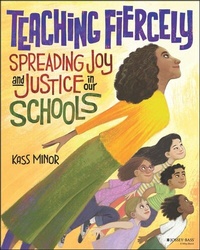
Teaching Fiercely
Description

In Teaching Fiercely: Spreading Joy and Justice in Our Schools, accomplished educator Kass Minor delivers an inspiring and practical exploration of what it means to be a just teacher in a system that actively incentivizes injustice. The author explains how to build joyful experiences even in the face of inevitable injustice and demonstrates how to accept the seemingly conflicting experience of joy in the face of heartbreak.
In the book, you'll learn to be a catalyst for change, unlearning the patterns of school that have marginalized children while becoming aware of tenets of justice as they manifest in educational spaces. You'll also discover:
* Strategies for creating human-centered care and joy, in which thoughts, actions, and decisions are drawn from within the school community
* Techniques for creating student-centered experiences within standards-based classrooms
* How to raise the level of family involvement in your students' education and improve communication between family and staff
An essential blueprint for K-12 educators, school support staff, and school administrators, Teaching Fiercely will also earn a place on the bookshelves of education policymakers, researchers, and students.
More details
Other editions
Additional editions
Content
Author's Note xiii
Foreword by Sara K. Ahmed xv
Introduction xvii
Acknowledgments xxxiii
Prologue: Anthem for a Teacher xxxv
Chapter 1: Building the Foundation: A Structured Generator of Hope for More Joyful and Just Schools 1
A Structured Generator of Hope 1
The Pedagogy of Justice 5
What Is Justice? 7
Justice for Whom? (In the Realm of School Integration) 17
Where is Joy Located in the Pursuit Toward Justice? 22
Dreams, Nourishment, Rituals: Toward Future Goodness 25
Historical Underpinnings: Exploring the Roots of Schooling 31
Chapter 2: Seeing and Feeling the Pressure of Injustice: Perspective Changes Everything 35
Dominant Culture: Perspective Changes Everything 38
Catalyst for Change: Knowing How to See and Feel the Pressure of Injustice 44
Identifying Layers of Perspective 49
Tools for Perspective Analysis: More than a Decade Later 52
Timeline Pedagogy: To Move Forward, We Must Look Back 62
Chapter 3: A Framework for Social Justice Work in Schools and Gentle Notes on Learning 75
Collaborate 77
Nurture 78
Build 81
Reflect 83
Connecting the Collaborate, Nurture, Build, and Reflect Framework 84
Teaching Fiercely: Spreading Joy and Justice in Our Schools ix
Gentle Notes on Learning: Rituals and the Beginnings of Our Thought Sanctuary 96
Somatic Literacy 97
Chapter 4: Pursue Joy by Thwarting Injustice: Develop Teacher Agency Through Reflective Practice and Collaboration 105
Points of Reflection 109
The Nature of a Curriculum-Making Journey 116
Embracing Teacher Intellect: Changing the Narrative About Teachers 133
Chapter 5: Moving Toward Joy: Student-Centered Experiences in Standards-Based Classrooms 141
To Teach Fiercely Requires Teacher Agency 145
Four Methods of Instructional Delivery 156
Curriculum-Making: Frameworks and Foundational Understandings 163
Chapter 6: The Joyful Work of Building Imaginative Capacities Matters: Know that Learning Predates School 175
"Do Schools Kill Creativity?" 179
Working Toward Justice: The Continued Conversation on Student Centeredness 183
Chapter 7: Beyond the Protest March: How to Design Justice-Oriented Learning Spaces, Experiences, and Curriculum That Is Immersed in Joy for Kids 205
Designing Justice-Oriented Learning Spaces 211
The Nuts and Bolts of Justice Designs 213
What Matters to Children 223
Chapter 8: Negotiating the Curriculum for Your Current Students in Today's World 227
Three Paths for Considering Kids, Justice, and Curriculum Design 233
Epilogue: Redefining Ferocity 245
My Edu-Credo 247
Works Cited 249
About the Author 265
Index 267
Introduction
Early 2000s
When I began teaching in the early 2000s, "social justice," "equity," "ABAR,"1 and "CR-SE"2 were not buzzwords floating around in public rhetoric, and most certainly were not featured on television or other media channels. Conversations about the "science of reading" had not yet hit public airwaves. The heat behind schools' choices for literacy curriculum took place mostly within academic circles working at universities, not so much between those who worked at schools, with children. If you saw something on TV about reading, or about how children should act, at least in my fledgling teacher world, you were most likely catching a rerun of Levar Burton's Reading Rainbow3 or maybe listening to Prince Tuesday from Mr. Rogers Neighborhood4 say a thing or two about how children should behave.
In the early 2000s, MySpace was still a thing, Facebook had just opened up to the community at large, and Twitter and Instagram didn't yet exist. In short, spreading information about what was really going on in schools-i.e., what kids were experiencing, how teachers were teaching, what parents and caregivers were saying-was much harder to access. As classroom teachers who remembered the strange undercurrent of both fear and jubilation during Y2K,5 my colleagues and I were teaching our hearts out-and, honestly, there weren't a lot of people around us who had "boo" to say about it, let alone comment on what books were in our classroom libraries.
My partner, Cornelius, and I joke about how in those first few years of teaching life we were feral teachers, teachers who were given so much freedom in the name of kids' best interests that putting parameters around our work would have inhibited our ability to activate our instinctual knowing, our innate calling, that is, to teach. I'm talking about the kind of teaching that has limited support these days: the kind of teaching that is raw and gritty yet playful and effective. The kind of teaching that is labored, almost subconsciously, by a teacher's work with the kids and families and colleagues that surround her, through trial and error, love and rejection.
Sigh.
People often give the word "feral" a bad rap, a negative connotation. But I think there's a really beautiful association with it. For example, at the Brooklyn Public Library down the street from where I live, a perhaps feral cat has built a home, or at least, has insisted upon its housing. It (he? she? they? not sure of the gender) can be seen in the front garden of the library, nestled in a cinder block with a scrap of wood over it, surrounded by three bowls of food that are always full. I imagine it comes and goes as it pleases. When we see it, its needs are met, belly full, with access to the world, unfettered. Our children have named it Mr. Books. Every time I visit the library with my daughters, books in hand, my heart skips a beat when we near the entrance. I worry Mr. Books will be gone, that his scruffy self will be absent amongst the flowers. And yet, we haven't missed him yet. He continues to survive.
I often think about who I would be had I begun my career in the climate educators currently experience, a climate that is defined by relevant truths, ahistoricism, and a new, post-2020 reality. How would I be me? Would I still be as curious or loving or connected?
During those early days in my teacherhood, I felt a great sense of freedom. In retrospect, I also realize that maybe to be free requires us to be somewhat feral. But to be free also means to struggle to survive-and as much as I felt that freedom, I felt that struggle, too. I felt it then, and I feel it now, albeit differently. Lots of things have happened to me, to you, to all of us working in schools, in education, within the past 20 years. As a profession, as a people, we're all over the place. Who are we? What is it that we do? Where are we going? Where have we . been?
In the beginning of my career as a new teacher, like Mr. Books, I was cared for by others, particularly, by the immediate community of teachers surrounding me on a daily basis-and also the progressive school reforms that had been implemented within my school. We were included in the Coalition of Essential Schools (CES), an endeavor built by contemporary progressives like Ted Sizer and Debbie Meier to reinforce John Dewey's foundational concept of Democracy in Education: fundamentally, that kids learn best by doing, interacting, and experiencing. They believed schools should foster those elements within their curriculum and for their students. Many of my colleagues shared that belief, and so did I.
We were also part of the New York State Performance Standards Consortium, lovingly dubbed the Consortium by those who were a part of it, a group of secondary schools that replaced high stakes testing with performance assessments for graduation requirements, teacher-led and state-approved. Most CES schools in New York City were part of the Consortium. In short, during those first few years of my teaching, my colleagues and I were blessed with a freedom and flexibility that many teachers were not then, and most certainly are not now: project-based learning was the norm, and standardized tests were the exception. We were lovingly engaged in a world of curriculum that we innovated, created, and adapted.
With students, we teachers created project-based learning that was directly connected to the students' personhood and their place-based experiences. Teachers worked hard to design project-based learning with the rigor they were implored to demonstrate, building deep literacy and numerical reasoning with the students in their classroom communities. I took my first (of what would soon be many) walking trips to explore Times Square in Manhattan with students and their ELA (English-language arts) teachers. Students captured comparisons of the real-life media feeds displayed on 42nd Street to the media displayed in dystopian novels Feed by M. T. Anderson and A Clockwork Orange by Anthony Burgess.
Rigor was one of the hottest edu-buzzwords of the early 2000s, and over time it's been grossly inflated. It's often associated with academically advanced material, or super-challenging instructional experiences. But rigor simply means to operate closely within a child's zone of proximal development so as to improve the likelihood that learning will stick and their ideas about new information will grow.
Another time, within the history department, we worked to capture the impact of a newly built IKEA in nearby Red Hook, Brooklyn. Students interviewed passersby, and created photo essays with shots fastidiously snapped from their Sidekicks-the popular cell phone of the time, pre-smartphone. They were able to demonstrate longitudinal shifts on their blocks; visual reflections regarding the impact of rapidly gentrifying Brooklyn on their families.
We even had students research one of the most polluted waterways in the world, the famed Gowanus Canal, a Superfund site6 (epa.gov), to find out exactly which contaminants surrounded some of their homes.
One of my first independently designed projects was called America Speaks, an exploration of the history of school in the United States, exposing students to the Civil Rights Movement, the ACLU (American Civil Liberties Union), and the very relevant question on whether or not racial school integration made a difference for Black and Brown students. Out of the approximately 500 students who attended our school, fewer than 1% identified as white. Decentering my teacher self as the knower in the room, students and I grappled with questions like: If America could speak, what would she say? Has integration "worked"? What are different ways people make change? What do we want our society to be like?
I was deeply invested in all of it. My students, the teachers I cotaught and created with. The families who patiently waited for me to do better, to get better at teaching their children. Student government, the curriculum, the basketball games, the skateboarders, Brooklyn, I loved them. I loved all of it. It was a beautiful time for me; I felt like I had figured out what I had been put on this Earth to do.
But there was an ugliness to all the deliciousness in that work. David Chang, renowned chef and restaurant mogul, has a beautiful food docuseries on Netflix called Ugly Delicious, an homage to the food your grandmother might make, heap on your plate, and insist that you eat at least two servings of. It tastes absolutely divine, and you and your family agree on the delightful exchange between your tastebuds and said food. But for others, those who don't know the recipe, who weren't part of cooking it, rather than looking divine, the food looks questionable. Unappetizing. Different.
Chang says this kind of food is the "ugly deliciousness" that restaurateurs enjoy eating at home, or that chefs and line cooks and waitstaff enjoy eating before their dining rooms open. No matter how delicious, for diners in restaurants, those dishes are really hard to appreciate. Maybe they don't know what they're eating, maybe it's something they've not seen before . whatever the case may be, chefs have a hard time selling the food that comes from the...
