

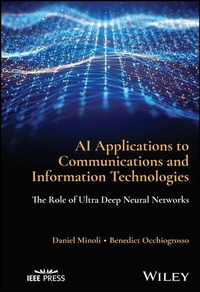
AI Applications to Communications and Information Technologies
Description

Apply the technology of the future to networking and communications.
Artificial intelligence, which enables computers or computer-controlled systems to perform tasks which ordinarily require human-like intelligence and decision-making, has revolutionized computing and digital industries like few other developments in recent history. Tools like artificial neural networks, large language models, and deep learning have quickly become integral aspects of modern life. With research and development into AI technologies proceeding at lightning speeds, the potential applications of these new technologies are all but limitless.
AI Applications to Communications and Information Technologies offers a cutting-edge introduction to AI applications in one particular set of disciplines. Beginning with an overview of foundational concepts in AI, it then moves through numerous possible extensions of this technology into networking and telecommunications. The result is an essential introduction for researchers and for technology undergrad/grad student alike.
AI Applications to Communications and Information Technologies readers will also find:
* In-depth analysis of both current and evolving applications
* Detailed discussion of topics including generative AI, chatbots, automatic speech recognition, image classification and recognition, IoT, smart buildings, network management, network security, and more
* An authorial team with immense experience in both research and industry
AI Applications to Communications and Information Technologies is ideal for researchers, industry observers, investors, and advanced students of network communications and related fields.
More details
Other editions
Additional editions
Persons
Daniel Minoli is Principal Consultant for DVI Communications, New York, USA, and a longtime Expert Witness and Testifying Expert in networking, wireless, video, IoT, and VoIP. In addition to working as Director of Engineering for gamut of premiere high-tech firms, he has acted as Adjunct Instructor at New York University and Stevens Institute of Technology, USA for twenty years. He has published extensively on networks, IP/IPv6, video, wireless communications, and related subjects.
Benedict Occhiogrosso is Co-Founder of DVI Communications, New York, USA, with extensive experience as a technology engineer, manager and executive. He is a subject matter expert in several disciplines now enhanced by artificial intelligence including telecommunications networking, speech recognition, image processing and building management systems. He has also served as a testifying expert witness and advisor on patent portfolios.
Content
1
Overview
1.1 Introduction and Basic Concepts
Artificial intelligence (AI) is a subfield of computer science (CS) that focuses on the creation of computer-based systems, applications, and algorithms that mimic, to the degree possible, some cognitive processes intrinsic to human intelligence.1 The field has had a long history and is now blossoming in an all-encompassing manner. AI technologies, particularly machine learning (ML) and deep learning (DL), are becoming ubiquitous in nearly all aspects of modern life. DL is a subfield of ML as discussed below. The goals of learning are (i) understanding a process or phenomenon and (ii) making prediction about outcomes, namely, inferring a function or relationship that maps the input to an output in such a manner that the learned relationship can be used to predict the future output from a future input. AI applications, and ML/DL-based systems in particular, are positioned to take over complex tasks generally performed by humans (decision-makers) or to provide added support to people. Siri, Alexa, augmented reality (AR), autonomous driving, and object recognition are just a few examples of AI applications. Driven in part off the massive data collection and associated analysis resulting from the widespread deployment of connected sensors in the Internet of Things (IoT) ecosystem in the smart city, the smart building, the smart institution, and the smart home, nearly, if not, all major industries have been impacted by and benefitted from AI.
In practical terms, AI in a given application space (use case) is a set of very advanced algorithms pertaining to decision-making processes in that given application space, in conjunction with a large set of training data that is utilized to fine-tune the parameters of the algorithms, allowing them 'to learn'. In a number of applications (e.g. but limited to, object recognition, speech recognition, classification, and network management), classical non-AI algorithms for decision-making have been used in the past, however, the more recent utilization of AI-specific learning, training, and execution algorithms have significantly improved the quality, efficiency, timeliness, and trustworthiness of the results.
This text focuses on AI/ML/DL applications in the Information and Communications Technology (ICT) sector of the industry, which includes networking, telecommunications, and applications-supporting systems. As the name implies, ICT spans the fields of information technology (IT) and the fundamentally critical communication technologies that make all the modern business and personal applications possible. Some areas where AI is being used in ICT, telecommunications and support operations include but are not limited to the following: network operations monitoring, network management, predictive maintenance, network security and fraud mitigation, customer service, virtual assistants, chatbots, Intelligent Customer Relationship Management systems, and intelligent automation based on AI-supported Robotic Process Automation. Expert systems for network management have been used for decades [1, 2].
ML endeavors to give computers the ability to learn without being explicitly programmed. ML encompasses the study and construction of algorithms that may learn from existing data and make predictions about new data. These ML mechanisms operate by building a model from training data to make future data-driven predictions or decisions expressed as assessments or outputs. A large number of ML algorithms exist, for example, neural networks (NNs) (also called models), logistic regression, Naive Bayes, Random Forest (RF), matrix factorization, and support vector machines (SVMs), among others. The focus of this textbook is principally, but exclusively, on NNs.
One way to classify AI is to categorize it as narrow AI and general AI - general AI is also known as artificial general intelligence (AGI).
Narrow AI: seeks to identify and establish automated solutions to problems or functions that are typically undertaken by a human (say, an analyst or performer), while, hopefully, improving the performance of the manual tasks undertaken to solve the problems or support the functions, according to some metric - for example, efficiency and endurance. It aims at performing a task at a time while continuing to improve its operation. Narrow AI is implemented as software that automates an analytical activity typically performed by humans. At press time, most of the AI applications were examples of narrow AI.
General AI: Instead of focusing on a narrow or single task, the goal of AGI is to teach and to empower the machine to comprehend and assess a wide range of parameters, issues, and processes that characterize the underlying domain or ecosystem. The goal is to enable the machine to make decisions based on dynamic learning instead of relying on prescriptive, earlier training. While utilizing a certain knowledge base and training, such a system has the ability to reach conclusions, decisions, and judgment based perhaps on another, possibly more appropriate paradigm; here, the independent learning is based on (or supplemented with) experience and pragmatics. Some researchers expect to achieve AGI through the advanced application of DL mechanisms. A number of tests to assess an AGI system's intelligence has emerged over the years. At press time there were nearly one hundred projects around the world focused on developing AGI.
Advanced AI fields include cognitive computing systems and natural language processing (NLP)/natural language understanding (NLU) under the rubric of generative AI. Cognitive computing systems are systems that endeavor to understand and emulate human behavior, while also providing intuitive and natural interface to the machine. NLP systems allow machines to understand written language or voice commands; they also support natural language generation that enables the machine to communicate in "spoken conversation." NLU is concerned with enabling computers to derive meaning from natural language inputs (such as spoken inputs). Related fields include automatic speech recognition (ASR), which is concerned with transforming audio data associated with speech into a token or other textual representation of that speech. ASR and NLU are heavily dependent on AI and are often used together as part of a language processing component of a system; see Figure 1.1 for an illustrative example. Additionally, Text-to-Speech (TTS) is a field concerned with transforming textual and/or other data into audio data that is synthesized to resemble quality human speech [3, 4]. AI is now also widely used for automated content generation systems. As a particular example, AI is now heavily used in medicine and healthcare; Table 1.1 lists just a few examples of usage and applicability.
This introductory chapter provides a brief overview of some key AI concepts but is not intended to provide an extensive tutorial on the AI field per se, for which there are many good sources. The chapter only lays out sufficient background to support the chapters that follow. However, a number of the basic concepts covered in this chapter are revisited and further expanded in the rest of the book, as appropriate. The Appendix at the end of this chapter provides a basic (non-exhaustive) glossary of key AI terms and concepts based on a variety of industry sources.
As noted, ML and DL are leading examples of AI; DL systems are considered to be a subset or subcategory of ML systems, as depicted graphically in Figure 1.2 and further discussed below. Systems such as IoT generate large amounts of data; the sheer volume of data requires AI, ML, and DL techniques for such volume of data to be mined properly and to allow one to reach accurate, useful, and timely data-driven insights. ML and DL techniques endeavor to examine and establish the internal relationships of a set of data; said data is typically collected from the variety of input devices aggregating visual, audio, image, and signal data from the field in question (the set of fields obviously being wide-ranging). ML and DL predict and classify data using various algorithms optimized to the dataset in question; in particular, DL-based systems are now routinely applied in recognition-, prediction-, and classification-related analyses.
Figure 1.1 AI in complex natural language processing.
Source: Adapted from Ref. [3]).
Table 1.1 Artificial intelligence in medicine and healthcare (short list).
Source: Adapted from https://pubmed.ncbi.nlm.nih.gov for the term artificial intelligence.
- Artificial intelligence in anesthesiology
- Artificial intelligence in drug design
- Artificial intelligence and machine learning in anesthesiology
- Artificial intelligence to deep learning: machine intelligence approach for drug discovery
- Artificial intelligence in medical imaging
- Artificial intelligence for diabetes care
- Artificial intelligence in nuclear medicine
- Artificial intelligence and ophthalmology
- Artificial intelligence in cardiovascular medicine
- Artificial intelligence and ophthalmic surgery
- Emerging role of deep learning-based artificial intelligence in tumor pathology
- Artificial intelligence for brain...
