

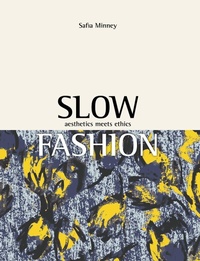
Slow Fashion
Description

Slow Fashion offers creatives, entrepreneurs, and ethical consumers alike a glimpse into the innovative world of the eco-concept store movement, sustainable design, and business that puts people, livelihoods, and sustainability central to everything they do.
Safia Minney argues that the future of brick and mortar retail is in the best in fair trade, sustainability, and organic products, together with vintage and second hand goods and local produce. Restorative economics, the well-being of our planet, and our bodies and minds can be inspired by this growing sector, one that is shaping big business.
This book curates pioneering people and projects that will inspire you to be part of the change. International names include Livia Firth, Zandra Rhodes, and Lily Cole. American change-makers include Andrew Morgan, filmmaker (The True Cost, a ground-breaking documentary that asks us each to consider who pays the price for our clothing), and Dana Geffner (Fair World Project).
With full color photography and elegant design, Slow Fashion profiles the people bringing the alternatives to the mainstream: designers, labels, and eco-concept stores across the world; fair trade producers; campaigns that are re-designing the fashion economy; and the fibers and fabrics which are making a difference.
Safia Minney is founder and CEO of fair trade and sustainable fashion label People Tree. She has turned a lifelong interest in environment, trade, and social justice issues into an award-winning social business. She is widely regarded as a leader in the Fair Trade movement and has been awarded Outstanding Social Entrepreneur by the World Economic Forum.
More details
Other editions
Additional editions
Person
Safia is widely regarded as a leader in the Fair Trade movement and has been awarded outstanding social entrepreneur by the World Economic Forum and an MBE for her work in Fair Trade and the fashion industry.
Content
- Intro
- Title Page
- Contents
- Introduction
- Building a Sustainable Supply Chain by Safia Minney
- What is ethical, Fair Trade, sustainable fashion and why is it important?
- Principles of Fair Trade
- Introduction
- Chapter 1 - Setting the fashion agenda & campaigning for change
- Imran Amed, Livia Firth, Andrew Morgan and Lucy Siegle in conversation
- Carry Somers, founder of Fashion Revolution Day
- Lucy Siegle, journalist and author of To Die For: Is Fashion Wearing Out The World?
- Orsola de Castro, founder of From Somewhere
- Annett Borg, Fashion Revolution Germany
- Patrick Kroker, human rights lawyer
- Peter Melchett, policy director at the Soil Association
- Kirsten Brodde, head of Greenpeace's detox campaign
- Bruce Crowther, founder of the Fair Trade Towns movement
- Dana Geffner, executive director of Fair World Project
- Tamsin Lejeune, founder of the Ethical Fashion Forum
- Tansy Hoskins, author of Stitched Up - The Anti-Capitalist Book of Fashion
- Introduction
- Chapter 2 - Fashion influencers
- Summer Rayne Oakes, model and author of Style, Naturally
- Lily Cole, model and actor
- Thekla Reuten, actor and ambassador for Strawberry Earth Academy
- Model and entrepreneur Jo Wood and singer Leah Wood
- Caryn Franklin, fashion commentator and activist
- Dean Newcombe, model and actor
- Io Takemura, ethical fashion promotor and director of Ethical Fashion Japan
- Arisa Kamada, model and People Tree ambassador
- Stylist Andie Redman and model and People Tree ambassador Rebecca Pearson
- Rika Sueyoshi, Arisa Kamada, Yoshiko Ikoma and Safia Minney in conversation
- Anoushka Probyn, fashion blogger
- Cara Bartlett, fashion blogger
- Fritha Strickland, fashion blogger
- Francesca Romana Rinaldi, professor at Milan's Fashion institute
- Seyi Rhodes, reporter and investigative journalist
- Introduction
- Chapter 3 - Designing for a sustainable future
- Zandra Rhodes, designer
- Mette Te Velde, founder and director of Strawberry Earth Academy
- Bora Aksu, designer
- Peter Jensen, designer
- Chris Haughton, designer, illustrator and author
- Alicia Reguera, creative designer and illustrator
- Hidekazu Hosokawa, director of Lee Japan, and cotton expert Ken-ichi Kondo
- Eileen Fisher, founder of women's clothing brand EILEEN FISHER, INC
- Introduction
- Chapter 4 - Social entrepreneurs
- Moon Sharma, managing director of TARA Projects
- Andrew Morgan, director of The True Cost
- Hanako Kakara, founder of Walk in Beauty Bridal
- Marieke Eyskoot, sustainable fashion and lifestyle expert
- Ute Naumann, ethical fashion agent and founder of Spice Agency
- Ben Conard, Fair Trade Winds
- Introduction
- Chapter 5 - Eco Concept Stores
- Vincent Nolan, market researcher
- Eco concept stores: Germany
- Friedrich, Heidelberg
- Ichwareindirndl, Frankfurt
- Dear Goods, Munich
- Liebschaften, Munich
- Fashion & More, Freising
- Greenality, Stuttgart
- Zündstoff, Freiburg
- Soulid, Darmstadt
- Czech Republic
- NILA Living, Prague
- Netherlands
- Charlie + Mary, Amsterdam
- BrandMission, Haarlem
- Geitenwollenwinkel, Amsterdam
- Eigen, Apeldoorn
- Britain
- The Keep, London
- 69b Boutique, London
- Japan
- People Tree, Tokyo
- Biople by Cosme Kitchen, Yokohama
- Kagure, Tokyo
- Neal's Yard Remedies, Tokyo
- Ethical Penelope, Nagoya
- Connetta, Nagoya
- Kikuya Zakkaten, Kyoto
- Resources
- Author Acknowledgements
- Copyright
