

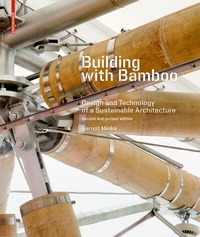
Building with Bamboo
Description

Although traditionally a building material of the warmer climate zones, bamboo is becoming increasingly popular amongst architects in the northern hemisphere; bamboo has several advantages - it is very stable, of low weight, and highly elastic, in addition to being readily available as well as renewable. The applications of bamboo in architecture have become significantly wider and diversified, so that today, even structures with large spans - such as bridges - are built with this material.
The new and revised second edition of this manual provides a practical, systematic overview of the numerous potential applications and processing methods of this renewable material. The comprehensive presentation of groundbreaking bamboo buildings has been updated with more recent projects.
More details
Other editions
New editions
Additional editions
Previous edition
Person
Content
- Intro
- Contents
- I. The Technology of Bamboo Building
- 1. Historical Examples
- Types of Bamboo
- Positive Environmental Effects
- Different Uses
- 2. The Plant
- 3. Cutting, Drying, Treatment and Storage
- 4. Physical Properties
- Introduction
- Resistance in Compression and Tension
- Modulus of Elasticity
- Performance in Fire
- Earthquake Resistance
- 5. Building with Bamboo in Europe and North America
- Introduction
- Availability
- Statutory Regulations
- Fire Performance
- 6. General Aspects of Construction
- Advantages and Disadvantages
- Selection of Bamboo Canes for Construction
- Incorrect and Correct Details
- 7. Basic Construction Elements
- Canes, Planks, Strips, Laths and Belts
- Laminated Elements
- 8. Tools and Their Uses
- 9. Joints
- 10. Constructive Elements and Systems
- Columns
- Beams, Trusses and Porticos
- Arches
- Floor Slabs and Roofs
- Walls
- Vaults
- Domes
- Hyperbolic Paraboloids
- Bamboo-Supported Membrane Roofs
- 11. Complementary Elements
- Floors and False Ceilings
- Handrails, Balconies and Stairs
- Doors and Windows
- 12. Reinforcing with Bamboo
- Cement Mortar Reinforced with Bamboo Fibres
- Concrete Elements Reinforced with Bamboo Canes
- Walls Reinforced with Bamboo
- II. Built Examples
- Residences
- Low Energy Bamboo House, Rotselaar, Belgium
- Stepped House in El Darién, Valle, Colombia
- Colibrí House, Cali, Colombia
- Blooming Bamboo Home, Cau Dien Town, Hanoi, Vietnam
- Guesthouse in Ubud, Bali, Indonesia
- House in Cochahaira Village, Boyacá, Colombia
- House in Sadhrana, Haryana, India
- Casa Cohuatichan, Cuetzalan, Mexico
- Prefabricated Bamboo Houses in Hawaii
- Cultural, Educational and Sacral Buildings
- Son La Restaurant, Son La, Vietnam
- Green School in Sibajang Kaja Badung, Bali, Indonesia
- Kindergarten and Community Centre, Naiju, Japan
- School in Rudrapur, Bangla Desh
- Naman Beach Bar, Danang, Vietnam
- Washrooms, La Selva, Spain
- Temporary Church in Pereira, Risaralda, Colombia
- Nomadic Museum, Mexico City, Mexico
- Offices
- Industrial and Infrastructural Buildings
- Tollgate, Pereira, Colombia
- Jewellery Factory in Ubud, Bali, Indonesia
- Multi-Storey Car Park Façade, Leipzig, Germany
- Office Building, Darmstadt, Germany
- Pavilions and Experimental Structures
- Pavilion, Vergiate, Italy
- ZERI Pavilion, EXPO 2000, Hanover, Germany
- Pavilions for the "German Esplanade", Chongquing, Guangzhou, Shenyang and Wuhan, China
- Indian Pavilion, EXPO 2010, Shanghai, China
- Vietnamese Pavilion, EXPO 2010, Shanghai, China
- German-Chinese House, EXPO 2010, Shanghai, China
- Sculptures for MERAN FLORA 2004, Meran, Italy
- Restaurant Roof, Coburg, Germany
- Exposition Roof, Cologne, Germany
- Bridges
- Footbridge, Santa Fe de Antioquia, Colombia
- Bridge in Cúcuta, Norte de Santander, Colombia
- Appendix
- Bibliography
- Associations, Journals
- About the Author Acknowledgements
- Illustration Credits
