

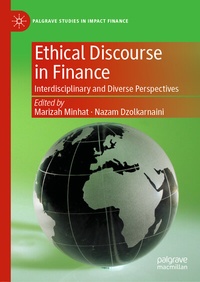
Ethical Discourse in Finance
Description

Ethical discourse is commonly not a priority in a conventional finance syllabus. Moral sentiments often take a back seat to market sentiments, even in shaping the direction of ethical finance business. This anomaly persists despite growing interest in ethical finance. Taking an interdisciplinary and diverse perspective, this book enriches the evolving definition and scope of ethical finance literature by focusing on actors, products and regulation that shape markets. Considering the gap between theory and practice, this book bridges academic and professional knowledge in unpacking ethical and governance issues in the financial industry. In an effort to include as many viewpoints as possible, regardless of popularity or who holds them, the book editors gathered thoughts from diverse fields, including accounting, economics, ethics, finance, governance, law, management, philosophy and religion. Appealing to academic and non-academic stakeholders with an interest in ethics and finance,this book is the result of and a testament to a distinct educational and public engagement project that included different generations and communities, for future reference.
More details
Other editions
Additional editions
Persons
Marizah Minhat holds a Master of Laws in Financial Law and Regulation from the London School of Economics and Political Science (LSE), an MSc in Banking and Finance with Distinction and a PhD from University of Stirling, UK. As a professionally qualified accountant, she is a member of four professional accounting bodies (CA ANZ, MIA, ICAEW and ACCA) and a committee member of the ICAEW Scotland. She served in various roles within higher education institutions in the UK, including Co-Director of International Centre for Management and Governance Research (ICMGR). She bridges academia and practice through her active engagements in research, publications and professional and charitable activities. She has published widely in the areas of finance, governance and human rights. Prior to her academic career, she worked in Group Finance of Tenaga Nasional Berhad.
Nazam Dzolkarnaini is an Associate Professor in Accounting and Finance at The Business School,Edinburgh Napier University, UK. He graduated with a First Class Honours degree in Accounting from Lincoln University, Canterbury, New Zealand, an MSc in Finance with Distinction and a PhD in Finance, both from University of Stirling, UK. He is a Fellow of the Higher Education Academy and a member of Chartered Accountants Australia and New Zealand (CA ANZ) and a Certified Financial Planner (CFP). He has published widely in the areas of corporate finance, microfinance, corporate governance, ethics and Islamic finance. He is involved in the All-Party Parliamentary Group at the UK Parliament and a Founding Director, Chairman and Trustee of the Ethical Finance and Investment Research (EFAIR) Foundation.
Content
Part 1. Setting the scene. Chapter 1. A Distinct Project on Diverse Ethical Discourse in Finance.- Chapter 2. Ethics, Governance, Finance: a Commentary from Experience.- PART 2: Actors. Chapter 3. Chapter 3: Boardroom Morality and the 'Fit and Proper' Test: an Aristotelian Perspective.- Chapter 4: Does Professionalism in Financial Services Have a Future?.- Chapter 5: Effective Ethical Leadership: A Case Study of a Canadian Insurance Company.- Part 3. Products. Chapter 6: A Christian Approach to Interest.- Chapter 7: The Integrity of Islamic Financial Products.- Chapter 8: Diversity in Ethical Funds.- Chapter 9: Ethical Considerations for Intellectual Property Protection under Sharia Law Principles in the GCC States.- Part 4. Markets. Chapter 10. Investing Ethical: Harder Than You Think.- Chapter 11. Lipstick on a Pig: Ethics in the Age of Financialization.- Chapter 12. More Than Debt: China's Belt and Road Initiative in Indian Subcontinent.- Chapter 13. The Debt of Nations.- Chapter14. Ethical Perspectives on Financial Stress Testing.
