

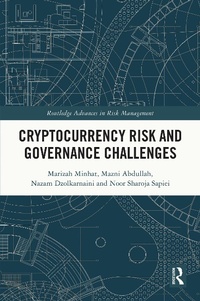
Cryptocurrency Risk and Governance Challenges
1st Edition
Published on 8. September 2023
174 pages
978-1-000-92931-7 (ISBN)
Description

This book provides an interdisciplinary critical perspective regarding risk, uncertainty and governance challenges of cryptocurrencies.
It considers the perspectives of several disciplines including accounting, cybersecurity, cyberlaw, economics, ethics, finance, financial regulation, Shariah (Islamic) law and technology. Different from other books on a similar topic, this book's in-depth analysis and critical discourse on cryptocurrency risk categories are supplemented by research evidence gathered from surveys and interviews with stakeholders. The inclusion of an Islamic insight matters given mixed views at present regarding the permissibility of cryptocurrencies and some countries have indeed imposed somewhat restricted functions of cryptocurrencies for non-religious reasons.
It is envisaged that this book will help enlighten stakeholders on this aspect of uncertainty and inspire fit and proper governance strategies for the public interest.
It considers the perspectives of several disciplines including accounting, cybersecurity, cyberlaw, economics, ethics, finance, financial regulation, Shariah (Islamic) law and technology. Different from other books on a similar topic, this book's in-depth analysis and critical discourse on cryptocurrency risk categories are supplemented by research evidence gathered from surveys and interviews with stakeholders. The inclusion of an Islamic insight matters given mixed views at present regarding the permissibility of cryptocurrencies and some countries have indeed imposed somewhat restricted functions of cryptocurrencies for non-religious reasons.
It is envisaged that this book will help enlighten stakeholders on this aspect of uncertainty and inspire fit and proper governance strategies for the public interest.
More details
Series
Edition
1. Auflage
Language
English
Place of publication
London
United Kingdom
Publishing group
Taylor & Francis Ltd
Target group
College/higher education
Illustrations
27 Line drawings, black and white; 27 Illustrations, black and white
ISBN-13
978-1-000-92931-7 (9781000929317)
Copyright in bibliographic data and cover images is held by Nielsen Book Services Limited or by the publishers or by their respective licensors: all rights reserved.
Schweitzer Classification
Other editions
Additional editions
Marizah Minhat | Mazni Abdullah | Nazam Dzolkarnaini
Cryptocurrency Risk and Governance Challenges
Book
12/2024
1st Edition
Routledge
€63.20
Shipment within 10-20 days
Marizah Minhat | Mazni Abdullah | Nazam Dzolkarnaini
Cryptocurrency Risk and Governance Challenges
Book
09/2023
1st Edition
Routledge
€205.90
Shipment within 10-20 days
Persons
Dr Marizah Minhat is an Associate Professor in Finance and Economics at the University of Bradford, United Kingdom. She founded the Responsible FinTech Research Group and taught in the MSc FinTech programme. She is a Fellow Chartered Accountant (FCA) of the Institute of Chartered Accountants in England and Wales (ICAEW), a member of ICAEW Digital Assets Working Party and Deputy Chair of ICAEW Scotland Network Board. She was also appointed as a Visiting Fellow at the London School of Economics (LSE).
Dr Mazni Abdullah is an Associate Professor at the Department of Accounting, Faculty of Business and Economics, University of Malaya, Kuala Lumpur, Malaysia. She is a Chartered Accountant (CA) of the Malaysian Institute of Accountants (MIA) and a member of the Malaysian Institute of Certified Public Accountants and the Malaysian Institute of Management. She is also a member of the Integrated Reporting Steering Committee of the MIA.
Dr Nazam Dzolkarnaini is an Associate Professor in Accounting and Finance at the University of Bradford, United Kingdom. He is a Fellow of Chartered Accountants Australia and New Zealand. He promotes public and community development in his role as a Founding Director, Chairman and Trustee of the Ethical Finance and Investment Research (EFAIR) Foundation.
Dr Noor Sharoja Sapiei is a Senior Lecturer at the Department of Accounting, Faculty of Business and Economics, University of Malaya, Kuala Lumpur, Malaysia. She is the Editor-in-Chief of the Asian Journal of Business and Accounting and an Editorial Advisory Board Member of the Asian Journal of Accounting Perspectives. She is also a member of the Taxation Practice Committee of the Malaysian Institute of Accountants (MIA).
Dr Mazni Abdullah is an Associate Professor at the Department of Accounting, Faculty of Business and Economics, University of Malaya, Kuala Lumpur, Malaysia. She is a Chartered Accountant (CA) of the Malaysian Institute of Accountants (MIA) and a member of the Malaysian Institute of Certified Public Accountants and the Malaysian Institute of Management. She is also a member of the Integrated Reporting Steering Committee of the MIA.
Dr Nazam Dzolkarnaini is an Associate Professor in Accounting and Finance at the University of Bradford, United Kingdom. He is a Fellow of Chartered Accountants Australia and New Zealand. He promotes public and community development in his role as a Founding Director, Chairman and Trustee of the Ethical Finance and Investment Research (EFAIR) Foundation.
Dr Noor Sharoja Sapiei is a Senior Lecturer at the Department of Accounting, Faculty of Business and Economics, University of Malaya, Kuala Lumpur, Malaysia. She is the Editor-in-Chief of the Asian Journal of Business and Accounting and an Editorial Advisory Board Member of the Asian Journal of Accounting Perspectives. She is also a member of the Taxation Practice Committee of the Malaysian Institute of Accountants (MIA).
Content
Table of Contents
Cryptocurrency Risk and Governance Challenges *
Book blurb and key words *
Preface *
Acknowledgements *
List of Acronyms and Abbreviations *
List of Tables and Figures *
1. Introduction *
1.1 Financial Technology (FinTech) *
1.2 The Market for Cryptocurrencies *
1.3 Abstracts of Chapters *
2. Priority Research *
2.1 Introduction *
2.2 Research Objectives *
2.3 Research Instruments *
2.4 Survey Sample *
2.5 Interview Sample *
3 Demystifying the Nature of Cryptocurrencies *
3.1 Introduction *
3.2 Money as a Public Good *
3.3 Cryptocurrency versus Electronic Money *
3.4 Speculative Assets *
3.5 Digital Asset, Digital Currency and Digital Token as Securities *
3.6 Cryptoassets as Exchange Tokens *
3.7 Crypto-Tokens as Objects of Property Rights *
3.8 Accounting Treatment *
3.9 Summary *
4 Information Asymmetry and Knowledge-Gap Risk *
4.1 Introduction *
4.2 Fundamentals *
4.3 Awareness *
4.4 Literacy *
4.5 Education *
4.6 Summary *
5 Opaqueness and financial crime risk *
5.1 Introduction *
5.2 Opaqueness *
5.3 Financial Crime *
5.4 Enforcement *
5.5 Due Diligence *
5.6 Activism *
5.7 Summary *
6 Technology and Security Risk *
6.1 Introduction *
6.2 Blockchain *
6.3 Smart Contract *
6.4 Security and Concentration *
6.5 Summary *
7 Speculative Value and Gambling Risk *
7.1 Introduction *
7.2 Speculation *
7.3 Gambling *
7.4 COVID-19 Pandemic *
7.4.1 Data and risk measures *
7.4.2 Results *
7.5 Summary *
8 Shariah-Compliant Risk *
8.1 Introduction *
8.2 Digital Currency as Mal *
8.3 Alternative Views *
8.4 Potential Harm *
8.5 Uncertainty *
8.6 Summary *
9 Regulatory Gap *
9.1 Introduction *
9.2 Malaysia *
9.3 United Kingdom *
9.4 Summary *
10 Governance Challenges in Cyberspace *
10.1 Introduction *
10.2 Criteria for Good Regulation *
10.3 Challenges in Cyber Governance *
10.4 The Latest Debacle *
10.5 Further Research *
11 Conclusions *
11.1 Introduction *
11.2 Cryptocurrency Risk *
11.3 Governance Implications *
References *
Appendix 1 - Sample Published Opinions of Stakeholders *
Appendix 2 - Requirement for Digital Asset Custodian in Malaysia *
Appendix 3 - Additional Requirements Relating to Digital Asset Exchange (DAX) in Malaysia *
Appendix 4 *
Index *
Cryptocurrency Risk and Governance Challenges *
Book blurb and key words *
Preface *
Acknowledgements *
List of Acronyms and Abbreviations *
List of Tables and Figures *
1. Introduction *
1.1 Financial Technology (FinTech) *
1.2 The Market for Cryptocurrencies *
1.3 Abstracts of Chapters *
2. Priority Research *
2.1 Introduction *
2.2 Research Objectives *
2.3 Research Instruments *
2.4 Survey Sample *
2.5 Interview Sample *
3 Demystifying the Nature of Cryptocurrencies *
3.1 Introduction *
3.2 Money as a Public Good *
3.3 Cryptocurrency versus Electronic Money *
3.4 Speculative Assets *
3.5 Digital Asset, Digital Currency and Digital Token as Securities *
3.6 Cryptoassets as Exchange Tokens *
3.7 Crypto-Tokens as Objects of Property Rights *
3.8 Accounting Treatment *
3.9 Summary *
4 Information Asymmetry and Knowledge-Gap Risk *
4.1 Introduction *
4.2 Fundamentals *
4.3 Awareness *
4.4 Literacy *
4.5 Education *
4.6 Summary *
5 Opaqueness and financial crime risk *
5.1 Introduction *
5.2 Opaqueness *
5.3 Financial Crime *
5.4 Enforcement *
5.5 Due Diligence *
5.6 Activism *
5.7 Summary *
6 Technology and Security Risk *
6.1 Introduction *
6.2 Blockchain *
6.3 Smart Contract *
6.4 Security and Concentration *
6.5 Summary *
7 Speculative Value and Gambling Risk *
7.1 Introduction *
7.2 Speculation *
7.3 Gambling *
7.4 COVID-19 Pandemic *
7.4.1 Data and risk measures *
7.4.2 Results *
7.5 Summary *
8 Shariah-Compliant Risk *
8.1 Introduction *
8.2 Digital Currency as Mal *
8.3 Alternative Views *
8.4 Potential Harm *
8.5 Uncertainty *
8.6 Summary *
9 Regulatory Gap *
9.1 Introduction *
9.2 Malaysia *
9.3 United Kingdom *
9.4 Summary *
10 Governance Challenges in Cyberspace *
10.1 Introduction *
10.2 Criteria for Good Regulation *
10.3 Challenges in Cyber Governance *
10.4 The Latest Debacle *
10.5 Further Research *
11 Conclusions *
11.1 Introduction *
11.2 Cryptocurrency Risk *
11.3 Governance Implications *
References *
Appendix 1 - Sample Published Opinions of Stakeholders *
Appendix 2 - Requirement for Digital Asset Custodian in Malaysia *
Appendix 3 - Additional Requirements Relating to Digital Asset Exchange (DAX) in Malaysia *
Appendix 4 *
Index *
