

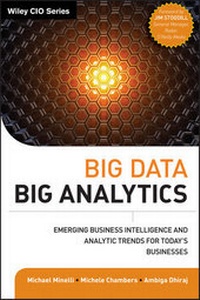
Big Data, Big Analytics
Description

More details
Other editions
Additional editions
Persons
Content
FOREWORD: BIG DATA AND CORPORATE EVOLUTION
When my friend Mike Minelli asked me to write this foreword I wasn't sure at first what I should put on paper. Forewords are often one part book summary and one part overview of the field. But when I read the draft Mike sent me I realized that this is a really good book, and it doesn't need either of those. Without any additional help from me it will give you plenty of insight into what is happening and why it's happening now, and it will help you see the possibilities for your industry in this transition to a data-centric age. Also, the book is just full of practical suggestions for what you can do about them. But perhaps there's an opportunity to establish a wider context. To explore what Big Data means across a broad arc of technological advancement. So rather than bore you with a summary of a book you're going to read anyway, I'll try to daub a bit of paint onto the big picture of what it all might mean.
This foreword is based on the thesis that Big Data isn't merely another technology. It isn't just another gift box en route to the world's systems integrators via the conveyor belt of Gartner hype cycles. I believe Big Data will follow digital computing and internetworking to take its place as the third epoch of the information age, and in doing so it will fundamentally alter the trajectory of corporate evolution. The corporation is about to undergo a change analogous to the rise of consciousness in humans.
So let's start at the beginning. The Industrial Age was an era of vast changes in society. We harnessed first steam and then electricity as prime movers to unleash astonishing increases in productivity. The result was the first sustained growth of wealth in human history.
Those early industrial concerns required vast pools of labor that gradually grew more specialized. To coordinate the efforts of all of those people, management developed systems of rules and hierarchy of authority. At massive scale the corporation was no longer the direct exercise of an owner's will, it was a kind of organism.
It was an organism whose systems of control were born out of the Napoleonic bureaucracy of the French State and its emphasis on specialized function, fixed rules, and rigid hierarchy. The "bureau" in bureaucracy literally means desk, and paper was both the storage mechanism in them and the signaling mechanism between them.
The bureaucracy was a form of organization that could process stimuli at scale and coordinate masses of participants, but it was, and remains today, severely limited in its evolutionary progress. Bureaucracy is the nematode of human industrial organization.
With over 24,000 species the nematode is a plentiful and adaptable round worm whose nervous system typically consists of 302 neurons. A mere 20 of those neurons are in its pharyngeal nervous system, the part that serves as a rudimentary brain. Yet it is able to maintain homeostasis, direct movement, detect information in its environment, create complex responses, and even manage some basic learning. So, it's a nice approximation for the bureaucratic corporation.
Despite its display of complex behaviors the nematode is of course completely unaware of them in any conscious sense. Its actions, like those of a bureaucracy, are reactive and dispositional. A worm bumps into something and is stimulated. Neurons fire. Worm reacts. It moves away or maybe eats what it bumped. Likewise shelves go empty and an order is placed. Papers move between desks. Trucks arrive. Shelves get replenished.
Worms and corporations are both complex event-processing engines, but they are largely deterministic. The corporation is evolving though, becoming more aware of its surroundings and emergent in its reactions. The information age, or the second industrial age, has been a major part of that.
In 1954 Joe Glickauf of Arthur Andersen implemented a payroll system for the General Electric Corporation on a UNIVAC 1 digital electronic computer. He thus introduced the computational epoch of the information age to the American corporation. (Incidentally, also creating the IT consulting industry.) Throughout the 1950s other corporations rapidly adopted systems like it to serve a wide spectrum of corporate processes. The corporation was still a nematode but we were wiring the worm and aggressively digitizing its nervous system.
Yet it remained basically the same worm. Sure, it became more efficient and could react faster but with basically the same dispositions, because as we automated those existing systems with computers we mimicked the paper. Invoices, accounts, and customer master files all simply migrated into the machine as we dumped file cabinets into database tables. We were wiring the worm, but we weren't re-wiring it.
So it remained a bureaucracy, just a more efficient, responsive, and scalable one. Yet this was the beginning of a symbiotic evolution between corporation and information age technology and it became a departure point in the corporation's further evolutionary history. This digital foundation is the substrate on which further evolutionary processes would occur.
Then about thirty years ago, Leonard Kleinrock, Lawrence Roberts, Robert Kahn, and Vint Cerf invented the Internet and ushered in the second epoch of information age, the network era.
Suddenly our little worm was connected to its peers and surrounding ecosystem in ways that it hadn't been before. Messaging between companies became as natural as messaging between desks and with later pushes by Jack Welch and others who understood the revolution that was at hand, those messages finally succumbed to the pull of digitization. The era of the paper purchase order and invoice finally died. The first 35 years of digitization had focused on internal processes; now the focus was more on interactions with the outside world. (I say more, because EDI had been around for a while. But it was with the cost structure of the Internet that it really took off.) For the worm it was like the evolution of a sixth sense. It could see further, predict deeper into the future, and respond faster.
But those new networks didn't just affect the way our corporations interacted with the outside world. They also began to erode the very foundation of bureaucracy: its hierarchy.
While the strict hierarchy of bureaucracy had been a force multiplier for labor during the industrial age, in practice it meant that a company could never be smarter than the smartest person at its head. Restrained by hierarchy, rigid rules, and specialized functions, the sum total of a corporation's intelligence was always much less than the sum of the intelligence of its participants.
With globalization, complex connections, and faster market cycle times the complexity of the corporation's environment has increased rapidly and has long since exceeded the complexity that any single person can understand. There has after all only been one Steve Jobs. Something had to give.
So corporations have (slowly) begun the journey toward more agile, network-enabled, learning organizations that can crowd source intelligence both within their ranks and from inside their customer bases. They are beginning to exhibit locally emergent behaviors in response to that learning. This is what is behind corporate mottos like Facebook's "Move fast and break stuff." It's just another way of saying that initiative is local and that the head can't know everything.
Of course companies in the network era still have organization charts. But they don't tell the whole story anymore. These days we need to analyze email patterns, phone records, instant messaging and other evidence of actual human connection to determine the real organizational model that emerges like an interstitial lattice within the official org chart.
So corporate evolution is no longer just incremental improvement along an efficiency and productivity vector. The very form of the corporation is changing, enabled by technology and spurred by the necessity of complexity and cycle times. The corporation is growing external sensors and the necessary neurons to deal with what it discovers. It is changing from dispositional and reactive to complex and emergent in order to better impedance match with the post-industrial world it occupies.
So here we are, at the doorstep of the Information Age's Big Data epoch. The corporation has already taken advantage of the computing and internetworking epochs to evolve significantly and adapt to a more complex world. But even bigger changes are ahead.
This book will take you through the entire Big Data story, so I'm not going to expound much on the meaning of Big Data here. I'll just describe enough to set the stage for the next phase of corporate evolution. And this is a key point: Big Data isn't Business Intelligence (BI) with bigger data.
We are no longer limited to the structured transactional world that has been the domain of corporate information technology for the last 55 years. Big Data represents a transition-in-kind for both storage and analysis. It isn't just about size.
The data your corporation does "BI" with today is mostly internally generated highly-structured transactional data. It's like a record of the neurons that fired. All too often the role of the business intelligence analyst really boils down to corporate kinesthesis. Reports are generated to tell the head of a hierarchy what its limbs are doing, or did.
But Big Data has the potential to be different. For one, often the data being...
