

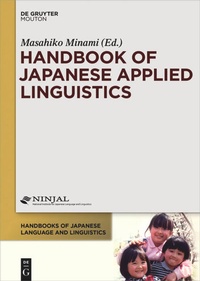
Handbook of Japanese Applied Linguistics
Description

Applied linguistics is the best single label to represent a wide range of contemporary research at the intersection of linguistics, anthropology, psychology, and sociology, to name a few. The Handbook of Japanese Applied Linguistics reflects crosscurrents in applied linguistics, an ever-developing branch/discipline of linguistics. The book is divided into seven sections, where each chapter discusses in depth the importance of particular topics, presenting not only new findings in Japanese, but also practical implications for other languages. Section 1 examines first language acquisition/development, whereas Section 2 covers issues related to second language acquisition/development and bilingualism/multilingualism. Section 3 presents problems associated with the teaching and learning of foreign languages. Section 4 undertakes questions in corpus/computational linguistics. Section 5 deals with clinical linguistics, and Section 6 takes up concerns in the area of translation/interpretation. Finally, Section 7 discusses Japanese sign language. Covering a wide range of current issues in an in an in-depth, comprehensive manner, the book will be useful for researchers as well as graduate students who are interested in Japanese linguistics in general, and applied linguistics in particular.
Chapter titles
Chapter 1. Cognitive Bases and Caregivers' Speech in Early Language Development (Tamiko Ogura, Tezukayama University)
Chapter 2. Literacy Acquisition in Japanese Children (Etsuko Haryu, University of Tokyo)
Chapter 3. Age Factors in Language Acquisition (Yuko Goto Butler, University of Pennsylvania)
Chapter 4. Cross-lingual Transfer from L1 to L2 Among School-age Children (Kazuko Nakajima, University of Toronto)
Chapter 5. Errors and Learning Strategies by Learners of Japanese as an L2 (Kumiko Sakoda, Hiroshima University/NINJAL)
Chapter 6. Adult JFL Learners' Acquisition of Speech Style Shift (Haruko Minegishi Cook, University of Hawai'i at Manoa)
Chapter 7. Japanese Language Proficiency Assessment (Noriko Kobayashi, Tsukuba University)
Chapter 8. The Role of Instruction in Acquiring Japanese as a Second Language (Kaoru Koyanagi, Sophia University)
Chapter 9. The Influence of Topic Choice on Narrative Proficiency by Learners of Japanese as a Foreign Language (Masahiko Minami, San Francisco State University)
Chapter 10. CHILDES for Japanese: Corpora, Programs, and Perspectives (Susanne Miyata, Aichi Shukutoku University)
Chapter 11. KY Corpus (Jae-Ho Lee, Tsukuba University)
Chapter 12. Corpus-based Second Language Acquisition Research (Hiromi Ozeki, Reitaku University)
Chapter 13. Assessment of Language Development in Children with Hearing Impairment and Language Disorders (Kiyoshi Otomo, Tokyo Gakugei University)
Chapter 14. Speech and Language Acquisition in Japanese Children with Down Syndrome (Toru Watamaki, Nagasaki University)
Chapter 15. Revisiting Autistic Language: Is "literalness" a Truth or Myth? Manabu Oi (Osaka University/Kanazawa University)
Chapter 16. Towards a Robust, Genre-based Translation Model and its Application (Judy Noguchi, Mukogawa Women's University; Atsuko Misaki, Kwansei Gakuin University; Shoji Miyanaga, Ritsumeikan University; Masako Terui, Kinki University)
Chapter 17. Japanese Sign Language: An Introduction (Daisuke Hara, Toyota Technological Institute)
Chapter 18. Japanese Sign Language Phonology and Morphology (Daisuke Hara, Toyota Technological Institute)
Chapter 19. Japanese Sign Language Syntax (Noriko Imazato, Kobe City College of Technology)
Chapter 20. Sign Language Development and Language Input (Takashi Torigoe, Hyogo University of Teacher Education)
Reviews / Votes
This is a valuable resource that expands the definition of 'applied linguistics' and identifies the links among the various topics that fall under that superordinate. Bringing first and second language learning, literacy acquisition, foreign language teaching, mother tongue education, and neurolinguistics into a single volume emphasizes the degree to which common processes underlie language behavior, and to which language analysis is central to solving societal problems.
Catherine Snow, Harvard University
The topic of this highly professional book covers an incredibly wide area of applied linguistics researched by specialists. The topics of the twenty chapters cover applied linguistics in the fields of cognitive linguistics, theory of acquisition/proficiency, cross-linguistic transfer, strategies, style shifts, corpus linguistics, autistic language, translation theory, sign language, among others. This handbook is an ideal book for any person who is interested in second language acquisition as a theorist and/or practitioner.
Seiichi Makino, Professor Emeritus, Princeton University
It is laudable that the editors have included considerations of sign languages in a handbook of Japanese linguistics, and I hope that other Japanese linguists will follow this fine example, as sign languages can provide valuable perspectives on other natural languages.
Susan Fischer, Professor Emerita, Rochester Institute of Technology
More details
Other editions
Additional editions
Person
Content
- Intro
- Preface
- Introduction to the Handbooks of Japanese Language and Linguistics
- Table of contents
- Contributors
- Introduction: Japanese applied linguistics and this volume
- I. First language (L1) acquisition/development
- 1. The roles of cognitive bases and caregivers' speech in early language development
- 2. Literacy acquisition in Japanese children
- II. Second language (L2) acquisition/development and bilingualism/multilingualism
- 3. Age factors in language acquisition
- 4. Cross-lingual transfer from L1 to L2 among school-age children
- III. The teaching and learning of foreign languages
- 5. Errors and learning strategies by learners of Japanese as a second language
- 6. Adult L2 learners' acquisition of style shift: The masu and plain forms
- 7 Japanese language proficiency assessment with the Simple Performance-Oriented Test (SPOT) as a primary focus
- 8. The role of instruction in acquiring Japanese as a second language
- 9. The influence of topic choice on narrative proficiency by learners of Japanese as a foreign language
- IV. Corpus linguistics
- 10. CHILDES for Japanese: Corpora, programs, perspectives
- 11. KY corpus
- 12. Corpus-based second language acquisition research
- V. Clinical linguistics
- 13. Assessment of language development in children with hearing impairment and language disorders
- 14. Revisiting autistic language: "Literalness" and "non-literalness" in Japanese children with autism
- VI. Translation
- 15. Towards a robust, genre-based translation model and its application
- 16. Translation: A theoretical perspective
- VII. Sign languages
- 17. Japanese Sign Language: An introduction
- 18. An information-based approach to the syllable formation of Japanese Sign Language
- 19. Syntax of Japanese Sign Language
- 20. Sign language development and language input
- Subject index
