

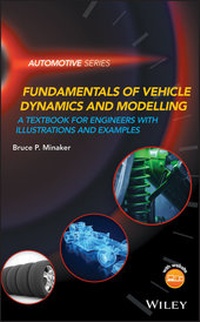
Fundamentals of Vehicle Dynamics and Modelling
Description

More details
Other editions
Additional editions
Person
Dr Bruce P. Minaker is an Associate Professor in the Department of Mechanical, Automotive, & Materials Engineering at the University of Windsor. His primary research interest is in modeling, simulation, and control of vehicle dynamics. For several years he has been developing software to automatically generate the equations of motion of multibody systems, particularly for use in modeling vehicle dynamics. A strong proponent of open source software; he makes all the code freely available for download. He teaches a number of courses in related areas, including the senior vehicle design projects. Dr Minaker earned his graduate degrees at Queen's University and his undergraduate degree at the University of Waterloo.
Content
Dedication
Preface
Acknowledgement
List of Symbols xv
1 Introduction 1
1.1 Past, present, and future 2
References 4
2 Tire Modelling 5
2.1 Rolling losses 5
2.2 Longitudinal force 7
2.3 Lateral force 9
2.4 Vertical moments 11
2.5 Normal force 12
References 14
3 Longitudinal Dynamics 15
3.1 Acceleration performance 16
3.1.1 Engine limited performance 16
3.1.2 Tire limited acceleration 21
3.1.3 Grade performance 23
3.2 Braking performance 23
4 Linear Dynamic Models 31
4.1 .e yaw plane model 31
4.1.1 Steady state analysis 35
4.1.2 Transient analysis 42
4.1.3 Frequency response 48
4.1.4 Time history solution 52
4.2 .e truck and trailer model 53
4.2.1 Steady state analysis 56
4.2.2 Transient analysis 57
4.3 .e quarter car model 60
4.3.1 Transient analysis 63
4.3.2 Frequency response 68
4.4 .e bounce-pitch model 73
4.4.1 Transient analysis 75
4.4.2 Frequency response 82
References 91
5 Full Car Model 93
5.1 Steady state analysis 93
5.1.1 .e bounce-pitch-roll model 94
5.1.2 .e lateral-yaw model 97
5.2 Transient analysis 99
5.3 Kinematic effects 101
5.3.1 Roll centres 103
5.3.2 Quasi static model, with roll centres 106
5.4 Numerical solution of suspension kinematics 110
5.4.1 Algebraic equations formulation 110
5.4.2 Differential equations formulation 112
5.4.3 Tire orientation effects 114
5.5 Suspension damping 116
References 119
6 Multibody Dynamics 121
6.1 Generating the governing equations 121
6.1.1 Preliminary definitions 122
6.2 Definition of coordinates 123
6.3 Kinematic differential equations 125
6.4 Newton Euler equations 128
6.4.1 Inertial forces 129
6.4.2 Elastic forces 130
6.4.3 Linear spring 132
6.5 Constraint equations 137
6.5.1 Spherical joint 139
6.6 State space form 141
6.7 Example systems 144
6.7.1 Rigid rider bicycle 144
6.7.2 Multibody quarter car 150
References 155
7 Mathematics 157
7.1 Algebraic equations 157
7.1.1 Nonlinear algebraic equations 157
7.1.2 Linear algebraic equations 158
7.2 Differential equations 159
7.2.1 Nonlinear differential equations 160
7.2.2 Linear first order ODEs 160
7.2.3 Eigen analysis 161
7.2.4 Linear second order ODEs 164
7.2.5 Frequency response analysis 167
7.3 Differential algebraic equations 172
7.3.1 Differential equation approach 172
7.3.2 Algebraic equation approach 173
7.3.3 Linear differential algebraic equations 174
A Appendix A 177
A.1 Algebraic equations 177
A.2 Differential equations 178
Index 183
