

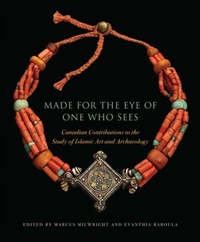
Made for the Eye of One Who Sees
Canadian Contributions to the Study of Islamic Art and Archaeology
1st Edition
Published on 10. September 2022
445 pages
978-0-2280-1325-9 (ISBN)
Description

Canada has seen the study of Islamic art and archeology grow steadily over the last five decades, with growth in research and teaching across numerous Canadian universities as well as important collections of Islamic art and archaeological materials, most notably at the Royal Ontario Museum and the Aga Khan Museum.
Made for the Eye of One Who Sees uncovers the contributions of scholars and museum curators at Canadian institutions to current scholarship on Islamic art. Employing a wide range of approaches and theoretical perspectives, contributors cover topics from across the Islamic world dating from the eighth century to the present. Subjects include the iconography of architectural design and decoration, the role of Qur'anic inscriptions, the representation of symbolic animals in sculpture, and the interpretation of Persian manuscript painting. The book also juxtaposes modern and contemporary worlds, providing insightful reflections on the early history of the Islamic collections at the Royal Ontario Museum, Matisse's creative encounter with Byzantine and Islamic visual culture, and the ongoing dialogue between new media and the traditional concepts underpinning Islamic art.
Bringing together recent scholarship on Islamic art, architecture, and archaeology, Made for the Eye of One Who Sees provides an overview of the important contributions Canada is making to this rich and evolving field of study.
Made for the Eye of One Who Sees uncovers the contributions of scholars and museum curators at Canadian institutions to current scholarship on Islamic art. Employing a wide range of approaches and theoretical perspectives, contributors cover topics from across the Islamic world dating from the eighth century to the present. Subjects include the iconography of architectural design and decoration, the role of Qur'anic inscriptions, the representation of symbolic animals in sculpture, and the interpretation of Persian manuscript painting. The book also juxtaposes modern and contemporary worlds, providing insightful reflections on the early history of the Islamic collections at the Royal Ontario Museum, Matisse's creative encounter with Byzantine and Islamic visual culture, and the ongoing dialogue between new media and the traditional concepts underpinning Islamic art.
Bringing together recent scholarship on Islamic art, architecture, and archaeology, Made for the Eye of One Who Sees provides an overview of the important contributions Canada is making to this rich and evolving field of study.
Reviews / Votes
"A book for the times, Made for the Eye of One Who Sees presents an engaging account of the successes and diversity in the field of Islamic art, architecture, and archaeology in Canada." Alan Walmsley, director of the Materiality in Islam Research Initiative, University of Copenhagen "Made for the Eye of One Who Sees represents a significant advance in Islamic art and history, bringing new materials and new interpretations into view." Margaret Graves, Indiana University and author of Arts of Allusion: Object, Ornament, and Architecture in Medieval IslamMore details
Language
English
Place of publication
Montreal, QC
Canada
Target group
Professional and scholarly
Edition type
Digital original
Illustrations
189 photos, 5 maps, full colour
189 photos, 5 maps, full colour
File size
40,08 MB
ISBN-13
978-0-2280-1325-9 (9780228013259)
Copyright in bibliographic data and cover images is held by Nielsen Book Services Limited or by the publishers or by their respective licensors: all rights reserved.
Schweitzer Classification
Other editions
Additional editions
Marcus Milwright | Evanthia Baboula
Made for the Eye of One Who Sees
Canadian Contributions to the Study of Islamic Art and Archaeology
Book
08/2022
McGill-Queen's University Press
€61.00
Shipment within 15-20 days
Persons
Marcus Milwright is professor of Islamic art and archaeology in the Department of Art History and Visual Studies, University of Victoria. Evanthia Baboula is assistant professor of arts of the Mediterranean in the Department of Art History and Visual Studies, University of Victoria.
Content
- Cover
- MADE FOR THE EYE OF ONE WHO SEES
- Title
- Copyright
- CONTENTS
- Foreword
- Acknowledgments
- Note to the Reader
- Treasures from the Islamic World at the Royal Ontario Museum
- Introduction
- PART ONE READING ARCHITECTURE
- 1 Mshatta's Façade and the Viewer
- 2 Innovative Tomb or Garden Retreat? The Bara Batashewala Mahal in Mughal Delhi
- 3 The Wazir Khan Masjid in Lahore: A Study of the Inscriptions
- 4 The Mosques of Firuz Shah
- PART TWO ARCHAEOLOGICAL RESEARCH
- 5 The Challenge of Interpreting Archaeological Remains in the Light of Written Sources: A Discussion Based on the Work of the Canadian Archaeological Mission in Zabid, Yemen
- 6 The Canadian Archaeological Mission of the Royal Ontario Museum in Yemen
- 7 Out of Sight, Out of Mind? Preliminary Observations on the Production and Use of Ceramic Drainage Pipes in the Islamic Middle East
- 8 A Group of Fourteenth-Century Ceramics from Deir Mar Musa, Syria
- PART THREE MATERIAL AND VISUAL CULTURE
- 9 Reaching New Heights: The Giraffe in the Material Culture, Ceremonial, and Diplomacy of Fatimid Egypt
- 10 Investigations into Later Persian Ceramics at the Royal Ontario Museum (1987-)
- 11 Stone Lions of Isfahan
- 12 Princes, Wine, and Animated Nature: Tabriz Painting about 1500
- PART FOUR THE PRODUCTION AND RECEPTION OF ISLAMIC ART IN MODERN TIMES
- 13 Building the Islamic Art Collection at the Royal Ontario Museum: The First Decades
- 14 Henri Matisse's Portrait of a Standing Riffian: Islam, Byzantium, and "Aristocratic Barbarism"
- 15 The Dialogic Exhibition
- 16 Process Thinking for Islamic Art and Media Art: Performative Abstraction and Collective Transformation
- Illustrations
- Contributors
- Index
