

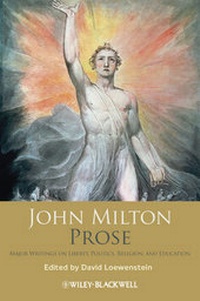
John Milton Prose
Description

Reviews / Votes
"....will ensure that Milton's prose continuesto challenge and reward the kind of active, discerning readershipthat Milton himself courted." (Renaissance Quarterly, 1 July 2014) "Milton's extraordinary prose, extensively represented in DavidLoewenstein's ambitious edition, has gained many new readers inrecent years, and it may be true that some students, at least inBritish schools and universities, read Tenure of Kings andMagistrates before, or even instead of, the greatpoetry." Times Literary Supplement (June 14 2013)"This excellent selection is what I have always wanted for mystudents: un-modernised texts very well edited and contextualised.Milton's seering radicalism, the extraordinary controlled freedomof his rhetoric, the engagement with the great issues of England'srevolution, but also with universal themes of God, Man, liberty,accountability, are made accessible as neverbefore."--John Morrill, Professor of British andIrish History, Cambridge "David Loewenstein's scrupulous editionoffers a remarkably generous range of Milton's prose works onreligion, politics, and domestic issues. The Prefatory Notes toeach work are a model of clarity and concision, and annotations areprecise and informative. The volume will be a wonderful resourcefor Milton scholars, teachers, and studentsalike."--Laura Knoppers, Editor, MiltonStudies "Richly annotated and with a fine, purposeful introduction,this wholly new edition makes available ten major prose works byMilton in their entirety, together with generous selections fromMilton's other tracts. No other edition allows the reader toappreciate so fully Milton's original engagement with concepts ofpolitical, religious, and domestic liberty. It is the best editionfor teaching purposes and the general reader. Scholars too willappreciate the wealth of fresh annotations." --Thomas N.Corns, University of Wales, Bangor "This is the most ambitious one-volume edition of Milton'sprose to date, one that both invites the general reader who iscurious about the author of Paradise Lost, andthat also satisfies the needs of classrooms. Readers willhave at their fingertips works from across Milton's writingcareer, with its wide range of occasions and styles. We seethe scrappy polemicist, the rhetorically powerful tyrannicide, thecritic and participant in religious reform, a Milton who was alwaysdaring, witty and engaged. With crisp prefatory introductionsto each work, helpful annotations, and a generous introduction tothe whole, there is no better guide to Milton's prosetreasures than this one. I will be eager to assign this tostudents." --Sharon Achinstein, University ofOxfordMore details
Other editions
Additional editions

Persons
Content
Chronology
Milton’s Life
Historical and Literary Events
Dec. 9, born in Bread Street, Cheapside London, to John and Sarah Milton.
1608
1611
King James (“Authorized”) Bible.
Educated by private tutors, including the Presbyterian cleric, Thomas Young.
1614–20
Brother Christopher born.
1615
1616
Death of Shakespeare.
Portrait at age 10 painted by Cornelius Janssen.
1618
Ben Jonson’s Works published.
Begins to attend St. Paul’s School; friendship with Charles Diodati begins. (?)
1620
1621
Donne appointed Dean of St. Paul’s.
1623
Shakespeare’s First Folio published.
First known poems, paraphrases of Psalms 114 and 136.
1623–4
Admitted to Christ’s College, Cambridge (Feb. 12).
1625
Death of James I; accession of Charles I.
Outbreak of plague.
Writes funeral elegies, “In quintum Novembris,” verse epistles, and Prolusions in Latin; “On the Death of a Fair Infant,” “At a Vacation Exercise” in English.
1626–8
William Laud made Bishop of London.
Takes BA degree (March).
1629
Charles I dissolves Parliament.
Writes “On the Morning of Christ’s Nativity” (Dec).
Writes “L’Allegro” and “Il Penseroso”(?).
1631
“On Shakespeare” published in the Second Folio of Shakespeare’s plays. Admitted to MA degree (July 3). Writes Arcades, entertainment for the Countess of Derby(?). Writes sonnet “How soon hath Time” (Dec). Starts to live with his family at Hammersmith.
1632
Galileo’s Dialogue Concerning the Two Chief World Systems published in Italian.
Writes “On Time,” “At a Solemn Music”(?).
1633
Donne’s Poems and Herbert’s The Temple published.
Laud made Archbishop of Canterbury.
A Maske (Comus) performed at Ludlow with music by Henry Lawes (Sept. 29).
1634
Carew’s masque, Coelum Britannicum.
Moves with his family to Horton, Buckinghamshire. Begins notes on his reading in Commonplace Book.
1635
Publication of A Maske Presented at Ludlow Castle. Mother dies (April 3).
Writes “Lycidas.”
1637
Trial and punishment of Puritans William Prynne, John Bastwick, and Henry Burton.
Descartes, Discourse on Method.
“Lycidas” published in collection of elegies for Edward King.
1638
Begins Continental tour (May 1638); meets Grotius, Galileo, Cardinal Barberini, Manso; visits Academies in Florence and Rome; visits Vatican Library; visits Naples, Venice, and Geneva.
Writes “Mansus,” other Latin poems.
1638–9
Learns of Charles Diodati’s death.
Returns to England (July).
Takes lodgings in Fleet Street.
Begins teaching nephews Edward and John Phillips and a few others.
1639
First Bishops’ War with Scotland.
Writes Epitaphium Damonis (epitaph for Charles Diodati). Begins work on Accidence Commenc’t Grammar, Art of Logic, Christian Doctrine(?).
1640
Long Parliament convened (Nov. 3); impeachment of Laud. George Thomason, London bookseller, begins his collection of tracts and books.
Publishes anti-episcopal tracts: Of Reformation; Of Prelatical Episcopacy; Animadversions upon the Remonstrants Defense.
1641
Impeachment and execution of Strafford (May)
Root and Branch Bill abolishing bishops.
Irish rebellion breaks out (Oct.).
Publishes The Reason of Church-government and An Apology [for] . . . Smectymnuus
Marries Mary Powell (May?), who returns (Aug.?) to her royalist family near Oxford.
Writes sonnet, “Captain or Colonel” when royalist attack on London expected.
1642
Civil War begins (Aug. 22). Royalists win Battle of Edgehill. Closing of theaters.
Publishes Doctrine and Discipline of Divorce (Aug.).
1643
Westminster Assembly of Divines to reform Church.
Solemn League and Covenant subscribed.
Thomas Browne, Religio Medici.
Publishes second edition of Doctrine and Discipline; Of Education (June); The Judgement of Martin Bucer concerning Divorce (Aug.); Areopagitica (Nov.).
1644
Royalists defeated at Battle of Marston Moor (July 2).
Publishes Tetrachordon and Colasterion on the divorce question.
Mary Powell returns. Moves to a large house in the Barbican.
1645
Execution of Laud.
New Model Army wins decisive victory at Naseby (June).
Edmund Waller, Poems.
Poems of Mr. John Milton published (Jan., dated 1645).
Writes sonnet to Lawes.
Daughter Anne born (July 29).
1646
First Civil War ends.
Crashaw, Steps to the Temple.
Father dies; moves to High Holborn.
1647
Daughter Mary born (Oct. 26).
Writes sonnet to Lord General Fairfax.
Translates Psalms 80–88.
1648
Second Civil War.
Pride’s Purge (Dec.) expels many Presbyterians from Parliament, leaving c.150 members of the House of Commons (the Rump).
Herrick, Hesperides.
Publishes Tenure of Kings and Magistrates (Feb.).
Appointed Secretary for Foreign
Tongues to the Council of State (March 15).
Writing the History of Britain.
Publishes Observations on Irish documents; Eikonoklastes (“The Idol Smasher”) (Oct.).
Given lodgings in Scotland Yard
1649
Trial of Charles I, executed Jan. 30. Eikon Basilike (“The Royal Image”) published in many editions.
Acts abolishing kingship and House of Lords (March).
Salmasius, Defensio Regia. Parliament declares England a free Commonwealth (May).
Second edition of Eikonoklastes (June).
1650
Marvell, Horatian Ode upon Cromwell’s Return from Ireland. Vaughan, Silex Scintillans (Part 1).
Publishes Defensio pro populo Anglicano in reply to Salmasius (Feb. 24).
Birth of son, John (March 16).
Moves to Petty France, near St. James Park.
1651
Hobbes, Leviathan.
Milton totally blind.
Writes sonnet, “When I consider how my light is spent”(?) and sonnets to Cromwell and Sir Henry Vane.
Daughter Deborah born (May 2).
Mary Powell Milton dies (May 5).
Son John dies (June).
1652
Regii Sanguinis Clamor (“Cry of the Royal Blood”), answer to Milton’s Defensio, published. First Dutch War (to 1654).
Translates Psalms 1–8.
1653
Cromwell dissolves Rump Parliament (April 20). “Barebones” Parliament. Cromwell made Lord Protector (Dec), under Constitution, “Instrument of Government.”
Publishes Defensio Secunda (“A Second Defense of the...
