

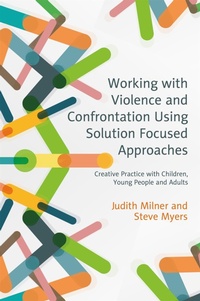
Working with Violence and Confrontation Using Solution Focused Approaches
Creative Practice with Children, Young People and Adults
Published on 21. October 2016
168 pages
978-1-78450-312-3 (ISBN)
Description

An authoritative, interdisciplinary book which outlines how solution focused practice is particularly effective in addressing violent behaviour in clients and service users, encompassing work with both adults and children.
Solution focused approaches have been used successfully with a range of violent behaviours from school-based bullying to severe domestic violence, as well as with victims of violence. Solution focused approaches hold people accountable for building solutions to their violent behaviour. The book shows how to engage clients in solution talk as opposed to problem talk, set useful goals and help clients to develop new behaviours. It outlines the practice principles and working techniques that make up solution focused practice with physical, emotional and sexual violence. Illustrative case studies and practice activities are provided.
This book is suitable for anyone working to help reduce violent behaviour, including social workers, counsellors, therapists, nurses, probation workers and youth offending teams.
Solution focused approaches have been used successfully with a range of violent behaviours from school-based bullying to severe domestic violence, as well as with victims of violence. Solution focused approaches hold people accountable for building solutions to their violent behaviour. The book shows how to engage clients in solution talk as opposed to problem talk, set useful goals and help clients to develop new behaviours. It outlines the practice principles and working techniques that make up solution focused practice with physical, emotional and sexual violence. Illustrative case studies and practice activities are provided.
This book is suitable for anyone working to help reduce violent behaviour, including social workers, counsellors, therapists, nurses, probation workers and youth offending teams.
Reviews / Votes
Milner and Myers have drawn on extensive experience of practice and training to offer what for many could be a radically different and more effective way of opening up discussions about actions which are usually too difficult to talk about, let alone change. -- John Wheeler, UKCP Registered Systemic Psychotherapist and President of the International Alliance of Solution Focused Training Institutes Some problems can seem more intractable and impervious to change efforts than others, and violence is certainly one of these, so it is refreshing to find a book that offers such a positive and hopeful approach to work in this field. Judith Milner and Steve Myers are to be commended for their boldness in showing how solution focused approaches can help people move from problems of violence towards preferred lives, and how such approaches can be used creatively, even at times playfully. Their book provides a cornucopia of useful questions directed at change, while keeping safety in mind, drawing from an interconnecting range of solution focused, brief therapy, narrative and Signs of Safety approaches. The plentiful practice examples and practice activities enhance the book's practical nature, which make it likely that anyone charged with finding solutions in violent situations will find something useful inside these pages. -- Guy Shennan, Independent Consultant in Solution Focused Practice and Chair of the British Association of Social WorkersMore details
Edition
Digital original
Language
English
Place of publication
London
United Kingdom
Target group
College/higher education
Professional and scholarly
Edition type
Digital original
ISBN-13
978-1-78450-312-3 (9781784503123)
Copyright in bibliographic data and cover images is held by Nielsen Book Services Limited or by the publishers or by their respective licensors: all rights reserved.
Schweitzer Classification
Other editions
Additional editions
Judith Milner | Steve Myers
Working with Violence and Confrontation Using Solution Focused Approaches
Creative Practice with Children, Young People and Adults
Book
10/2016
Jessica Kingsley Publishers
€42.50
Shipment within 15-20 days
Persons
Previously a senior lecturer in social work, Judith Milner recently retired from work as a therapist, consultant and independent expert to family courts in child protection, domestic violence and contested contact cases. She is widely published on solution focused practice. Steve Myers is Director of Social Sciences at University of Salford, Manchester. A social work academic since 1995, he has led research projects and has authored and co-authored a series of books and articles about violence, sex and solutions. Judith and Steve both live in Yorkshire.
Content
- Intro
- Working with Violence and Confrontation Using Solution Focused Approaches
- Chapter 1. Introduction
- Solution focused approaches
- Solution focused explanations for violent behaviour
- Resilience
- The Signs of Safety approach
- Chapter 2. Understanding the Position of Each Person
- Respectfulness
- Problem-free talk
- Listening
- Building partnership
- Talking with people who can't or won't talk
- Do's for constructive conversations
- Don'ts for constructive conversations
- Chapter 3. Finding Exceptions or Unique Outcomes to Violence and Conflict
- Separating the person from the problem
- Where exceptions are relevant to the problem
- Where the exceptions don't seem relevant
- Where there are no exceptions at all
- Recording signs of safety
- Conclusion
- Chapter 4. Setting Achievable Goals
- Defining goals
- Setting safety goals
- Preferred futures
- The miracle question
- Group miracle questions
- Shortened circular miracle question
- Where the problem is denied
- Where there are conflicting goals
- People with learning difficulties
- Chapter 5. Discovering Strengths and Resources
- Turning deficits into resources
- Starting a strengths conversation
- Strengths in adversity
- Complicating stories
- Group strengths and resources
- Finding strengths in people who are socially isolated
- Strengths that build safety
- Chapter 6. Scaling Safety and Progress
- Scaling questions
- Scaled questions for safety goal setting
- Questions for assessing safety
- Questions that assess likelihood of change
- Assessing progress
- Being creative
- Chapter 7. Ending a Session
- Deciding on tasks
- Evaluating the session and ending it
- Feedback
- Subsequent sessions
- When things are better
- When things are the same
- When things are worse
- When things are mixed
- Chapter 8. Groupwork
- Using connections
- Advantages of groupwork
- Setting up a group
- Determining group rules
- Groupwork practice principles
- Managing difficult group members
- Flexible groupwork in testing situations
- Forgotten victims
- References
- Index
- Blank Page
