

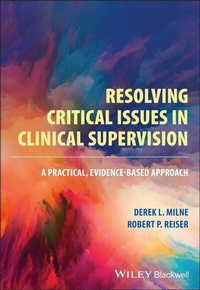
Resolving Critical Issues in Clinical Supervision
Description

Address key challenges in clinical supervision with this comprehensive account of common critical issues faced by almost all practitioners
Clinical supervision is a crucial aspect of clinical practice across the health and social professions. It can directly impact patient outcomes, shape clinical careers, and generally enhance professional development more broadly. The relationship between a clinical supervisor and their supervisees is therefore a hugely important one, embedded within challenging health and social care settings, which produces unique and complex challenges, but for which little formal guidance exists.
Resolving Critical Issues in Clinical Supervision answers the need for guidance of this kind with a practical, accessible discussion of major challenges and their possible solutions, drawing on the best available evidence from research, expert consensus, and relevant theory. It provides dedicated advice for supervisors and supervisees, alongside suggestions for the clinical service managers and associated others who aim to resolve the most common critical issues. The result is an extensively researched and wide-ranging guide which promises to make sense of the main challenges, describe the best-available coping strategies, and thereby strengthen career-long clinical supervision.
Resolving Critical Issues in Clinical Supervision readers will also find:
* Authors with decades of directly relevant clinical, research, and teaching experience
* Dedicated treatment of the most common critical issues, such as unethical supervisory practices, ineffective treatment, and the role of organizational structure in undermining clinical supervision
* An evidence-based approach that provides practical guidelines of relevance to many health and social care professions.
Resolving Critical Issues in Clinical Supervision is a valuable guide for both clinicians and service leaders looking to establish and maintain best practices in clinical supervision.
More details
Other editions
Additional editions
Persons
Derek L. Milne, PhD is a retired clinical psychologist and visiting professor who worked in England's National Health Service (NHS) for 33 years, including a decade as Director of the Doctorate of Clinical Psychology at Newcastle University and twelve years as a Clinical Tutor at Newcastle and Leeds Universities, UK. He has published extensively on clinical supervision and evidence-based practice.
Robert P. Reiser, PhD is a clinical psychologist practicing in California and an Adjunct Faculty at the Beck Institute for Cognitive Behavior Therapy. He has published widely on evidence-based approaches to clinical supervision, and trains psychiatric residents in the Department of Psychiatry at the University of California, San Francisco.
Content
About the Authors viii
Acknowledgements ix
1 Introduction: What are the Critical Issues in Supervision? 1
2 What Is the Appropriate Supervisory Relationship? 22
3 Who Is Ultimately Responsible for Patient Care? 39
4 Understanding Unethical Issues in Clinical Supervision 50
5 Resolving Unethical Issues in Clinical Supervision 68
6 Resolving Critical Issues in Training for Supervision 88
7 Skills in Dealing with Incompetent Supervisors 114
8 Skills in Dealing with Challenging Supervisees 136
9 Resolving Other Supervisee Challenges: Ineffective Treatment 156
10 Placing Supervision in Context: How the Organizational System Affects the Quality of Supervision 172
11 Conclusions: What Do We Now Know about Resolving Critical Issues in Supervision? 196
Index 204
