

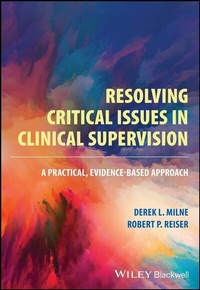
Resolving Critical Issues in Clinical Supervision
Description

Address key challenges in clinical supervision with this comprehensive account of common critical issues faced by almost all practitioners
Clinical supervision is a crucial aspect of clinical practice across the health and social professions. It can directly impact patient outcomes, shape clinical careers, and generally enhance professional development more broadly. The relationship between a clinical supervisor and their supervisees is therefore a hugely important one, embedded within challenging health and social care settings, which produces unique and complex challenges, but for which little formal guidance exists.
Resolving Critical Issues in Clinical Supervision answers the need for guidance of this kind with a practical, accessible discussion of major challenges and their possible solutions, drawing on the best available evidence from research, expert consensus, and relevant theory. It provides dedicated advice for supervisors and supervisees, alongside suggestions for the clinical service managers and associated others who aim to resolve the most common critical issues. The result is an extensively researched and wide-ranging guide which promises to make sense of the main challenges, describe the best-available coping strategies, and thereby strengthen career-long clinical supervision.
Resolving Critical Issues in Clinical Supervision readers will also find:
* Authors with decades of directly relevant clinical, research, and teaching experience
* Dedicated treatment of the most common critical issues, such as unethical supervisory practices, ineffective treatment, and the role of organizational structure in undermining clinical supervision
* An evidence-based approach that provides practical guidelines of relevance to many health and social care professions.
Resolving Critical Issues in Clinical Supervision is a valuable guide for both clinicians and service leaders looking to establish and maintain best practices in clinical supervision.
More details
Other editions
Additional editions
Persons
Derek L. Milne, PhD is a retired clinical psychologist and visiting professor who worked in England's National Health Service (NHS) for 33 years, including a decade as Director of the Doctorate of Clinical Psychology at Newcastle University and twelve years as a Clinical Tutor at Newcastle and Leeds Universities, UK. He has published extensively on clinical supervision and evidence-based practice.
Robert P. Reiser, PhD is a clinical psychologist practicing in California and an Adjunct Faculty at the Beck Institute for Cognitive Behavior Therapy. He has published widely on evidence-based approaches to clinical supervision, and trains psychiatric residents in the Department of Psychiatry at the University of California, San Francisco.
Content
About the Authors viii
Acknowledgements ix
1 Introduction: What are the Critical Issues in Supervision? 1
2 What Is the Appropriate Supervisory Relationship? 22
3 Who Is Ultimately Responsible for Patient Care? 39
4 Understanding Unethical Issues in Clinical Supervision 50
5 Resolving Unethical Issues in Clinical Supervision 68
6 Resolving Critical Issues in Training for Supervision 88
7 Skills in Dealing with Incompetent Supervisors 114
8 Skills in Dealing with Challenging Supervisees 136
9 Resolving Other Supervisee Challenges: Ineffective Treatment 156
10 Placing Supervision in Context: How the Organizational System Affects the Quality of Supervision 172
11 Conclusions: What Do We Now Know about Resolving Critical Issues in Supervision? 196
Index 204
1
Introduction: What are the Critical Issues in Supervision?
In this book we identify the main kinds of critical issues that arise in supervision, suggesting how they can best be resolved. Our guidance is practical, and draws on the evidence-based practice approach that we have used to write prior books and academic papers (e.g., Milne & Reiser, 2017). Much of our earlier work addressed the 'formative' function of supervision, studying how supervisors could facilitate the supervisees' learning and professional development (e.g., Milne & Reiser, 2017). Our last book addressed the 'restorative' function of supervision, again adopting a practical emphasis (Milne & Reiser, 2020). To complete the job, in this new book we will be focusing on the final aspect, the 'normative' function of supervision. This concerns the management or administration of supervision, having to do with areas such as quality control, risk management, gatekeeping, and ethical practice.
Critical issues arise regularly within clinical supervision (hereafter 'supervision'), as an inevitable consequence of complex healthcare environments that include constantly shifting and sometimes competing priorities and pressures. Examples include the often-conflicting priorities of managers and supervisees, which can lead to dilemmas in which supervision is a low management priority, yet essential for the professional development of supervisees (Gonge & Buus, 2010). Even when supervision is securely in place, numerous factors can create tensions between healthcare workers and those who manage their clinical services. A further and fundamental source of tension arises from the sometimes divergent formative, normative, and restorative functions of supervision (Kadushin, 1968). Such intrinsic tensions arise from the increasing organisational pressures on clinical supervisors to monitor and scrutinise the work of their supervisees for varied reasons such as quality assurance, administrative accountability, and risk management. In addition, some professions appear to have a general ambivalence or resistance towards clinical supervision, leading to its devaluation or avoidance (e.g., the nursing profession: White & Winstanley, 2014).
In this chapter we set the scene for resolving such issues, taking a constructive and evidence-based perspective that will characterise this book. Our optimism is based on the accumulating evidence that supervision is uniquely valuable in healthcare (Milne & Reiser, 2020; Watkins & Milne, 2014), and on our extensive experience of working with supervisors and supervisees across many professions and contexts since the 1980s (e.g., Milne, 1983). Our ongoing involvement in supervision research and practice is now approaching the 40-year mark, culminating most recently in an evidence-based supervision manual (Milne & Reiser, 2017), and a book specifically concerned with restorative supervision (Milne & Reiser, 2020). Based on this experience and our distinctively evidence-based perspective, we will now outline this latest book, clarifying what we mean by normative supervision, and reviewing the best-available literature in order to classify the main critical issues that arise within normative supervision. We will close this introductory chapter by describing how our evidence-based approach can lead to the resolution of these issues. Later chapters will examine all the identified critical issues. The result is an exceptionally wide-ranging review of critical issues, together with evidence-based suggestions on how best to understand and resolve them.
What Is Clinical Supervision?
Supervision has a long history, dating back to the beginnings of social work in the eighteenth century (White & Winstanley, 2014). Although the different healthcare professions make variable use of supervision (Hession & Habernicht, 2020), it has become increasingly recognised internationally as an essential part of modern healthcare systems (Watkins & Milne, 2014). In addition to supporting staff (Milne & Reiser, 2020), it contributes to evidence-based practice (Beidas & Kendall, 2010), and it enhances clinical effectiveness, partly through minimising harm (Milne, 2020). These benefits of supervision are further examined later in this chapter.
Although these benefits are widely endorsed, the definition of supervision has proved problematic. One problem is that illogical variants such as 'peer supervision' (Martin et al., 2018) and 'self-supervision' (Basa, 2018) have developed. Among other reasons, these are flawed because they are irrational (i.e., they are self-contradictory terms), and because they remove the hierarchical relationship that is required to oversee and control supervision (see Chapter 2). The other problem is that there are many different ways in which supervision has been conceptualised and practised: 'Clinical supervision has become a synonym for coaching, mentorship, peer review, clinical facilitation, preceptorship, clinical teaching, buddying, debriefing and other oversight. encounters. Not uncommonly, the term is also used as a byword for "personal performance review", case review, and even therapy' (White, 2017, p. 1251). A third problem is that the different health and social care professions define supervision in distinctive ways (Vandette & Gosselin, 2019). This makes it vital that we next clarify what we mean by supervision.
An early and influential account of supervision is given by Dawson (1926), which defined supervision in terms of the three functions mentioned earlier: educational ('formative'), administrative ('normative') and supportive ('restorative'). Formative supervision addresses the professional development of staff members, mainly through refining their clinical competencies. Normative supervision focuses on enhancing quality-control, an administrative or management perspective (e.g., managing waiting lists; organisational issues). Lastly, supportive supervision concerns the well-being of staff, improving their morale and job satisfaction. More recent definitions help us to build on Dawson (1926): Clinical supervision is a formal process of professional support and learning, which enables individual practitioners to develop knowledge and competence, assume responsibility for their own practice, and enhance consumer protection and safety of care in complex clinical situations (Department of Health 1993, p. 15). In turn, this National Health Service (NHS) definition provided a foundation for an empirical definition of clinical supervision: The formal provision, by approved supervisors, of a relationship-based education and training that is work-focused and which manages, supports, develops and evaluates the work of designated supervisees. The objectives are primarily: quality control (e.g., "gate-keeping" and ethical practice); maintaining and facilitating the supervisees' competence and capability; and helping supervisees to work effectively (e.g., promoting quality control and preserving client safety); accepting developing own professional identity; enhancing self-awareness and resilience/effective personal coping with the job; critical reflection lifelong learning skills (Milne, 2007).
Definition of Normative Supervision
We should also define the normative function of supervision. Following Kadushin and Harkness (2002), we define normative supervision as an aspect of clinical supervision that addresses supervisees' professional functioning in their organisational context, aiming to ensure that workplace arrangements are effective and satisfactory. It is a formal, constructive, work-focussed, and interpersonal process, addressing the supervisee's critical issues and encouraging positive learning opportunities. It is conducted with due authority by a trained, suitably experienced, and appropriate supervisor. The main supervision methods are workload review (e.g., joint problem-solving discussions); education and training (e.g., competence development through guided experiential learning); awareness-raising (e.g., via facilitated reflection on practice); and evaluation, monitoring and feedback, related to work performance (e.g., to ensure quality control). This definition complements and develops the one we provided for the restorative function of supervision in our recent book on that function (D. Milne & Reiser, 2020), and both elaborate as necessary the empirical definition of supervision explained here.
What are the Most Common Critical Issues?
Ladany et al. (2016) reviewed the literature in relation to psychological therapy, concluding that the most common issues presented to supervisors by their supervisees were skill deficits and competency concerns; interpersonal dilemmas (e.g., role conflicts); problematic attitudes and behaviour; and work-related misunderstandings (e.g., diversity or power issues). Some of these will also affect supervisors, and self-doubt about one's supervisory competence appears to be common (probably linked to the scarcity and brevity of training in supervision). Major textbooks of most relevance to this book (e.g., Beddoe & Davys, 2016; Haarman, 2013) also address similar issues, including:
- Competence concerns: inadequate cultural competence among supervisors; fostering clinical/professional competence and capability in supervisees (adherence, skill and appropriateness); defining, evaluating and addressing incompetence.
- Relationship struggles: collusion; struggles over authority, accountability, and...
