

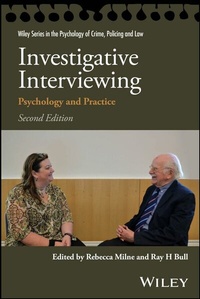
Investigative Interviewing
Description

"Professors Milne and Bull have produced an updated magnus opus of the science of investigative interviewing. It is not only an indispensable substitute for the cruelty of torture and coercion in solving crime, as this volume demonstrates, it is also a much more effective way of establishing the truth and assigning responsibility, which is the only legitimate object of criminal investigations." -JUAN E. MENDEZ, Former UN Special Rapporteur on Torture (2010-2016)
"Investigative Interviewing: Psychology and Practice (1999) was nothing short of the clearest, most comprehensive approach on how to effectively interview in a criminal context while adhering to the highest possible ethical principles. Milne and Bull are back with a new edition of their landmark text, updating it to include, as contributors, many of the scholars who have been influenced by the original. This edition is sure to inspire another generation of practitioners and researchers to pursue truth and justice in investigative interviews." -CHRISTOPHER E. KELLY, PhD, Professor of Criminal Justice, Saint Joseph's University (USA), Co-Director, International Investigative Interviewing Research Group
"This second edition of Investigative Interviewing: Psychology and Practice is a rare achievement. The Editors have brought together a stellar group of contributors to create more than a textbook: it's a bridge between research and the realities of investigative work. This is a vital resource for anyone committed to ethical and effective investigations: one that informs, challenges and ultimately helps improve the way investigations are conducted." -PAULO BARBOSA MARQUES, Inspector, Polícia Judiciária
Become a well-informed and skilled investigative interviewer
In the newly revised second edition of Investigative Interviewing: Psychology and Practice, a team of distinguished forensic psychologists and practitioners deliver an up-to-date and practical guide to the psychological concepts and evidence-based research that underpin and inform investigative interviewing. The editors have included works that examine the foundational skills and processes that make up the ethical interviewing of witnesses, victims, and those suspected of crime. Each chapter is written by a group of contributors who are leaders in their field.
Readers will also find:
- A thorough introduction to the principles of memory formation and their implications for investigative interviewing
- Comprehensive explorations of the cognitive interview, and examination concerning how to help those who are deemed vulnerable, with complex needs, to give reliable information
- Practical discussions of how to manage conversations, detect truth/deceit, and develop rapport-based interpersonal techniques
- Fulsome treatments of how to convince members of an investigative organisation to adopt the techniques and strategies discussed in the book.
Perfect for aspiring and practicing professionals engaged in the interviewing of participants in the criminal justice and investigation processes, Investigative Interviewing: Psychology and Practice will also benefit solicitors, barristers, social workers, and judges with an interest in the art and science of interviewing.
More details
Other editions
Additional editions
Persons
Rebecca Milne, PhD, is a Professor of Forensic Psychology at the School of Criminology and Criminal Justice at the University of Portsmouth. Her research is focused on police interviewing and investigation, helping to develop procedures that improve the quality of interviews of witnesses, victims, informants, and suspects.
Ray H Bull, PhD, is Emeritus Professor of Forensic Psychology, University of Leicester. His research is focused on investigative interviewing, and he has testified in court as an expert witness on over 50 occasions.
Content
About the Editors ix
About the Authorsxi
Foreword xix
1 Introduction 1
Rebecca Milne and Ray Bull
2 What Is Memory? 13
Ray Bull, Brandon May, and Rebecca Milne
3 The Cognitive Interview and Enhanced Cognitive Interview 63
Gary Dalton, Brandon May, and Rebecca Milne
4 The Conversation Management Approach 111
Andy Griffiths and Eric Shepherd
5 Rapport Based Interviewing in Investigative Interviews: the ORBIT Model 137
Laurence Alison, Joshua Ratcliff, Frances Surmon- Böhr, and Emily Alison Copyrighted Material
6 Detecting Truth and Lies in Interviews with Suspects and Persons of Interest 163
Coral J. Dando, Thomas C. Ormerod, and Andrea Shawyer ix
7 Interviewing Vulnerable Groups 201
Kev Smith, Ray Bull, and Laura Hynes
8 Complex Vulnerability and Facilitative Communication Roles 235
Michelle L. A. Mattison, Brendan M. O'mahony, Patrick Risan, and Martin Vaughan
9 Investigative Interviewing: A Cultural Perspective 265
Kate Chenier and Jeffery Chin
10 Changing Hearts and Minds 287
Ivar Fahsing and Asbjørn Rachlew
11 Conclusion: What Will the Future Bring? 311
Ray Bull and Rebecca Milne
