

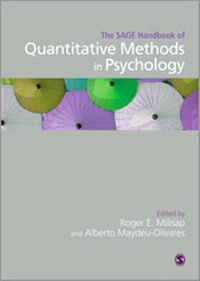
The SAGE Handbook of Quantitative Methods in Psychology
1st Edition
Published on 23. July 2009
800 pages
978-1-4462-0667-6 (ISBN)
Description

`I often... wonder to myself whether the field needs another book, handbook, or encyclopedia on this topic. In this case I think that the answer is truly yes. The handbook is well focused on important issues in the field, and the chapters are written by recognized authorities in their fields. The book should appeal to anyone who wants an understanding of important topics that frequently go uncovered in graduate education in psychology' - David C Howell, Professor Emeritus, University of Vermont
Quantitative psychology is arguably one of the oldest disciplines within the field of psychology and nearly all psychologists are exposed to quantitative psychology in some form. While textbooks in statistics, research methods and psychological measurement exist, none offer a unified treatment of quantitative psychology. The SAGE Handbook of Quantitative Methods in Psychology does just that.
Each chapter covers a methodological topic with equal attention paid to established theory and the challenges facing methodologists as they address new research questions using that particular methodology. The reader will come away from each chapter with a greater understanding of the methodology being addressed as well as an understanding of the directions for future developments within that methodological area.
Drawing on a global scholarship, the Handbook is divided into seven parts:
Part One: Design and Inference: addresses issues in the inference of causal relations from experimental and non-experimental research, along with the design of true experiments and quasi-experiments, and the problem of missing data due to various influences such as attrition or non-compliance.
Part Two: Measurement Theory: begins with a chapter on classical test theory, followed by the common factor analysis model as a model for psychological measurement. The models for continuous latent variables in item-response theory are covered next, followed by a chapter on discrete latent variable models as represented in latent class analysis.
Part Three: Scaling Methods: covers metric and non-metric scaling methods as developed in multidimensional scaling, followed by consideration of the scaling of discrete measures as found in dual scaling and correspondence analysis. Models for preference data such as those found in random utility theory are covered next.
Part Four: Data Analysis: includes chapters on regression models, categorical data analysis, multilevel or hierarchical models, resampling methods, robust data analysis, meta-analysis, Bayesian data analysis, and cluster analysis.
Part Five: Structural Equation Models: addresses topics in general structural equation modeling, nonlinear structural equation models, mixture models, and multilevel structural equation models.
Part Six: Longitudinal Models: covers the analysis of longitudinal data via mixed modeling, time series analysis and event history analysis.
Part Seven: Specialized Models: covers specific topics including the analysis of neuro-imaging data and functional data-analysis.
Quantitative psychology is arguably one of the oldest disciplines within the field of psychology and nearly all psychologists are exposed to quantitative psychology in some form. While textbooks in statistics, research methods and psychological measurement exist, none offer a unified treatment of quantitative psychology. The SAGE Handbook of Quantitative Methods in Psychology does just that.
Each chapter covers a methodological topic with equal attention paid to established theory and the challenges facing methodologists as they address new research questions using that particular methodology. The reader will come away from each chapter with a greater understanding of the methodology being addressed as well as an understanding of the directions for future developments within that methodological area.
Drawing on a global scholarship, the Handbook is divided into seven parts:
Part One: Design and Inference: addresses issues in the inference of causal relations from experimental and non-experimental research, along with the design of true experiments and quasi-experiments, and the problem of missing data due to various influences such as attrition or non-compliance.
Part Two: Measurement Theory: begins with a chapter on classical test theory, followed by the common factor analysis model as a model for psychological measurement. The models for continuous latent variables in item-response theory are covered next, followed by a chapter on discrete latent variable models as represented in latent class analysis.
Part Three: Scaling Methods: covers metric and non-metric scaling methods as developed in multidimensional scaling, followed by consideration of the scaling of discrete measures as found in dual scaling and correspondence analysis. Models for preference data such as those found in random utility theory are covered next.
Part Four: Data Analysis: includes chapters on regression models, categorical data analysis, multilevel or hierarchical models, resampling methods, robust data analysis, meta-analysis, Bayesian data analysis, and cluster analysis.
Part Five: Structural Equation Models: addresses topics in general structural equation modeling, nonlinear structural equation models, mixture models, and multilevel structural equation models.
Part Six: Longitudinal Models: covers the analysis of longitudinal data via mixed modeling, time series analysis and event history analysis.
Part Seven: Specialized Models: covers specific topics including the analysis of neuro-imaging data and functional data-analysis.
All prices
More details
Language
English
Place of publication
London
United Kingdom
Target group
Professional and scholarly
ISBN-13
978-1-4462-0667-6 (9781446206676)
Copyright in bibliographic data and cover images is held by Nielsen Book Services Limited or by the publishers or by their respective licensors: all rights reserved.
Schweitzer Classification
Other editions
Additional editions
Roger E. Millsap | Alberto Maydeu-Olivares
The SAGE Handbook of Quantitative Methods in Psychology
Book
07/2009
1st Edition
SAGE Publications Inc
€201.00
Shipment within 10-20 days
Persons
Dr. Maydeu-Olivares has been Assistant Professor of Statistics and Econometrics at the Universidad Carlos III, Professor of Marketing and Quantativative Methods at the IE Business School, and he is currently ICREA-Academia Distinguished Professor of Psychology at the University of Barcelona. Among other awards he has received the American Psychological Association (div 5) Dissertation Award, the Young Investigator (Cattell) Award from the Society of Multivariate Experimental Psychology, and the Catalan Young Investigator Award. He has published over 70 refereed articles and edited two volumes: Contemporary Psychometrics (2005) and Handbook of Quantitative Methods in Psychology (2009). He is currently President-Elect of the Psychometric Society.
Content
PART ONE: DESIGN AND INFERENCE
Causal Inference in Randomized and Non-randomized Studies - Michael Sobel
The Definition, Identification and Estimation of Causal Parameters
Experimental Design - Roger Kirk
Quasi-Experimental Design - Charles Reichardt
Missing Data - Paul Allison
PART TWO: MEASUREMENT THEORY
Classical Test Theory - James Algina and Randall D Penfield
Factor Analysis - Robert C MacCallum
Item Response Theory - David Thissen and Lynne Steinberg
Special Topics in Item Response Theory - Michael Edwards and Maria Orlando Edelen
Latent Class Analysis - David Rindskopf
PART THREE: SCALING
Multidimensional Scaling - Yoshio Takane et al
Correspondence Analysis, Multiple Correspondence Analysis and Recent Developments - Heungsun Hwang et al
Modeling Preference Data - Albert Maydeu-Olivares and Ulf B[um]ockenholt
PART FOUR: DATA ANALYSIS
Applications of Multiple Regression in Psychological Research - Razia Azen and David Budescu
Categorical Data Analysis with a Psychometric Twist - Carolyn Anderson
Multilevel Analysis - Jee-Seon Kim
An Overview and Some Contemporary Issues
Resampling Methods - William H Beasley and Joseph L Rodgers
Robust Data Analysis - Rand R Wilcox
Meta-Analysis - Andy Field
Bayesian Data Analysis - Herbert Hoijtink
Cluster Analysis - Lawrence Hubert et al
A Toolbox for MATLAB
PART FIVE: STRUCTURAL EQUATION MODELS
General SEM - Robert Cudeck
Maximum Likelihood And Bayesian Estimation For Nonlinear Structural Equation Models - Melanie Wall
Structural Equation Mixture Modeling - Conor Dolan
Multilevel Latent Variable Modeling - David Kaplan et al
Current Research and Recent Developments
PART SIX: LONGITUDINAL MODELS
Modeling Individual Change over Time - Suzanne Graham, Judy Singer and John Willett
Time Series Models for Examining Psychological Processes - Emilio Ferrer and Guangjian Zhang
Applications and New Developments
Event History Analysis - Jeroen Vermunt
PART SEVEN: SPECIALIZED METHODS
Neuroimaging Analysis (I) - Josep Marco-Pallares et al
Electroencephalography
Neuroimaging Analysis (II) - Estela Camara et al
Magnetic Resonance Imaging
Functional Data Analysis - James O Ramsay
Causal Inference in Randomized and Non-randomized Studies - Michael Sobel
The Definition, Identification and Estimation of Causal Parameters
Experimental Design - Roger Kirk
Quasi-Experimental Design - Charles Reichardt
Missing Data - Paul Allison
PART TWO: MEASUREMENT THEORY
Classical Test Theory - James Algina and Randall D Penfield
Factor Analysis - Robert C MacCallum
Item Response Theory - David Thissen and Lynne Steinberg
Special Topics in Item Response Theory - Michael Edwards and Maria Orlando Edelen
Latent Class Analysis - David Rindskopf
PART THREE: SCALING
Multidimensional Scaling - Yoshio Takane et al
Correspondence Analysis, Multiple Correspondence Analysis and Recent Developments - Heungsun Hwang et al
Modeling Preference Data - Albert Maydeu-Olivares and Ulf B[um]ockenholt
PART FOUR: DATA ANALYSIS
Applications of Multiple Regression in Psychological Research - Razia Azen and David Budescu
Categorical Data Analysis with a Psychometric Twist - Carolyn Anderson
Multilevel Analysis - Jee-Seon Kim
An Overview and Some Contemporary Issues
Resampling Methods - William H Beasley and Joseph L Rodgers
Robust Data Analysis - Rand R Wilcox
Meta-Analysis - Andy Field
Bayesian Data Analysis - Herbert Hoijtink
Cluster Analysis - Lawrence Hubert et al
A Toolbox for MATLAB
PART FIVE: STRUCTURAL EQUATION MODELS
General SEM - Robert Cudeck
Maximum Likelihood And Bayesian Estimation For Nonlinear Structural Equation Models - Melanie Wall
Structural Equation Mixture Modeling - Conor Dolan
Multilevel Latent Variable Modeling - David Kaplan et al
Current Research and Recent Developments
PART SIX: LONGITUDINAL MODELS
Modeling Individual Change over Time - Suzanne Graham, Judy Singer and John Willett
Time Series Models for Examining Psychological Processes - Emilio Ferrer and Guangjian Zhang
Applications and New Developments
Event History Analysis - Jeroen Vermunt
PART SEVEN: SPECIALIZED METHODS
Neuroimaging Analysis (I) - Josep Marco-Pallares et al
Electroencephalography
Neuroimaging Analysis (II) - Estela Camara et al
Magnetic Resonance Imaging
Functional Data Analysis - James O Ramsay
