


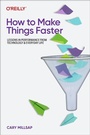
How to Make Things Faster
Description

Slow systems are frustrating. They waste time and money. But making consistently great decisions about performance can be easy, if you understand what''s going on. This book explains in a clear and thoughtful voice why systems perform the way they do. It''s for anybody who''s curious about how computer programs and other processes use their time and about what you can do to improve them.
Through a mix of personal vignettes and technical use cases, Cary Millsap reviews the process of improving performance and provides best practices for optimizing systems efficiently. You''ll learn how to identify the information needed to improve a system, how to find the root causes of performance issues, and how to fix them. You''ll also learn how performance optimization is both a skill set and a mindset, and how to develop both over time.
If you''re a computer professional whose success relies on software that goes fast, by the end of this book you''ll be able to identify, view, scope, analyze, and remedy performance issues with consistency and confidence.
More details
Other editions
Additional editions
Content
- Intro
- Copyright
- Table of Contents
- Foreword
- Preface
- Acknowledgments
- Conventions Used in This Book
- O'Reilly Online Learning
- How to Contact Us
- Part I. Look at It
- Chapter 1. Bob
- Chapter 2. Phyllis
- Chapter 3. The Real Goal
- Chapter 4. Nancy
- Chapter 5. Looking at the Right It
- Chapter 6. When You Can't Look at It
- Part II. Method
- Chapter 7. Forty-Nine Grievances
- Chapter 8. The Shipping Labels Problem
- Chapter 9. More Grievances
- Chapter 10. Priority
- Chapter 11. But My Whole System Is Slow
- Chapter 12. Collateral Benefit
- Chapter 13. The Silver Bullet
- Chapter 14. The List
- Chapter 15. Method R
- Part III. Profiling
- Chapter 16. Payroll
- Chapter 17. The Sequence Diagram
- Chapter 18. The Gantt Chart
- Chapter 19. Tracing
- Chapter 20. The Profile
- Chapter 21. Creating a Profile
- Part IV. Measuring Performance
- Chapter 22. Performance Is a Feature
- Chapter 23. The Reproducible Test Case
- Chapter 24. Intermittent Problems
- Chapter 25. How Much to Trace
- Chapter 26. Identifying Experiences
- Chapter 27. Measurement Intrusion
- Part V. Optimizing
- Chapter 28. A Riddle
- Chapter 29. A Game
- Chapter 30. Event Count
- Chapter 31. Event Duration
- Chapter 32. Filter Early
- Chapter 33. Look Left
- Chapter 34. Tow-Millsap Law
- Chapter 35. The Bottleneck
- Chapter 36. Beware the "System Bottleneck"
- Chapter 37. The Problem with Optimizing Subsystems
- Chapter 38. Every Problem Is a Skew Problem
- Chapter 39. Critical Path
- Part VI. Delays
- Chapter 40. Kevin
- Chapter 41. Queueing Delay
- Chapter 42. Queueing Theory
- Chapter 43. The Hyperbola
- Chapter 44. Traffic Intensity
- Chapter 45. Utilization
- Chapter 46. Hyperbolic Leverage
- Chapter 47. Coherency Delay
- Chapter 48. Delays and Throughput
- Part VII. Waste
- Chapter 49. Debra
- Chapter 50. The Ramp
- Chapter 51. Martha
- Chapter 52. Efficiency
- Chapter 53. Fix It, or Feed It?
- Chapter 54. Yeti
- Chapter 55. Fast vs. Efficient
- Chapter 56. Scalability
- Part VIII. Problem Solving
- Chapter 57. Four Simple Questions
- Chapter 58. Reaching the End of Your Data
- Chapter 59. Your C-Level Feedback Loop
- Chapter 60. Collateral Damage
- Chapter 61. Too Much of a Good Thing
- Chapter 62. Doug
- Chapter 63. When Are You Done?
- Part IX. Predicting
- Chapter 64. Richard
- Chapter 65. Why Predict?
- Chapter 66. Predicting with Profiles
- Chapter 67. Go/No-Go Predictions
- Chapter 68. Linear Behavior
- Chapter 69. Skew
- Chapter 70. Event Interdependencies
- Chapter 71. Nonlinear Behavior
- Part X. Latency Hiding
- Chapter 72. Mom
- Chapter 73. Dominic
- Chapter 74. Parallelization
- Chapter 75. How to Melt a System
- Chapter 76. Multitasking
- Chapter 77. Human Multitasking
- Part XI. Fallacies
- Chapter 78. The Evil Genie
- Chapter 79. The Leather Jacket
- Chapter 80. The Buried Outlier
- Chapter 81. Be Careful What You Wish For
- Chapter 82. Percentile Specifications
- Chapter 83. The Hit Rate Problem
- Chapter 84. The MPG Problem
- Chapter 85. The Ratio Trick
- Chapter 86. Even Throughput and Response Time?
- Chapter 87. Are Ratios Useless?
- Chapter 88. When Ratios Are Reliable
- Chapter 89. Describing Performance Improvements
- Chapter 90. The "n Times Faster" Myth
- Part XII. Testing
- Chapter 91. Why Test?
- Chapter 92. Risk
- Chapter 93. Destructive Testing
- Chapter 94. Testing Is Not a Phase
- Chapter 95. Automated Testing
- Chapter 96. Preventing Problems
- Part XIII. Planning
- Chapter 97. Mrs. Utley
- Chapter 98. Capacity Planning
- Chapter 99. Utilization Targets
- Chapter 100. When to Upgrade
- Part XIV. Politics
- Chapter 101. Proving
- Chapter 102. The Problem with Underpromising
- Chapter 103. Seven Project Risk Magnifiers
- Chapter 104. Fail Fast
- Chapter 105. Face
- Chapter 106. The Jeweler's Method
- Chapter 107. Change Control
- Chapter 108. Record Keeping
- Chapter 109. Failure
- Chapter 110. Don't Worry, Be Nervous
- Part XV. Just for Fun
- Chapter 111. Optimizing for Kids
- Glossary
- References
- Index
- About the Author
