

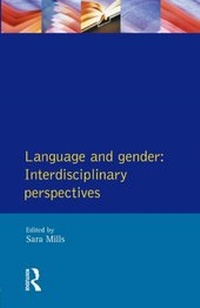
Language and Gender
Interdisciplinary Perspectives
1st Edition
Published on 3. June 2014
296 pages
978-1-317-89300-4 (ISBN)
Description

This volume examines important themes in the theoretical debates on the relationship of language and gender. It analyses this relationship across a range of different disciplinary perspectives from linguistics, literary theory, cultural studies and visual analysis. The focus of the book goes beyond an analysis of women's language to discuss the complexities of gendered language with chapters on lesbian poetics, the language of girls and boys and the relationship between gender and genre.
More details
Language
English
Place of publication
London
United Kingdom
Publishing group
Taylor & Francis Ltd
Target group
College/higher education
File size
12,04 MB
ISBN-13
978-1-317-89300-4 (9781317893004)
Copyright in bibliographic data and cover images is held by Nielsen Book Services Limited or by the publishers or by their respective licensors: all rights reserved.
Schweitzer Classification
Other editions
Additional editions
Book
01/2017
1st Edition
Routledge
€207.60
Shipment within 10-20 days
Book
09/1995
1st Edition
Longman
€79.90
Shipment within 10-20 days
Person
Content
List of Contributors
Acknowledgements
Introduction, Sara Mills
Section 1: Position Papers: Difference or Dominance
1. Language, gender and career, Jennifer Coates
2. Rethinking language and gender studies: some issues for the 1990s, Deborah Cameron
Section 2: Lesbian Poetics
3. Constructing a lesbian poetic for survival, Liz Yorke
4. Sappho and the other woman, Margaret Williamson
5. `Her wench of bliss: gender and the language of Djuna Barnes' Ladies Almanack, Deborah Tyler-Bennett
Section 3: Gender/Genre
6. Cyborgs and cyberpunk: rewriting the feminine in popular fiction, Jenny Wolmark
7. Claiming the speakwrite: linguistic subversion in the feminist dystopia, Elisabeth Mahoney
Section 4: Gender, Language and Education
8. Feminising classroom talk?, Joan Swann and David Graddol
9. Primary school teachers' explanation of boys' disruptiveness in the classroom: a gender-specific aspect of the hidden curriculum, Cleopatra Altani
10. `We're boys, miss!': finding gendered identities and looking for gendering of identities in the foreign language classroom, Jane Sunderland
Section 5: Gender, Language and Children
11. Dominance and communicative incompetence: the speech habits of a group of 8-11 year old boys in a Lebanese rural community, Farida Abu-Haidar
12. Voice and gender in children, Alison Lee, Nigel Hewlett and Moray Nairn
Section 6: Language Media/Visual Analysis and Gender
13. Feminism, language and the rhetoric of TV wildlife programmes, Barbara Crowther and Dick Leith
14. Man in the news: the misrepresentation of women speaking in news-as-narrative-discourse, Carmen Rosa Caldas-Coulthard
15. Commonplaces: the woman in the street: text and gender in the work of Jenny Holzer and Barbara Kruger, Helen Mills
Conclusions, Sara Mills
Bibliography
Index
Acknowledgements
Introduction, Sara Mills
Section 1: Position Papers: Difference or Dominance
1. Language, gender and career, Jennifer Coates
2. Rethinking language and gender studies: some issues for the 1990s, Deborah Cameron
Section 2: Lesbian Poetics
3. Constructing a lesbian poetic for survival, Liz Yorke
4. Sappho and the other woman, Margaret Williamson
5. `Her wench of bliss: gender and the language of Djuna Barnes' Ladies Almanack, Deborah Tyler-Bennett
Section 3: Gender/Genre
6. Cyborgs and cyberpunk: rewriting the feminine in popular fiction, Jenny Wolmark
7. Claiming the speakwrite: linguistic subversion in the feminist dystopia, Elisabeth Mahoney
Section 4: Gender, Language and Education
8. Feminising classroom talk?, Joan Swann and David Graddol
9. Primary school teachers' explanation of boys' disruptiveness in the classroom: a gender-specific aspect of the hidden curriculum, Cleopatra Altani
10. `We're boys, miss!': finding gendered identities and looking for gendering of identities in the foreign language classroom, Jane Sunderland
Section 5: Gender, Language and Children
11. Dominance and communicative incompetence: the speech habits of a group of 8-11 year old boys in a Lebanese rural community, Farida Abu-Haidar
12. Voice and gender in children, Alison Lee, Nigel Hewlett and Moray Nairn
Section 6: Language Media/Visual Analysis and Gender
13. Feminism, language and the rhetoric of TV wildlife programmes, Barbara Crowther and Dick Leith
14. Man in the news: the misrepresentation of women speaking in news-as-narrative-discourse, Carmen Rosa Caldas-Coulthard
15. Commonplaces: the woman in the street: text and gender in the work of Jenny Holzer and Barbara Kruger, Helen Mills
Conclusions, Sara Mills
Bibliography
Index
