

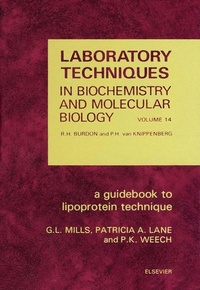
A Guidebook to Lipoprotein Techniques
Published on 14. May 2014
527 pages
978-0-08-085883-8 (ISBN)
Description

This volume is a comprehensive collection of methods for the isolation, characterization, analysis and estimation of soluble lipoproteins. It surveys each aspect of lipoprotein technology in a critical manner which will enable the investigator to select the methods most relevant to his requirements. Having made his choice, he will then find a detailed description of how to perform the technique.
More details
Series
Language
English
Place of publication
San Diego
Netherlands
Product notice
Windows
ISBN-13
978-0-08-085883-8 (9780080858838)
Copyright in bibliographic data and cover images is held by Nielsen Book Services Limited or by the publishers or by their respective licensors: all rights reserved.
Schweitzer Classification
Other editions
Additional editions

G.L. Mills | P.A. Lane | P.K. Weech
A Guidebook to Lipoprotein Techniques: Volume 14
Book
04/2000
Elsevier
€86.65
Article exhausted; check different version
Persons
Content
- Front Cover
- A Guidebook to Lipoprotein Technique
- Copyright Page
- Contents
- Preface
- Glossary of lipoprotein nomenclature as used in this manual
- Glossary of apo-lipoprotein nomenclature as used in this manual
- Chapter 1. Brief introduction to the plasma lipoproteins
- 1.1. Nomenclature of the lipoproteins
- 1.2. Nomenclature of apo-lipoproteins
- Chapter 2. The isolation and purification of plasma lipoproteins
- 2.1. Isolation by ultracentrifugation
- 2.2. Isolation by precipitation
- 2.3. Isolation by chromatography
- 2.4. Isolation by preparative electrophoresis
- 2.5. The isolation of Lp(a) and LP-X
- 2.6. The preservation of isolated lipoproteins
- Chapter 3. The characterisation of plasma lipoproteins: intro: duction to principles and methods
- 3.1. The purity of lipoprotein preparations
- 3.2. Physical and chemical characterisation
- 3.3. Heterogeneity and polydispersity
- Chapter 4. Physical characterisation of lipoproteins
- 4.1. The analytical ultracentrifuge
- 4.2. Partial specific volume (hydrated density)
- 4.3. The analysis of polydispersity in the preparative ultracentrifuge
- 4.4. Gel filtration
- 4.5. Electron microscopy
- Chapter 5. Electrophoretic analysis of intact lipoproteins
- 5.1. Preparation of samples
- 5.2. Electrophoresis on paper
- 5.3. Electrophoresis on cellulose acetate membranes
- 5.4. Electrophoresis in agarose gel
- 5.5. Electrophoresis in polyacrylamide gel
- 5.6. Immunoelectrophoresis
- 5.7. Two-dimensial immuno-electrophoresis
- 5.8. Isoelectric focussing
- Chapter 6. The chemical characterisation of lipoproteins
- 6.1. Estimation of total lipoprotein
- 6.2. Separation of the lipid and protein moieties
- 6.3. Analysis of the lipid moiety
- 6.4. Analysis of the protein moiety
- 6.5. Qualitative analysis of apo-lipoproteins by immunodiffusion
- 6.6. Identification and estimation of carbohydrates
- 6.7. Quantitative analysis of lipoproteins by micro-scale thin-layer chromatography
- Chapter 7. The estimation of lipoproteins
- 7.1. Estimation of lipoproteins by refractometry
- 7.2. Nephelometry
- 7.3. The estimation of lipoproteins by chemical methods
- 7.4. Estimation of LP-X
- 7.5. Immunoassay of lipoproteins
- Chapter 8. Isolation and assay of apo-lipoproteins
- 8.1. Isolation of apo-lipoprotein A-1
- 8.2. Isolation of apo-lipoprotein A-II
- 8.3. Isolation of apo-lipoprotein A-IV
- 8.4. Isolation of apo-lipoprotein B
- 8.5. Isolation of the C apo-lipoproteins
- 8.6. Isolation of apo-lipoprotein D
- 8.7. Isolation of apo-lipoprotein E
- 8.8. Isolation of apo-lipoprotein F
- 8.9. The estimation of apo-lipoproteins
- Appendix 1. The collection and preservation of blood plasma
- Appendix 2. Methods of concentrating lipoprotein solutions
- Appendix 3. The extraction of lipid from lipoproteins
- Appendix 4. The preparation of stains
